Physical Address
304 North Cardinal St.
Dorchester Center, MA 02124
Physical Address
304 North Cardinal St.
Dorchester Center, MA 02124

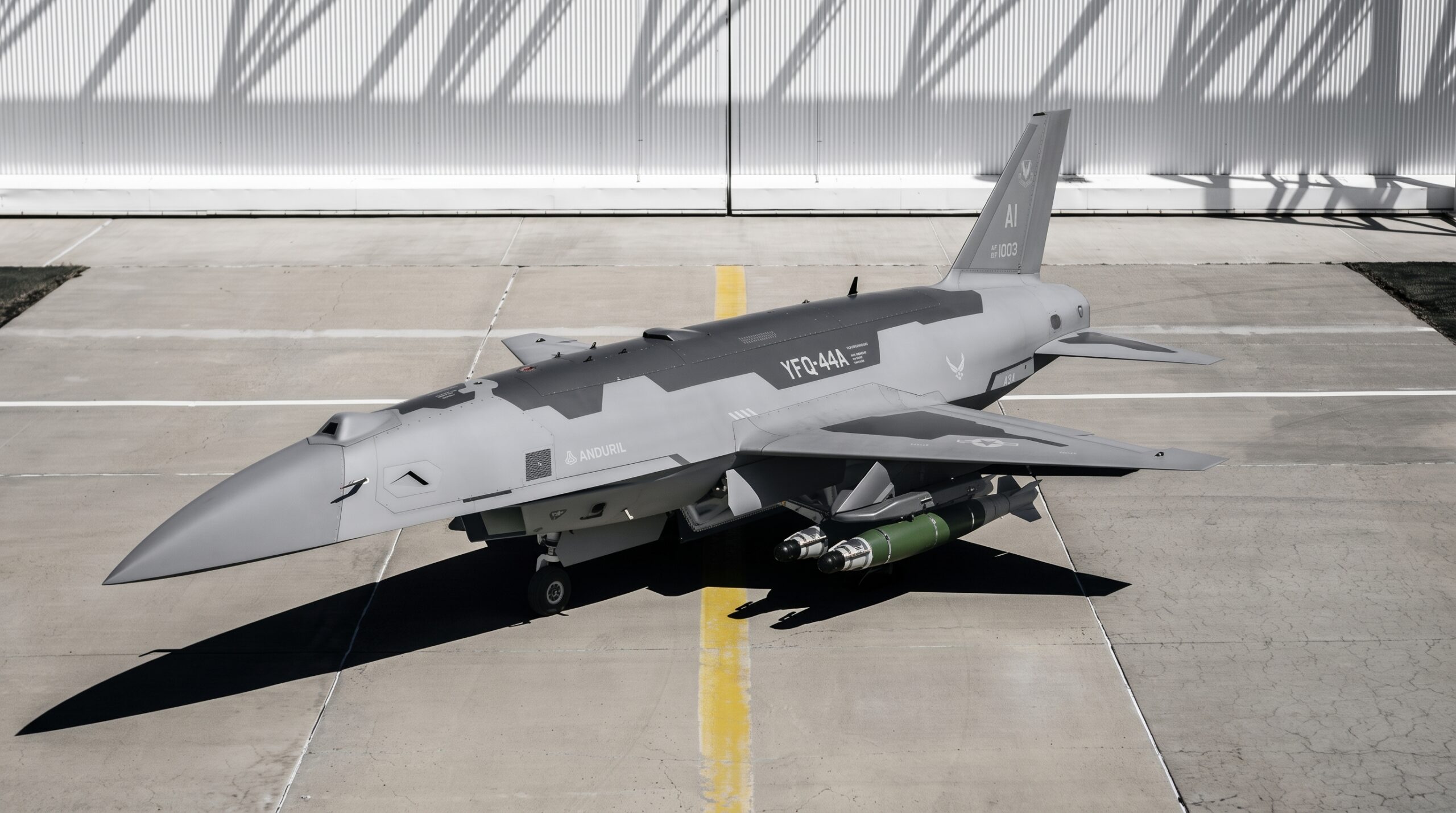
Military Sentinel, Washington – Defense manufacturer Anduril Industries has begun physical fit checks and weapon integration on its FQ-44 Fury semi-autonomous drone, expanding the unmanned fighter’s payload beyond counter-air operations into precision ground attack and standoff strike missions.
Originally positioned as an air-dominance loyal wingman designed to carry radar-guided air-to-air missiles, the FQ-44 is now slated to field a wide suite of air-to-surface munitions. Newly unveiled configurations confirm that ground-based fit checks include 500-pound Joint Direct Attack Munition (JDAM) kits, 250-pound GBU-39/B Small Diameter Bombs (SDB), low-cost cruise missiles such as Anduril’s Barracuda-500 series, and pod-launched 70 mm guided rockets.
Test imagery revealed the prototype YFQ-44A equipped with dual-rail adapter racks beneath its wings, allowing it to transport multiple small-diameter guided glide bombs on a single station. This capability significantly elevates the kinetic density of individual sorties without requiring the platform to rely exclusively on large strike bays.
Role: Multirole Collaborative Combat Aircraft (CCA)
Length: 20 ft (6.1 m)
Wingspan: 17 ft (5.2 m)
Max Takeoff Weight: ~5,000 lb (2,268 kg)
Powerplant: 1 × Williams FJ44-4M turbofan (4,000 lbf thrust)
Performance: Mach 0.95 maximum speed; up to 50,000 ft service ceiling; +9g rated
Stores Stations: 2 weapon stations on YFQ-44A prototype (expandable up to 4 hardpoints on production variants)
The FQ-44 design traces back to Blue Force Technologies’ “Fury” aggressor concept before Anduril acquired the firm in 2023. The U.S. Air Force selected the aircraft alongside General Atomics’ FQ-42 Vengeance for Increment I of its Collaborative Combat Aircraft program, later awarding production-representative contracts.
The platform has progressed at a rapid development cadence. Anduril moved the airframe from prototype delivery through initial taxiing and flight evaluations toward series assembly within roughly two years. Built around open software architectures and autonomous control nodes, the jet operates with minimal operator workload, allowing single human pilots in fifth-generation fighters to task autonomous wingmen via mission-level directives.
Transforming the FQ-44 into an air-to-ground strike asset shifts the tactical paradigm of crewed-uncrewed teaming (MUM-T). In high-threat contested airspace, deploying lower-cost, high-mass unmanned aircraft to suppress surface-to-air missile nodes or strike heavily defended hardened facilities spares expensive crewed fighters from entering hostile surface engagement envelopes.
A mixed flight of FQ-44s can distribute operational responsibilities dynamically: one aircraft provides forward airborne radar coverage and counter-air deterrence with AMRAAMs, while wing-matched drones deliver standoff glide munitions or low-cost cruise missiles from separate geometric vectors. If these flight clearances and weapon separations prove successful, the FQ-44 will transform from an experimental loyal wingman into an essential precision strike node across allied air fleets.