Physical Address
304 North Cardinal St.
Dorchester Center, MA 02124
Physical Address
304 North Cardinal St.
Dorchester Center, MA 02124


Military Sentinel, Laem Chabang, Thailand – The Nimitz-class aircraft carrier USS Abraham Lincoln pulled into port here this week for its first extended liberty call in 286 days, closing out one of the longest continuous carrier deployments in recent U.S. Navy history after months of combat operations against Iran.
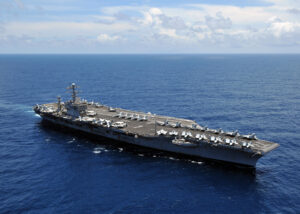
USS Abraham Lincoln left its homeport of San Diego on November 21, 2025, on what the Navy initially described as a routine deployment expected to run roughly six months. That timeline collapsed as the carrier and its strike group were retained in the U.S. Central Command area of responsibility to support Operation Epic Fury, the U.S.-Israeli military campaign against Iran, including a naval blockade of Iranian ports.
By August 14, the ship had logged 200 days in a combat zone. Navy figures cited in multiple reports put the strike group’s air wing at more than 10,000 combat sorties and roughly 1.5 million pounds of ordnance dropped over the course of the campaign. [Low confidence — these sortie and tonnage figures are widely repeated in press coverage but have not been independently verified against an official Navy release; treat as needs verification.]
Aside from brief stops in Guam in December and a replenishment call in Oman, the carrier and its roughly 5,000 sailors and Marines remained continuously at sea until this week’s arrival at Laem Chabang, near Pattaya.
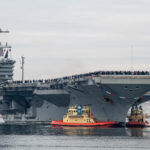
Photos of the carrier arriving in Thailand went viral for a starker reason: streaks of “running rust” and algae along the waterline, hull, and flight-deck edges. Naval analysts interviewed by CNN said the appearance, while dramatic, is a predictable result of sustained operations rather than a sign of mechanical trouble. Carl Schuster, a former U.S. Navy captain who served three tours on Nimitz-class carriers, said rust along the waterline is unremarkable after 60-plus days of continuous operations at sea — and that cosmetic maintenance simply isn’t feasible mid-deployment, let alone mid-combat.
Rear Adm. Robert E. Loughran, commander of Carrier Strike Group 3, framed the port call as recognition of that strain. “Our arrival in Laem Chabang provides a well-deserved opportunity for our Sailors and Marines to rest and recharge,” Loughran said in a Navy statement, adding that the port visit “underscores the strong and enduring partnership and alliance between the United States and Thailand.”
Several outlets have also reported concerns about crew welfare during the extended deployment, including strained morale and supply disruptions tied to the loss of a Bahrain logistics hub. [Medium confidence] These welfare concerns appear across multiple outlets and are plausible given the deployment’s length, but the more severe specific claims circulating online have not been confirmed by the Navy and should be treated as unverified pending an official response. [VERIFY SOURCE]
USS Abraham Lincoln was relieved on station last month by the Japan-based USS George Washington, freeing it to begin the transit home to San Diego. The Thailand stop is expected to be brief before the carrier resumes its eastward journey.
The deployment’s length — and the visible toll it has taken on the ship — is likely to renew debate inside the Navy over carrier surge capacity and crew rotation policy at a time when the service is already managing overlapping demands in the Middle East and the Indo-Pacific. Whether the Lincoln’s experience becomes a one-off or a preview of how future carrier deployments are managed will depend largely on how quickly Middle East tensions with Iran ease.