Physical Address
304 North Cardinal St.
Dorchester Center, MA 02124
Physical Address
304 North Cardinal St.
Dorchester Center, MA 02124

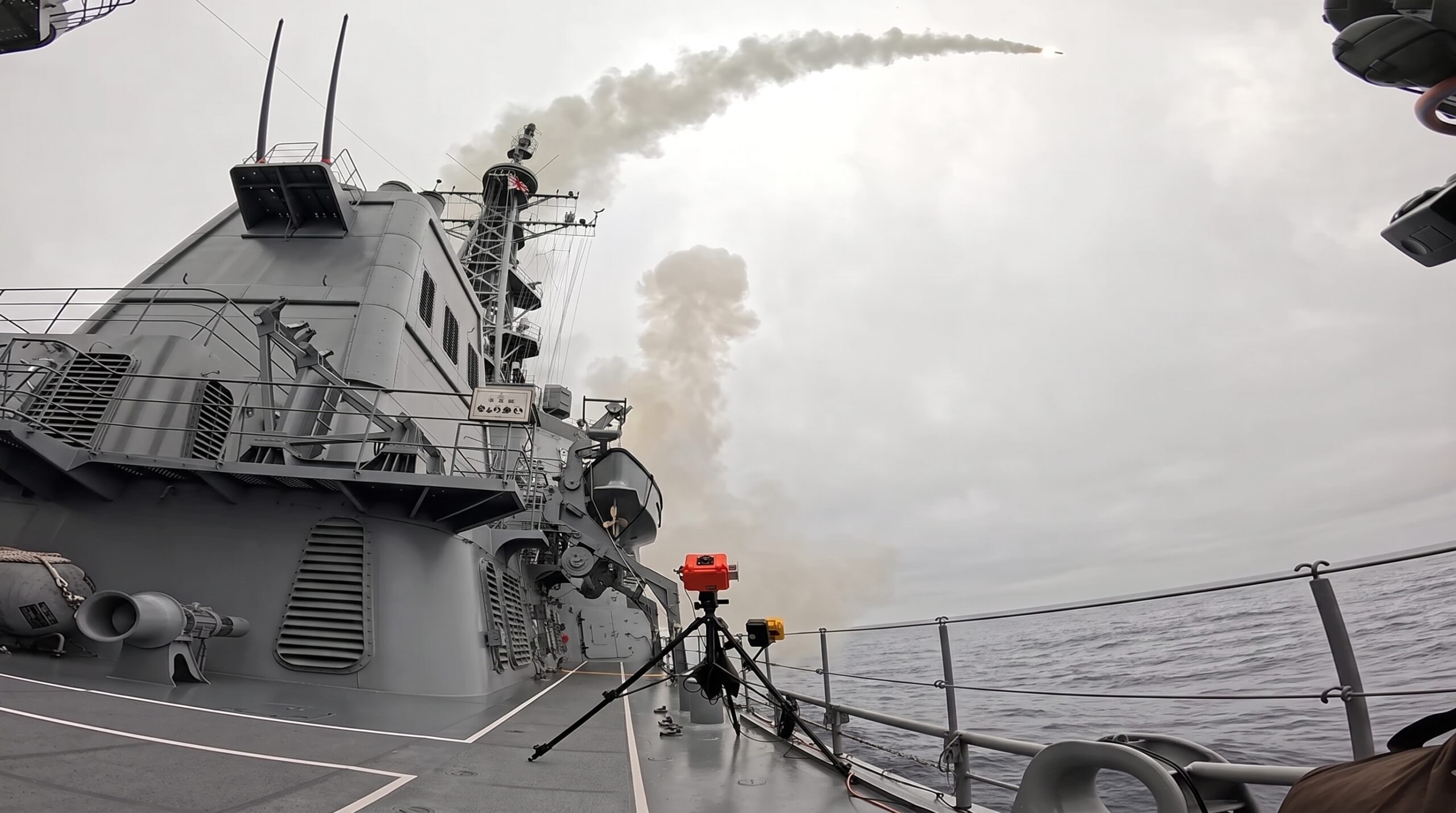
Military Sentinel, Sasebo, Japan – Japan Maritime Self-Defense Force (JMSDF) destroyer JS Chokai (DDG-176) returned to its homeport of Sasebo on Aug. 30, 2026, after a year-long deployment to the United States during which the ship was modified and its crew trained to operate the Tomahawk land-attack cruise missile, according to USNI News.
Chokai departed Yokosuka Naval Base on Sept. 25, 2025, bound for San Diego. Modification work to integrate Tomahawk launch capability began that October and was completed in late March 2026. On July 29, the destroyer conducted a live Tomahawk firing, validating both the ship’s systems and crew proficiency — the milestone that confirmed Japan’s first operational Tomahawk-capable surface combatant.
The deployment, though not continuously at sea, was the longest a JMSDF ship has spent away from Japan, JMSDF Chief of Staff Adm. Akira Saito said at an Aug. 25 press conference, according to a Ministry of Defense transcript. The previous record was six months. To manage crew fatigue over the extended period, Tokyo covered costs for sailors to stay ashore periodically and rotate home — a measure Saito said was used for the first time and will inform planning for future long-duration deployments.
Japan is procuring 400 Tomahawk missiles under a contract signed in January 2024, and plans to extend Tomahawk capability across its remaining seven Aegis destroyers plus two Aegis System Equipped Vessels currently under construction. Japan Defense Minister Shinjiro Koizumi said deliveries remain on schedule.
The Tomahawk buy stems from Japan’s 2022 National Defense Strategy, which called for long-range standoff weapons enabling Japan to strike an adversary’s forces from a distance as part of a “counterattack capability.” Koizumi reiterated at an Aug. 28 briefing that Japan’s standoff missiles remain a defensive-only capability, to be used strictly in response to an armed attack. [VERIFY SOURCE — official English-language MOD statement wording should be confirmed against the primary transcript for any republication.]
Chokai’s return coincides with a busy period for regional naval activity. Japan’s Joint Staff Office announced details of the U.S.-Japan-South Korea trilateral Freedom Edge 2026 exercise, running Sept. 7-11 in the East China Sea west of Kyushu, involving roughly 560 JMSDF and allied personnel, destroyers Asahi and Atago, P-1 patrol aircraft, and JASDF fighter and AEW&C assets. Koizumi declined to comment on whether President Donald Trump had ordered any scaling-back of the exercise, as he reportedly did with the U.S.-South Korea Ulchi Freedom Shield drill.
Separately, Pacific Vanguard 2026 began Aug. 31 in Guam, bringing together naval forces from Australia, Canada, Japan, New Zealand, South Korea and the United States for interoperability training through Sept. 11.
Chokai’s certification is a proof-of-concept for Japan’s broader counterstrike posture rather than an isolated technical milestone. With seven more Aegis destroyers and two new-build ships slated for Tomahawk integration, the modification and training pipeline validated on Chokai — including the crew-endurance measures Saito flagged — will likely serve as the template for the rest of the fleet. Whether Japan sustains this pace domestically (versus relying on further U.S.-based conversions) is a detail [VERIFY SOURCE] worth confirming as the program matures, since no domestic conversion timeline was specified in available reporting.