Physical Address
304 North Cardinal St.
Dorchester Center, MA 02124
Physical Address
304 North Cardinal St.
Dorchester Center, MA 02124
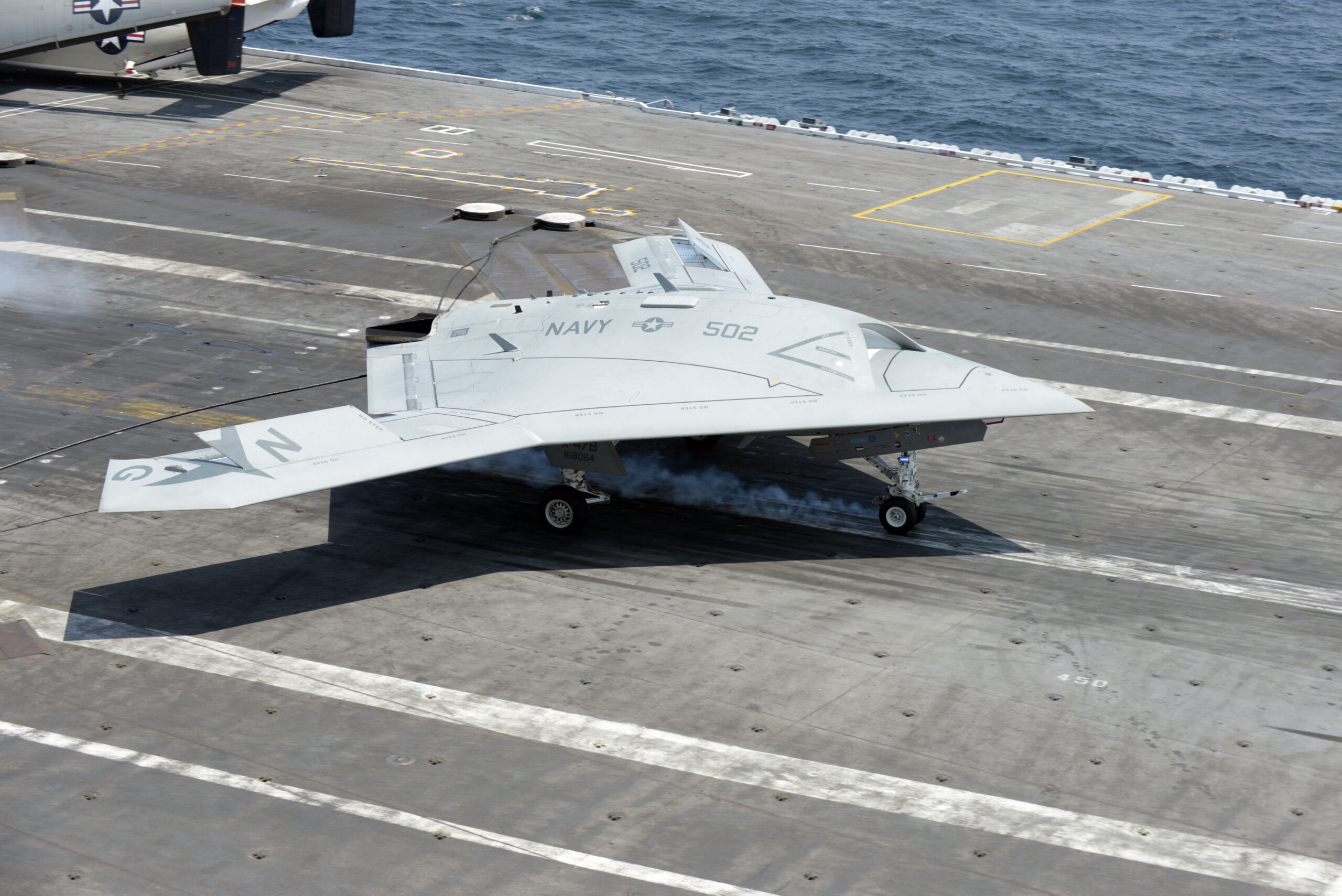
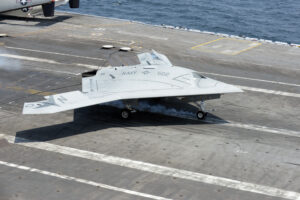
Military Sentinel, Washington — The U.S. Navy formally opened industry engagement on August 31, 2026, for the first increment of a carrier-capable, weaponized Collaborative Combat Aircraft (CCA) intended to operate as an autonomous “loyal wingman” alongside crewed fighters aboard both Gerald R. Ford-class and Nimitz-class carriers.
Naval Air Systems Command (NAVAIR), acting for the Future Advanced Capability Program Office (PMA-228), issued Request for Information N00019-27-RFI-PMA228-CCA, seeking two functional prototypes on an accelerated schedule. The document — reported by Army Recognition and reproduced via SAM Directory — frames the aircraft as affordable, risk-tolerant, extended-range and carrier-capable, able to launch and recover using both the Ford class’s Electromagnetic Aircraft Launch System (EMALS) and Advanced Arresting Gear, and the Nimitz class’s legacy steam catapults and Mk-7 arresting gear. Industry responses are due September 18, 2026.
NAVAIR described the program, known as CCA Increment 1, as an information and market-research effort rather than a formal solicitation — the Navy has made no commitment to award a contract. Officials indicated a possible prototype effort under Other Transaction Authority (10 U.S.C. §4022), which could lead to a Request for White Papers and eventually a Request for Project Proposal.
Dual compatibility with Ford- and Nimitz-class carriers is the program’s most consequential design constraint. Rather than confining autonomous combat aviation to the newest Ford-class ships, a common airframe certified for both launch-and-recovery architectures would let the capability spread across the wider carrier fleet without waiting on full recapitalization — a potentially significant advantage given the decades-long service life of Nimitz-class ships still in the fleet.
The RFI also treats the effort as a software and digital-architecture problem as much as an airframe competition. NAVAIR is requesting autonomy software baselines, digital twins, flight-clearance documentation, and a “Platform in a Box” concept that separates the aircraft itself from its command-and-control and mission-autonomy systems — an approach meant to keep the Navy from being locked into a single vendor’s proprietary stack as autonomy software matures.
The push builds on groundwork laid by the MQ-25A Stingray refueling drone program, which conducted its first test flight in April 2026 and has already established unmanned shipboard procedures aboard USS George H.W. Bush (CVN 77) through the Navy’s Unmanned Carrier Aviation Mission Control System. NAVAIR has said that system could form the technical foundation for future CCA operations. In December 2025, two BQM-177A aircraft flew autonomously in a Live Virtual Constructive exercise in which a virtual F/A-18 issued mission-level tasking — a demonstration NAVAIR credited toward its broader autonomy architecture.
The Navy’s move follows similar efforts elsewhere in the U.S. military: the Air Force’s YFQ-42A is already in flight testing under its own CCA program, and the Marine Corps’ 2026 Aviation Plan expands manned-unmanned teaming development. Navy officials have framed their own effort as uniquely demanding because a carrier-based CCA must additionally withstand catapult loads, arrested landings, saltwater exposure and constrained deck handling.
If successful, Increment 1 would give carrier strike groups a way to add sensors, weapons and electronic-warfare capacity to an air wing without a corresponding increase in embarked pilots — spreading risk across autonomous platforms in contested airspace, particularly relevant to the long distances involved in a potential Indo-Pacific conflict. NAVAIR has emphasized affordability and scalable manufacturing in the RFI, suggesting the goal is a producible fleet asset rather than a one-off demonstrator. This program is still in an early, pre-decisional phase, and specific aircraft designs, contractors, cost estimates, and timelines beyond the September 18 response deadline have not been disclosed — these details need verification as the competition develops.