Physical Address
304 North Cardinal St.
Dorchester Center, MA 02124
Physical Address
304 North Cardinal St.
Dorchester Center, MA 02124

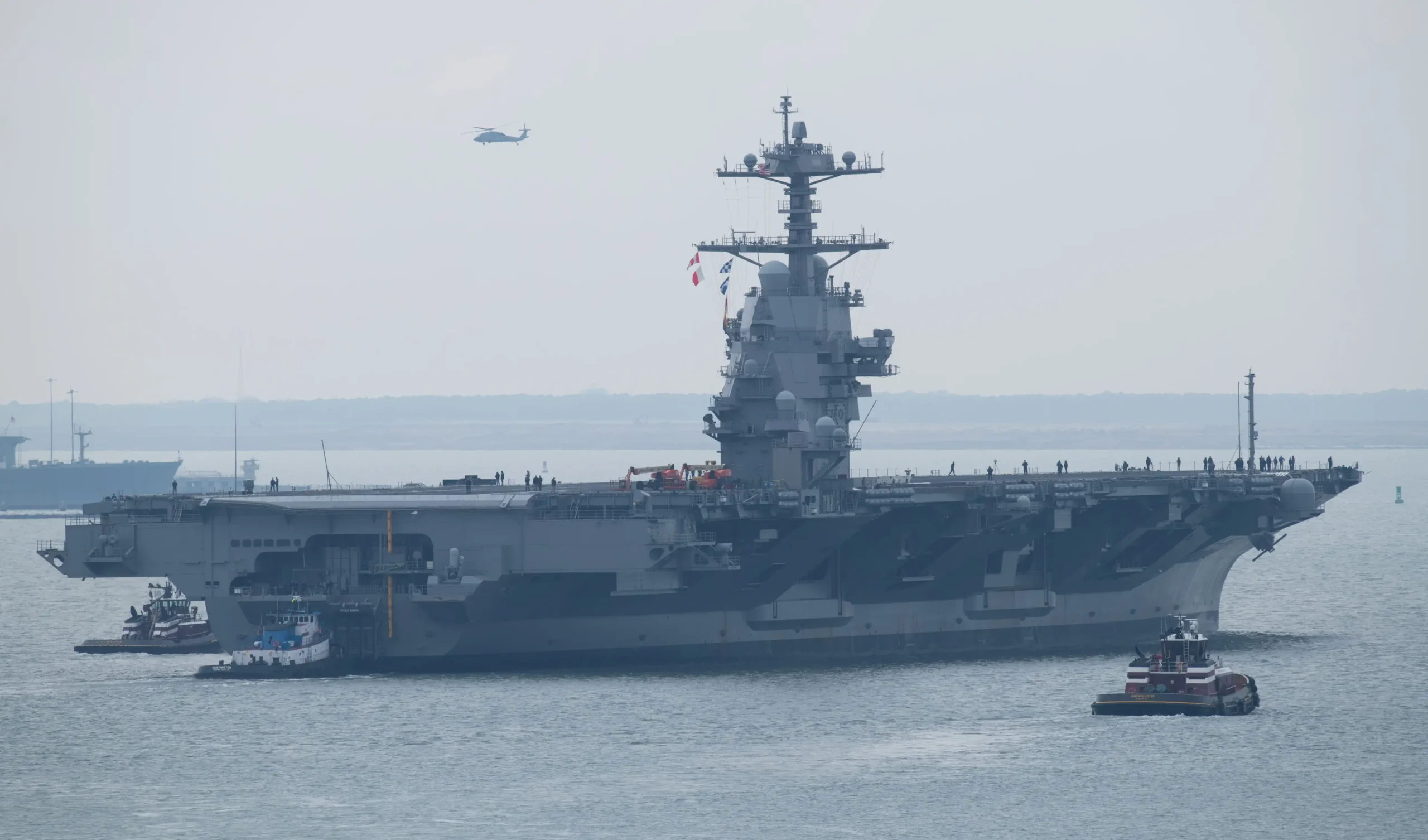
Military Sentinel, NEWPORT NEWS, Va. – The U.S. Navy has taken preliminary acceptance of the future aircraft carrier USS John F. Kennedy (CVN-79) from shipbuilder Huntington Ingalls Industries (HII) Newport News Shipbuilding, permitting sailors to move aboard and initiate operational workups while final construction wraps up ahead of full contractual delivery.
The unusual transfer mechanism allows the service to assume day-to-day command and life aboard the 100,000-ton supercarrier while civilian contractors complete remaining shipboard systems alongside active-duty personnel. The ship will transit to Naval Station Norfolk to accelerate training evolutions prior to its formal delivery, projected for spring 2027.
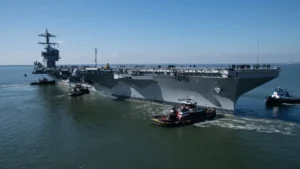
The arrangement comes with CVN-79 standing at approximately 99% structural and mechanical completion following earlier builder’s and acceptance trials. By granting partial acceptance, the Navy avoids leaving the hull idle alongside the fitting-out pier, shaving months off the time required to bring its crew to operational readiness.
The move mirrors lessons learned from lead ship USS Gerald R. Ford (CVN-78), which faced prolonged testing schedules and post-delivery shipyard periods before conducting its first global deployments.
Outstanding work primarily involves fine-tuning select auxiliary systems:
Advanced Weapons Elevators (AWE): Seven of the ship’s 11 electromagnetic weapons elevators have been turned over to the fleet, unlocking access to primary ammunition handling routes while work on the final four continues.
Aviation & Radar Suites: Integration checkouts are ongoing for the Enterprise Air Surveillance Radar (EASR) and the ship’s native F-35C Lightning II integration configuration.
Propulsion Plant Tuning: Dual Bechtel A1B nuclear reactors remain fully integrated, powering ship service loads and sea-trial evaluations.
Service leadership has stressed the urgency of inducting Kennedy into the operational fleet as existing Nimitz-class hulls approach their statutory retirement thresholds. USS Nimitz (CVN-68) and USS Dwight D. Eisenhower (CVN-69) have both shouldered punishing deployment cycles in response to crises in the Middle East and the Indo-Pacific.
Allowing ship’s company to conduct damage control qualifications, navigation watches, and tactical communications integration while HII engineers complete the remaining punch-list items is designed to ensure Kennedy can transition immediately into formal post-shakedown training following its official spring 2027 handover.
As global theater commanders demand constant carrier strike group presence, the Navy’s willingness to partially accept CVN-79 underscores a broader procurement pivot: trading rigid administrative milestones for early operational fleet alignment.

James Whitfield is a defense news writer at Military Sentinel, covering military technology, naval operations, military aviation, international security, and global defense developments. His work focuses on providing informative reporting, relevant context, and accessible explanations of modern military affairs and emerging defense technologies.
Contact: [email protected]