Physical Address
304 North Cardinal St.
Dorchester Center, MA 02124
Physical Address
304 North Cardinal St.
Dorchester Center, MA 02124

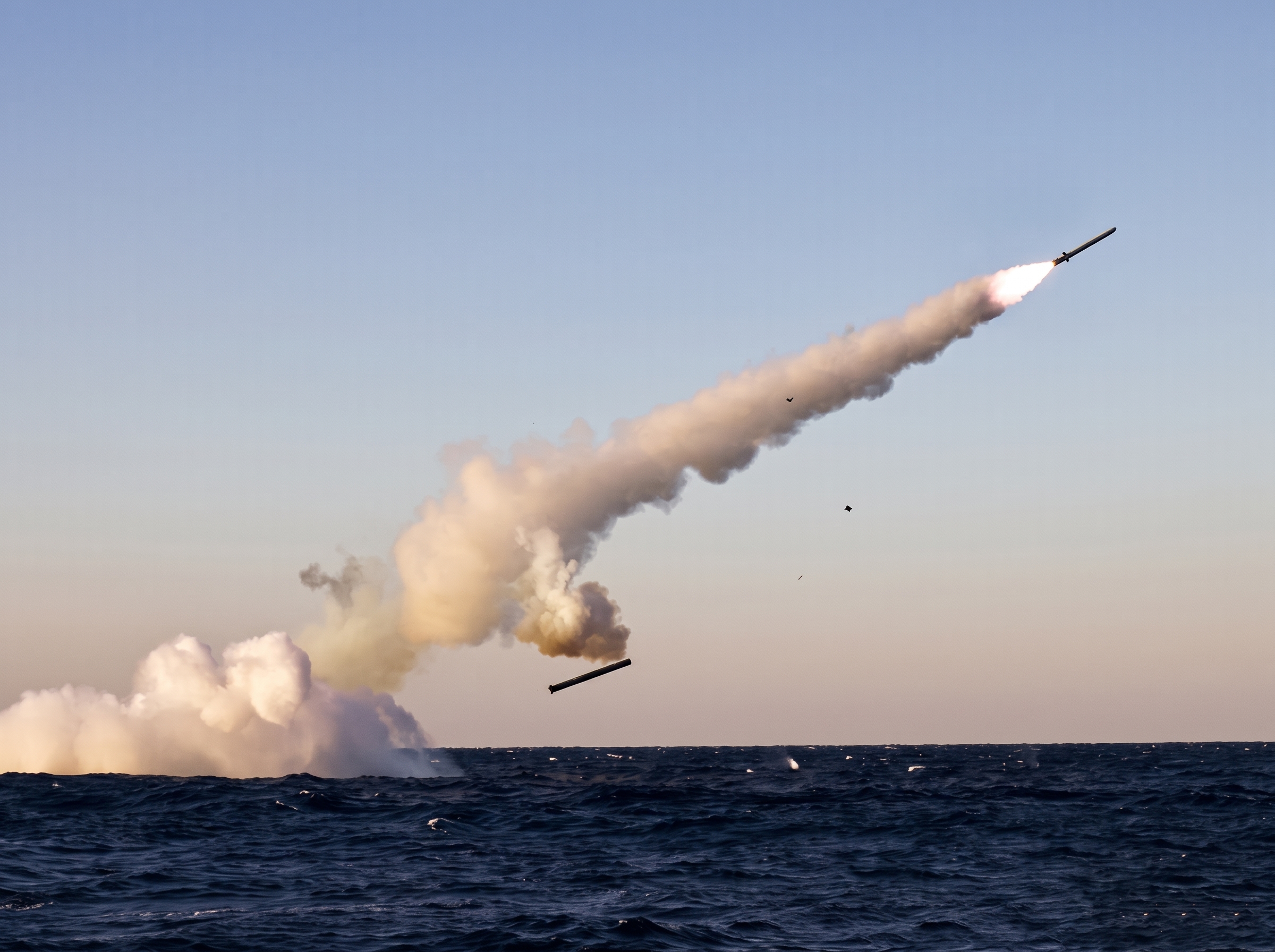
Military Sentinel, Sinpo – North Korea has conducted an underwater test launch of two strategic cruise missiles from a submarine off its eastern coast, signaling an effort to diversify its sea-based strike capabilities beyond ballistic systems. The launch was carried out from waters near the coastal city of Sinpo in South Hamgyong Province into the Sea of Japan, also known as the East Sea. South Korea’s Joint Chiefs of Staff confirmed the detection of the launch and stated that South Korean and United States intelligence authorities were analyzing the detailed flight parameters. The exercise represents Pyongyang’s continued drive to demonstrate an asymmetric, multi-axis nuclear delivery posture capable of complicating allied air and missile defense networks across the Korean Peninsula.
The test marks a notable operational shift, as North Korea had previously prioritized submarine-launched ballistic missiles for its naval deterrent. By adapting low-flying, land-attack cruise missiles to submerged platforms, the Korean People’s Army naval branch seeks to exploit gaps in regional early-warning radar coverage, which is predominantly oriented toward tracking high-altitude ballistic trajectories.
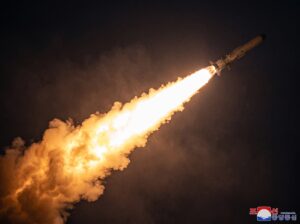
According to statements released by state-run Korean Central News Agency, the operation involved the experimental diesel-electric submarine 8.24 Yongung (August 24 Hero), which deployed into Kyongpo Bay off Sinpo to execute the test. The state media outlet reported that two strategic cruise missiles were fired from torpedo tubes or a dedicated vertical launch cell while the vessel was submerged.
KCNA claimed the two missiles traveled for 7,563 to 7,575 seconds along figure-eight flight trajectories totaling 1,500 kilometers before striking a designated target in the Sea of Japan. While state-run performance claims cannot be independently verified, South Korea’s Joint Chiefs of Staff acknowledged detecting an unspecified missile event originating from the Sinpo maritime zone, noting that allied surveillance assets tracked the activity throughout the firing window. Military officials in Seoul emphasized that allied forces maintain a high state of readiness, coordinating closely with U.S. Indo-Pacific Command.
The timing coincided with the commencement of major joint U.S.-South Korea combined military exercises, including the computer-simulated and field-training maneuvers known as Freedom Shield. Pyongyang has routinely utilized weapon tests during allied drills to signal political defiance and operational readiness.
The missiles involved in the drill belong to North Korea’s evolving family of land-attack cruise missiles, widely identified by defense analysts as variants within the Hwasal-1, Hwasal-2, or newer Pulhwasal series. In state nomenclature, the “strategic” designation indicates the weapon is designed to carry a nuclear payload, specifically intended to accommodate the miniaturized Hwasan-31 tactical nuclear warhead unveiled by North Korean state media.
Unlike ballistic missiles that follow high-arcing parabolic paths into the upper atmosphere, these cruise missiles operate within the dense lower atmosphere using small turbofan or turbojet sustainers following a solid-propellant booster ignition. They fly at subsonic speeds typically Mach 0.6 to 0.8 at altitudes often below 100 meters, utilizing terrain-following flight profiles and mid-course satellite-aided inertial navigation alongside optical or radar terminal guidance. This low-altitude flight profile presents acute detection challenges for surface-based air defense radars, which face horizon limitations and terrain clutter.
Deploying these systems from an underwater platform further complicates early detection. While ground-based transporter-erector-launchers can be monitored by satellite imagery prior to launch, a submerged submarine provides an element of pre-launch concealment, effectively expanding the vectors from which a standoff attack could theoretically originate.
Despite the propaganda value attributed to the test, defense analysts emphasize that North Korea faces severe platform limitations at sea. The 8.24 Yongung is a one-off experimental testbed displacing approximately 2,000 tonnes submerged. Derived from reverse-engineered Soviet Golf-class or Yugoslavian designs, the diesel-electric vessel lacks air-independent propulsion systems, significantly restricting its submerged endurance and operational radius.
Conventional diesel-electric submarines require frequent snorkeling to recharge their lead-acid battery banks using diesel generators, during which they become acoustically noisy and vulnerable to radar and thermal detection. Western and South Korean anti-submarine warfare platforms—including P-8A Poseidon maritime patrol aircraft, advanced sonar arrays, and modern attack submarines—hold a decisive technological advantage in tracking North Korea’s aging submarine fleet.
Integrating cruise missiles onto limited platforms also presents trade-offs. The 8.24 Yongung was originally modified to test single Pukguksong-series ballistic missiles from its sail. Utilizing torpedo-tube launching or adapting small internal cells for cruise missiles reduces space for defensive torpedoes and crew sustainment, underscoring that the platform remains primarily an experimental launch vehicle rather than a combat-ready patrol asset.
The development of submarine-launched cruise missiles directly challenges regional integrated air and missile defense architectures across Northeast Asia. South Korea’s layered defense doctrine anchored by the “Kill Chain” preemptive strike mechanism and the Korea Air and Missile Defense network relies heavily on early detection of launch preparations and interception of incoming warheads.
While ballistic interceptors such as Patriot PAC-3, THAAD, and shipborne SM-3 interceptors are optimized for high-speed, high-angle ballistic threats, counter-cruise missile defense requires dense, overlapping low-altitude coverage. Systems like the Cheongung-II (KM-SAM) and shipborne SM-2 or RIM-162 ESSM interceptors are capable against subsonic air-breathing threats, but early detection over water remains reliant on continuous airborne early warning and control aircraft patrols.
Looking ahead, regional militaries will focus on whether North Korea can transition these cruise missile launch capabilities to operational combat hulls, such as its recently converted Romeo-class multi-missile submarine, or if technical hurdles will restrict submarine-launched cruise missiles to periodic demonstrations. South Korean and U.S. naval forces are expected to expand joint anti-submarine exercises and maritime surveillance deployments across the Sea of Japan to maintain real-time tracking of North Korean underwater movements.