Physical Address
304 North Cardinal St.
Dorchester Center, MA 02124
Physical Address
304 North Cardinal St.
Dorchester Center, MA 02124

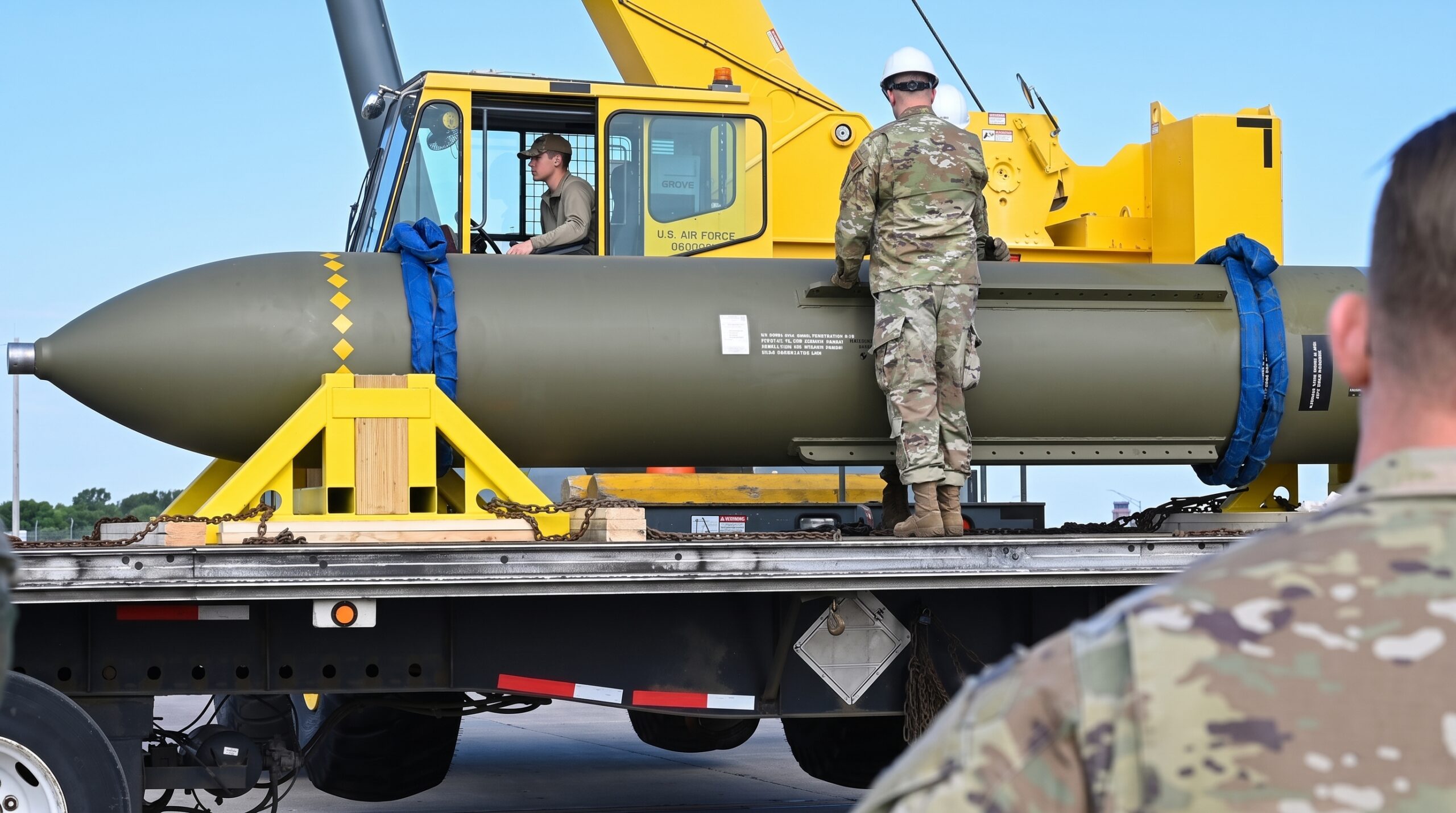
Military Sentinel, Eglin Air Force Base, Florida – The U.S. Air Force has signed a combined $149 million in contracts with four manufacturers to keep producing the hardened steel cases used in its largest bunker-busting bombs, spreading the work across a group of small forging and machining shops instead of a single prime contractor.
The Air Force Life Cycle Management Center’s Attack Weapons Branch at Eglin Air Force Base ran the competition, which drew four offers before the awards were made. Each winner Superior Forge and Steel (Lima, Ohio), Ellwood National Forge (Irvine, Pa.), Faxon Machining LLC (Cincinnati, Ohio), and Grand Valley Manufacturing (Titusville, Pa.) received a firm-fixed-price, cost-type indefinite-delivery, indefinite-quantity (IDIQ) contract for what the service designates “large penetrator warhead case assembly production.”
The scope covers both full-scale and subscale warhead cases, the latter used for testing. Work under the contracts is slated to run through September 7, 2033, contingent on the Air Force exercising an extension option.
Notably, the Air Force obligated only $10,000 in fiscal 2026 research and development funding at the time of the award. That figure is not a sign the program is underfunded it’s standard IDIQ practice, where the government commits to a ceiling but only pays out as it places actual delivery orders over the life of the contract.
A large penetrator warhead case is the hardened outer shell engineered to survive slamming into a hardened target a bunker, tunnel complex, or fortified structure intact long enough for the explosive fill to detonate where it’s needed rather than on impact.
The Air Force’s current weapon in this class is the GBU-57 Massive Ordnance Penetrator (MOP), a 30,000-pound (13,600 kg) bomb built by Boeing that carries roughly 6,000 kg (approx. 2,700 kg per the source figure) of explosive payload and is carried by the B-2 and B-52.
The Air Force is not stopping at sustaining the current stockpile. In September 2025 it awarded Applied Research Associates a two-year design and prototyping contract for a Next Generation Penetrator, with Boeing partnered on the tail kit. The notice announcing this week’s case-production awards did not specify whether the new contracts will supply the existing GBU-57 line, the next-generation program, or both a detail worth watching as the Pentagon signals it wants a deeper bench of deep-strike options after Fordow.
Splitting case production across four smaller manufacturers rather than relying on a single large contractor suggests the Air Force is hedging against supply-chain bottlenecks for a weapon class it has just used in a high-profile strike and is actively trying to modernize. Expect further contract actions tied to the Next Generation Penetrator program as ARA and Boeing’s prototyping work matures.