Physical Address
304 North Cardinal St.
Dorchester Center, MA 02124
Physical Address
304 North Cardinal St.
Dorchester Center, MA 02124
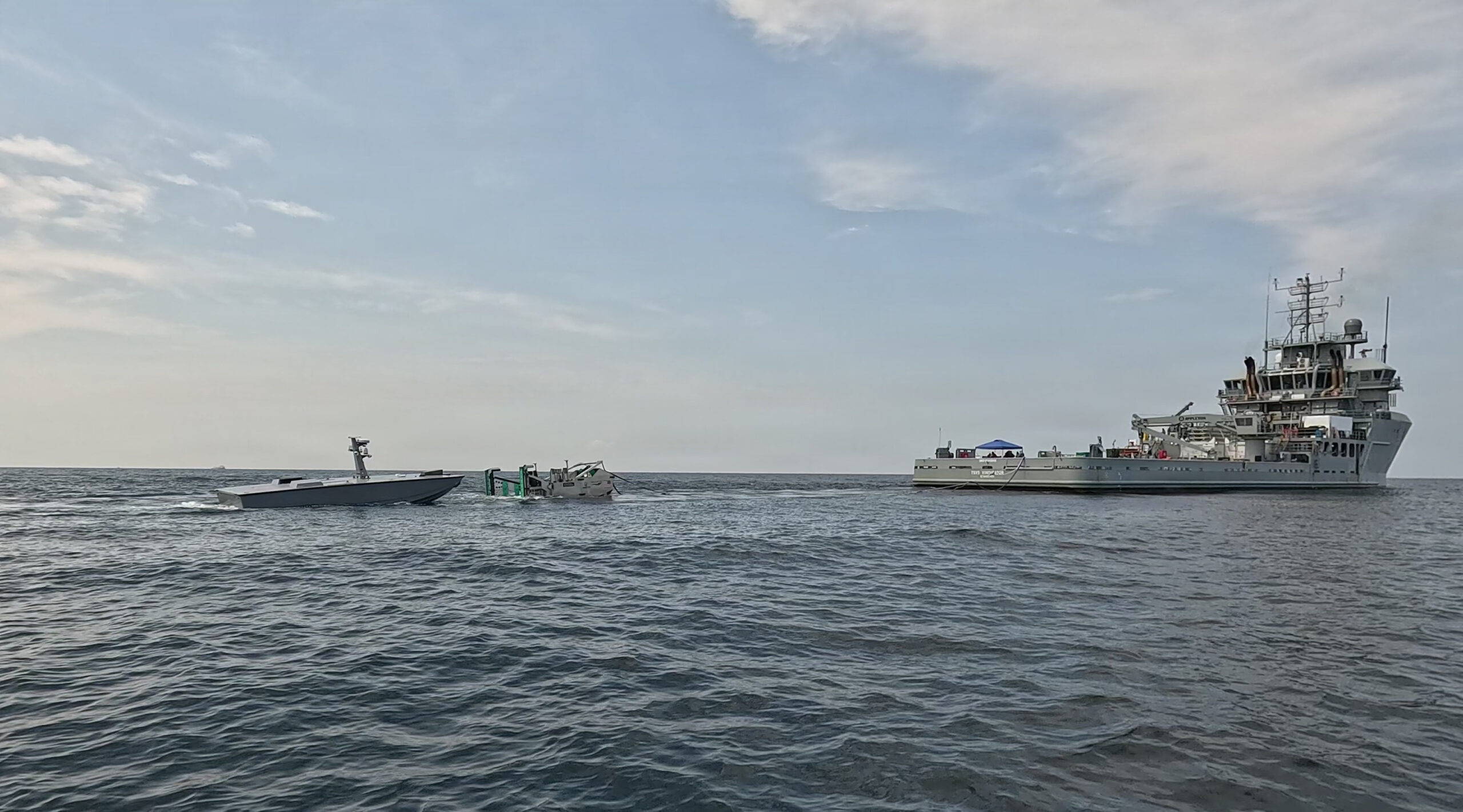
Military Sentinel, Norfolk, Va. – The U.S. Navy has demonstrated a robotic towed connector capable of repeatedly capturing, refueling, and releasing an unmanned surface vessel (USV) at sea, part of a push to keep unmanned platforms on station longer without relying on crewed support ships.

The trial took place Aug. 11 off Joint Expeditionary Base Little Creek-Fort Story, Virginia, and was disclosed in a Tuesday news release. It was run by Naval Air Warfare Center Weapons Division’s (NAWCWD) Blue Water Instrumentation (BWI) unit and BWI’s Future Capabilities Office fleet management team, working with industry partners Maritime Tactical Systems Inc. (MARTAC) and Sealartec.
The demonstration was sponsored by U.S. Fleet Forces Command, Naval Surface Warfare Center Dahlgren Division, and Naval Surface Warfare Center Carderock Division, while the Littoral Combat Ship Mission Modules Program Office (PMS 420) and the Navy’s Portfolio Acquisition Executive for Robotics and Autonomous Systems provided the contracting support that enabled the partnership.
The test paired the Navy-owned T38 USV, built by MARTAC and Sealartec, with Sealartec’s towable capture and connection device (TCCD) a robotic refueling system that the Navy-industry team moved from concept to real-world testing in seven months. The TCCD itself was towed by training support vessel USNS Vindicator (TSV-5) during the demonstration.
T38 specifications (part of MARTAC’s Devil Ray family):
Refueling system: Sealartec markets its Autonomous Replenishment At Sea (A-RAS) system as fitting 3- to 24-meter USVs while under tow, operable to Sea State 6, with a fuel transfer rate of 757 liters in 15 minutes — figures drawn from the company’s own product page rather than independently verified Navy test data. [This needs verification against Navy-published performance results.]
During the event, the team ran dozens of full-cycle capture, refuel, and release exercises at sea, plus pierside demonstrations, with Vindicator transferring a total of 400 gallons of fuel to the T38. Sealartec CEO Amitai Peleg said the system completed roughly 100 connection cycles in total over the days leading up to and including the demonstration, generating design and operational lessons for the TCCD.
BWI’s Future Capabilities Office director, Spencer Holloway, tied the effort to a specific operational gap: NAWCWD’s near-term priority is supporting hypersonic and precision long-range fires testing, where flight profiles can extend thousands of miles and require data-collection assets spread across a wide area — and every time an unmanned vessel has to return to port to refuel, the Navy loses persistence, coverage, and redundancy, and interrupts the mission.
Peleg framed the trial as a step toward removing the human from the loop entirely: Sealartec’s roadmap calls for the USV to approach the refueling device, communicate via automated protocols, and maneuver itself into position, largely eliminating human dependency from the process.
U.S. Fleet Forces Command’s Ronald Raymer, who took part in the demonstration, put the strategic case plainly: unmanned refueling could let the Navy lean more heavily on unmanned vessels instead of manned ones, push USVs into higher-threat areas without risking crewed ships and personnel, and distribute capability across an area without buying more large, expensive manned vessels and their refueling support.
BWI’s next milestone is an end-to-end autonomous refueling demonstration combining vessel rendezvous, approach, capture, fuel transfer, disconnection, and return to mission in a single evolution. Near-term engineering work is focused on cutting command-and-control latency for precise maneuvering during operator-assisted testing, and integrating next-generation local positioning systems to support fully autonomous refueling.
Based on the pace described (concept to test in seven months, roughly 100 cycles completed), a fully autonomous end-to-end capability appears to be a near-term but not yet scheduled milestone; the release did not include a target date, so any timeline should be treated as unconfirmed until the Navy states one.
The bigger implication sits with hypersonic and long-range fires testing ranges, where USV coverage is currently capped by fuel endurance. If the concept scales past this proof-of-concept stage, it would let the Navy stretch instrumented USV coverage across the kind of vast test ranges that thousand-mile-plus weapons trials require without adding crewed ships to the mix.