Physical Address
304 North Cardinal St.
Dorchester Center, MA 02124
Physical Address
304 North Cardinal St.
Dorchester Center, MA 02124

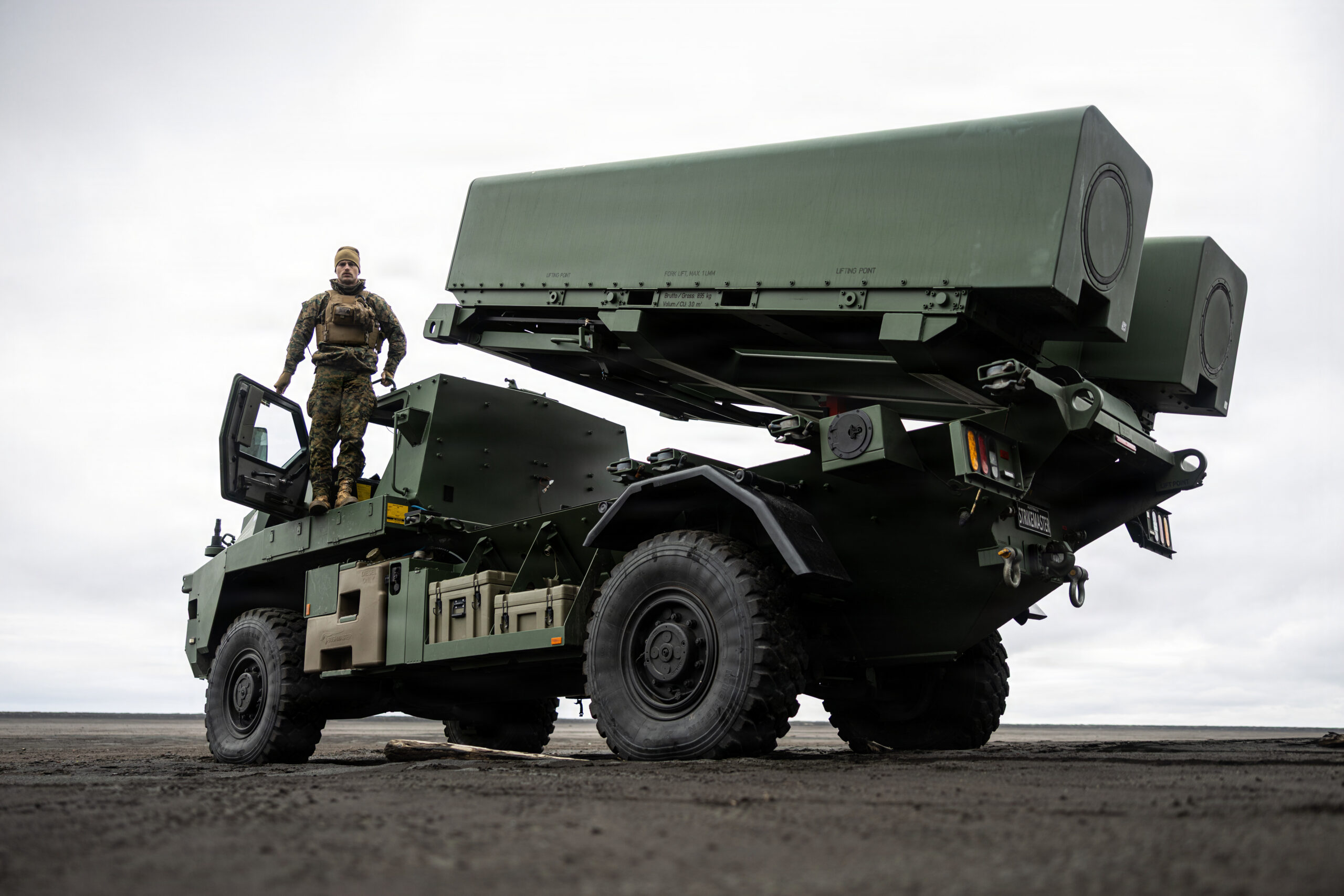
Military Sentinel, Trondheim, Norway – The U.S. Navy and Marine Corps moved two expeditionary long-range fire systems the Navy’s Containerized Launching System and the Marine-operated Strike Master Coastal Defense System into Norway’s High North in late August as part of Operation Atlantic City 26 and NATO’s Arctic Sentry enhanced Vigilance Activity, service imagery released this month confirms.
Pentagon-released photos show a Containerized Launching System loaded onto a U.S. Air Force C-17 Globemaster III on Aug. 25 and offloaded two days later at Trondheim. From there, elements were pushed forward to Jan Mayen, a remote volcanic island roughly 621 miles (1,000 km) from the Norwegian mainland, for the exercise window running Aug. 26 to Sept. 4.
A Marine-operated Strike Master system followed a similar path, loading onto a Royal Air Force A400M Atlas at Trondheim on Aug. 28 before it was documented operating on Jan Mayen on Aug. 30.
Marines with Fire Support Battalion, 10th Marine Regiment, and Marine Air Support Squadron 1 also stood up a command-and-control node on Jan Mayen, linking the Strike Master with Norway’s National Manoeuvre Air Defence System (NOMADS).
Jan Mayen sits north of the Greenland-Iceland-U.K. (GIUK) gap, the Cold War-era chokepoint against Soviet and now Russian naval movement into the Atlantic. Positioning ground-based maritime strike systems there signals a renewed U.S. and allied focus on contesting that corridor as Russian military activity in the region increases.
Operationally, the drills also test whether these systems can be inserted fast enough to matter. The airlift sequence C-17 and A400M transport, offload, forward push to an isolated island is itself the capability being demonstrated, not just the missiles.
A U.S. Navy image caption described the airlift as demonstrating “the rapid projection of joint logistics and interoperable communication assets directly into the High North to sustain forward NATO forces.”
U.K. Defense Secretary Wes Streeting, whose forces joined via LXX Squadron RAF and Commando Force elements, called the exercise a demonstration of partnership strength and Arctic operating capability.
The Navy has disclosed only one live firing of the Containerized Launching System an October 2023 SM-6 shot from USS Savannah (LCS-26). By contrast, the Army’s related Typhon system (also Mk 70-based) has fired in Australia and, as recently as May 2026, hit a target 390 miles away in the Philippines. That’s a real asymmetry: the Navy’s version of this launcher has a much thinner live-fire record than its Army cousin, despite sharing the same underlying hardware. Readers should weigh the Norway deployment as a logistics and integration exercise first there’s no indication a live fire took place during Atlantic City 26 based on available reporting.