Physical Address
304 North Cardinal St.
Dorchester Center, MA 02124
Physical Address
304 North Cardinal St.
Dorchester Center, MA 02124

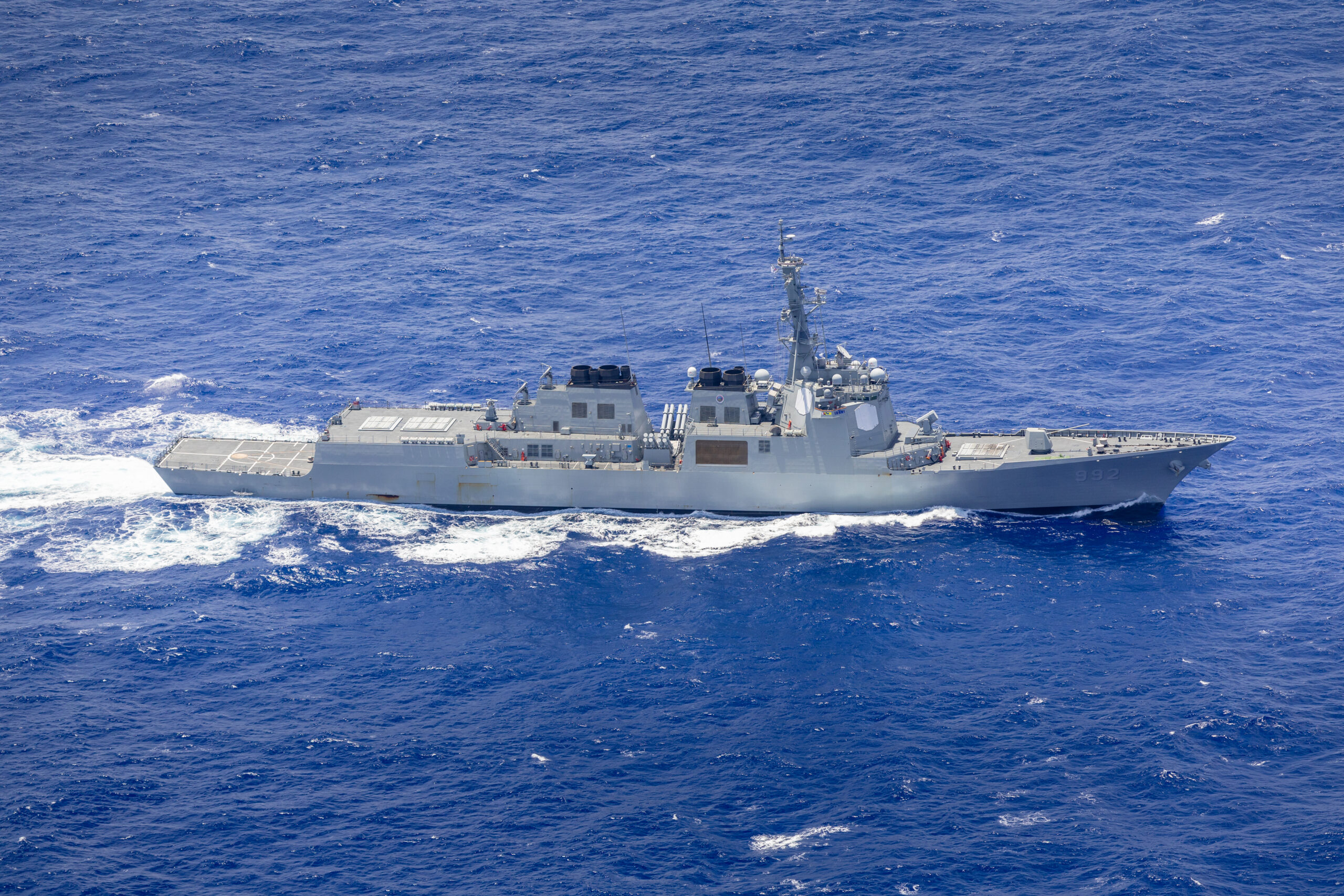
Military Sentinel, Jeju Island – The United States, Japan, and South Korea began the five-day Freedom Edge 2026 exercise on Sept. 7 in waters east and south of Jeju Island, deploying six surface combatants and a mixed land-based air fleet without a U.S. aircraft carrier for the second straight year, as the three allies work to tighten missile-defense coordination against a growing North Korean naval threat.
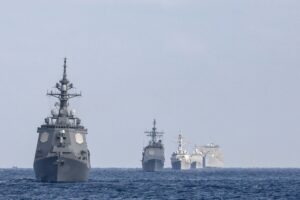
Freedom Edge is a trilateral, multi-domain exercise now in its fourth iteration over 27 months. This year’s run, the second consecutive edition without a carrier, pairs destroyers with fighters, tankers, and airborne early-warning aircraft flying primarily from land bases rather than an embarked air wing. The drill runs through Sept. 11 in international waters around Jeju, with Japanese activity extending west to the East China Sea near Kyushu.
The stated training focus covers integrated air and missile defense, maritime missile defense, maritime interdiction, cyber defense, logistics, and notably real-time trilateral data sharing, meaning radar tracks generated by ships and aircraft from all three militaries must be fused across separate national command networks fast enough to support identification and intercept decisions.
Five of the six participating ships have been publicly identified:
Four of the five named ships carry the Aegis combat system, concentrating substantial shipborne air and missile defense capacity in a relatively small surface force. Japan is also contributing roughly 560 personnel along with P-1 patrol aircraft, SH-60K helicopters, F-15 and F-2 fighters, E-767 and E-2D airborne early-warning aircraft, and KC-46A/KC-767 tankers; U.S. F-16s and KC-135s are also taking part.
This is a smaller force than the carrier-backed editions of 2024, which included the USS Theodore Roosevelt and USS George Washington and involved as many as seven to eight major ships. The shift toward a carrier-free format puts more weight on land-based aviation, aerial refueling, and cross-national data sharing to replace the integrated air wing a carrier normally provides.
The exercise opened one day after North Korea commissioned the roughly 5,000-ton guided-missile destroyer Kang Kon at Wonsan on Sept. 6 a ship that partially capsized during its May 2025 launch before being repaired and completing weapons testing this past July. Kang Kon carries the same weapons suite as its sister ship, Choe Hyon, commissioned in June, and North Korea has since test-fired cruise missiles from the new vessel.
U.S. Forces Japan commander Lt. Gen. Stephen Jost said Sept. 7 that it remains “not safe to say” the carrier-free format has become the new normal for Freedom Edge, leaving open whether future iterations will again include a flattop.
With North Korea expanding its east-coast naval infrastructure and pursuing additional warship classes, the trilateral partners face a growing mix of ship-, land-, air-, and submarine-launched missile threats. How well this year’s leaner, more distributed force performs on sensor fusion and missile-defense coordination without a carrier’s built-in air wing may shape whether Washington, Tokyo, and Seoul treat the format as a durable model or a temporary substitute.