Physical Address
304 North Cardinal St.
Dorchester Center, MA 02124
Physical Address
304 North Cardinal St.
Dorchester Center, MA 02124
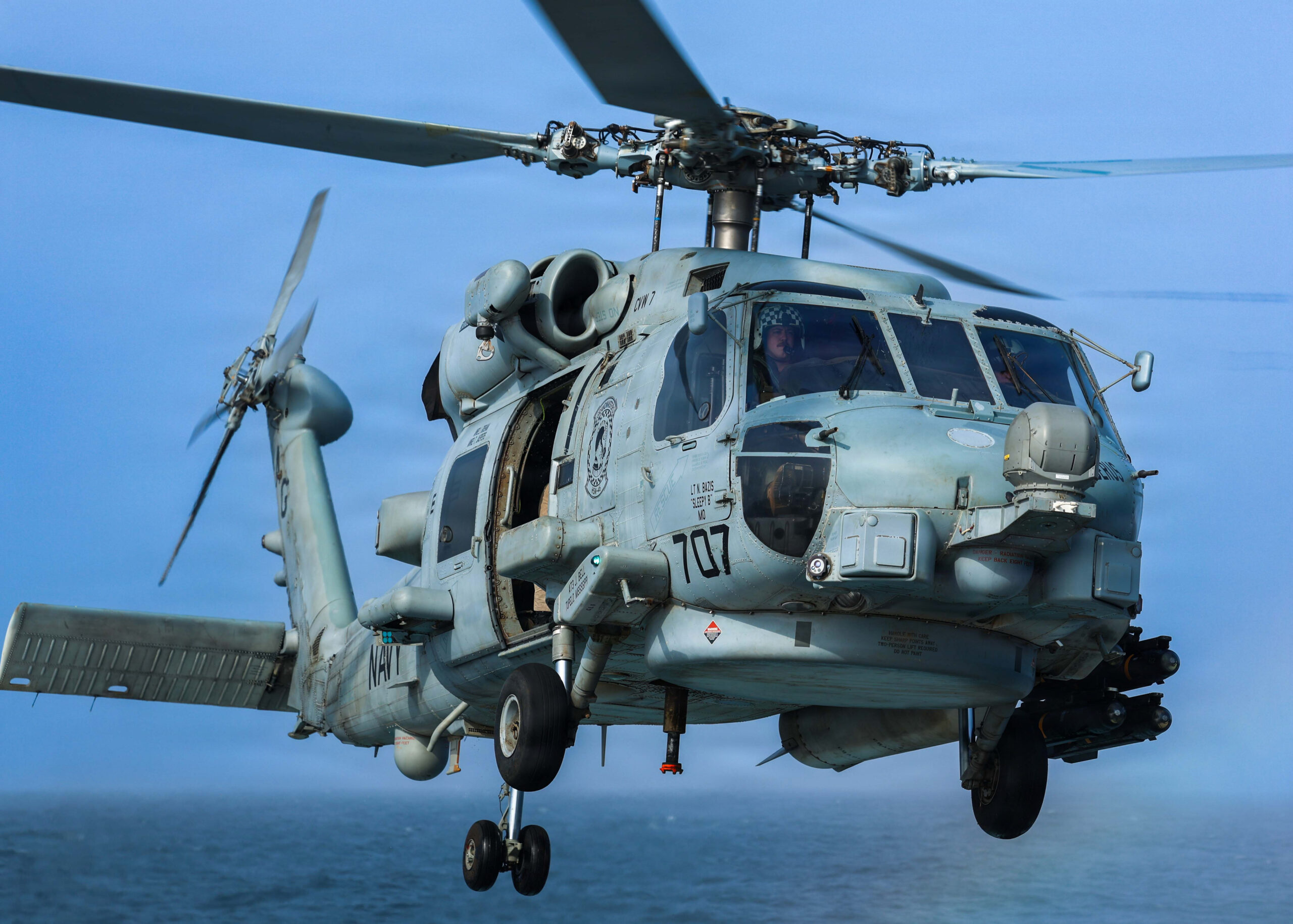
Military Sentinel, Washington – U.S. naval forces operating in the Middle East have redirected at least 99 commercial vessels attempting to reach or depart Iranian ports, leveraging shipborne MH-60R Seahawk multi-mission helicopters to maintain a persistent maritime blockade across the Strait of Hormuz and Gulf of Oman.
The enforcement campaign follows a U.S. Central Command (CENTCOM) directive ordering a selective blockade targeting Iranian maritime commerce while permitting non-Iranian regional traffic to flow freely. Rather than relying solely on surface ship picket lines, the operation utilizes an airborne surveillance and interdiction network distributed across amphibious ready groups and surface combatants.
Aviation assets are operating directly from platforms such as the Wasp-class amphibious assault ship USS Boxer (LHD 4)—embarking elements of the 11th Marine Expeditionary Unit—as well as Arleigh Burke-class guided-missile destroyers like the USS Rafael Peralta (DDG 115).
Enforcing selective maritime denial across crowded shipping channels requires positive identification before deploying boarding parties or kinetic intervention. The MH-60R serves as the primary sensor node to extend maritime domain awareness well past the radar horizon of surface warships.
Key technical systems deployed on the aircraft include:
AN/APS-153(V) Multimode Radar: Features Automatic Radar Periscope Detection and Discrimination (ARPDD) algorithms to track small surface targets in high-clutter environments.
AN/AAS-44C Multi-Spectral Targeting System: Provides electro-optical and infrared (EO/IR) surveillance, laser designation, and visual range-finding.
Tactical Datalinks (Link 16 and Hawklink): Enables real-time streaming of radar tracks, video feeds, and targeting data directly to fleet command nodes.
This sensor suite allows helicopter crews to visually verify vessel registrations, inspect hull markings, and monitor compliance with navigational instructions from safe standoff distances.
The coercive mechanism behind the diversions incorporates a graduated response model. In mid-July, after the Curaçao-flagged tanker Belma defied naval warnings to alter course away from Kharg Island, U.S. forces disabled the vessel’s propulsion system by striking its smokestack with AGM-114 Hellfire missiles. This demonstrated precision capability has allowed naval forces to compel adherence without resorting to sinking commercial vessels.
The operational pressure reflects significant shifts in Persian Gulf trade dynamics:
Crude Flow Reductions: U.S. Energy Information Administration (EIA) data indicates crude transit through the Strait of Hormuz fell from 21.6 million barrels per day in late 2025 to 4.9 million barrels per day by mid-2026.
Asymmetric Risk: Tehran retains substantial retaliatory capacity through fast-attack craft, anti-ship cruise missiles, and loitering munitions operated by the Islamic Revolutionary Guard Corps Navy (IRGCN).
Moving forward, the primary operational challenge for CENTCOM lies in maintaining round-the-clock aerial interception corridors without expanding tactical confrontations into broader regional maritime engagements.