Physical Address
304 North Cardinal St.
Dorchester Center, MA 02124
Physical Address
304 North Cardinal St.
Dorchester Center, MA 02124


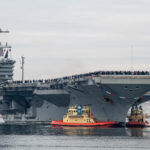
Military Sentinel, Portsmouth – The Royal Navy has deployed aircraft carrier HMS Queen Elizabeth to serve as the dedicated HMS Queen Elizabeth NATO command ship for the alliance’s Allied Reaction Force (Maritime), leading multinational deterrence operations across United Kingdom and northern European waters.
The three-month autumn deployment marks the operational return of the 65,000-tonne capital ship following the completion of its second major maintenance and docking period at Rosyth Dockyard. With an embarked multinational battle staff and more than 800 personnel aboard, the flagship has officially assumed the role of NATO’s Afloat Command Platform—representing the first time a Queen Elizabeth-class carrier has undertaken this specific alliance command duty.
While underway, HMS Queen Elizabeth will direct joint allied naval manoeuvres while undergoing rigorous combat certification under the Royal Navy’s Flag Officer Sea Training (FOST) organization. The syllabus tests the carrier across the entire spectrum of modern maritime warfare, including anti-submarine warfare (ASW), integrated air and missile defense, and joint strike coordination.
“Sailing this autumn is a key milestone for both our NATO commitment, as the Afloat Command Platform, and also on our journey back to the Royal Navy’s ‘very high readiness’ aircraft carrier,” stated Captain Claire Thompson OBE RN, commanding officer of HMS Queen Elizabeth. “Sailing with an embarked battle staff, integration and training is essential whilst relearning the skills required to conduct safe and effective aviation as we ensure that we are prepared to deliver operational activity at the heart of NATO should it be required.”
The Queen Elizabeth-class represents the centerpiece of the UK’s maritime strike doctrine, engineered around short take-off and vertical landing (STOVL) air operations and distributed command-and-control infrastructure.
Displacement: Approximately 65,000 tonnes (full load)
Flight Deck Configuration: Ski-jump ramp; 280-meter length with twin-island architecture separating navigation and flight control
Air Wing Capacity: Up to 40 aircraft, including fifth-generation F-35B Lightning II multirole stealth fighters, Merlin HM2 anti-submarine helicopters, and Wildcat reconnaissance assets
Complement: 700 to 800 core crew, scaling to approximately 1,600 personnel with full air wing and strike staff embarked
Command Infrastructure: Dedicated high-bandwidth joint operations center designed to direct multinational task forces
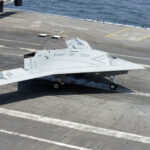
HMS Queen Elizabeth’s operational transition directly reinforces NATO’s maritime posture in the High North and North Atlantic, an area seeing heightened undersea and surface activity. The carrier’s command integration aligns with wider UK defense initiatives, including £240 million allocated toward developing autonomous “loyal wingman” jet-powered drones under the Hybrid Carrier Air Wing framework to augment manned F-35B operations.
The current deployment establishes the operational foundation for HMS Queen Elizabeth to complete intensive alliance exercises throughout 2027. Upon concluding this training cycle, the warship is slated to relieve sister vessel HMS Prince of Wales in late 2027 as the UK’s primary high-readiness strike carrier and national flagship.