Physical Address
304 North Cardinal St.
Dorchester Center, MA 02124
Physical Address
304 North Cardinal St.
Dorchester Center, MA 02124


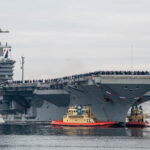
Military Sentinel, Washington – The U.S. Navy aircraft carrier USS Abraham Lincoln (CVN-72) and its associated carrier strike group have completed a prolonged deployment to the Middle East, concluding a high-intensity operational tour defined by extensive cruise missile strikes and integrated defensive actions. Over the course of the deployment, escorting guided-missile cruisers and destroyers assigned to the strike group expended approximately 450 Tomahawk Land Attack Missiles (TLAM) alongside hundreds of defensive surface-to-air interceptors to counter regional threats and degrade hostile infrastructure.
The conclusion of the strike group’s mission marks one of the most sustained naval combat engagements undertaken by the American surface fleet in recent decades. Operating across the Red Sea, the Gulf of Aden, and the Arabian Sea, the carrier air wing and its surface screen maintained a persistent presence intended to deter wider escalations while protecting vital international shipping lanes.
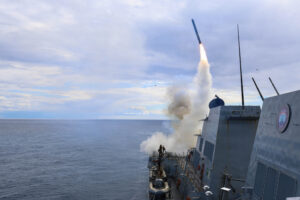
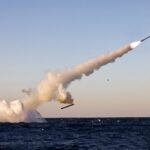
The high volume of Tomahawk missile expenditures reflects the operational strategy employed by U.S. Central Command to strike anti-ship missile sites, radar installations, command facilities, and weapons depots. Surface combatants within the strike group—consisting of Arleigh Burke-class destroyers and Ticonderoga-class guided-missile cruisers—bore the primary responsibility for long-range land-attack salvos.
Equipped with Mark 41 Vertical Launch Systems (VLS), these surface escorts provided rapid-response strike options that reduced reliance on manned carrier-borne aircraft during initial suppression phases. Modern iterations of the Raytheon Tomahawk cruise missile, including the Block IV and Block V variants, provided loitering capability, two-way satellite datalinks, and reprogrammable target-acquisition systems. These technical features allowed naval planners to execute high-precision strikes into heavily defended or contested areas without exposing flight crews to hostile surface-to-air missile umbrellas.
Simultaneously, Carrier Air Wing 9 (CVW-9), embarked aboard the USS Abraham Lincoln, conducted thousands of flight hours. Multirole F/A-18E/F Super Hornets, EA-18G Growler electronic warfare aircraft, and F-35C Lightning II stealth fighters conducted direct air interdiction, defensive counter-air patrols, and continuous reconnaissance across broad maritime chokepoints.
The expenditure of hundreds of land-attack missiles and advanced interceptors highlights significant logistical demands on naval supply chains. Replenishing vertical launch cells during continuous operations presents a formidable operational hurdle, as combatants must traditionally rotate to designated deep-water facilities or friendly ports capable of safely transferring explosive ordnance into ship silos.
Beyond the immediate movement of hulls, the depletion of precision munitions has intensified discussions within defense acquisition leadership regarding production capacity. Standard industrial production rates for the Tomahawk family typically hover around 60 to 100 missiles annually across domestic military and foreign military sales contracts. Consuming several hundred tactical missiles in a single theater deployment puts noticeable pressure on existing Pentagon inventories, necessitating accelerated procurement schedules and sustained funding lines to rebuild reserve stockpiles.
Similarly, surface escorts consumed significant numbers of Standard Missile variants—primarily SM-2 and SM-6 interceptors—alongside Evolved SeaSparrow Missiles (ESSM) to defeat inbound one-way attack drones and anti-ship cruise missiles. Ensuring the industrial base can produce interceptors at a pace that matches modern consumption rates remains a central strategic concern for defense planners.
With the USS Abraham Lincoln beginning its transit away from the region, the Pentagon faces the ongoing task of balancing naval presence requirements between the Middle East and the Indo-Pacific. The deployment demonstrated the tactical flexibility and layered defense mechanisms inherent in a carrier strike group, yet it also underscored the wear and tear inflicted on naval hulls, airframes, and crews during extended maritime combat missions.
U.S. defense officials are closely evaluating operational data gathered during the Lincoln’s deployment to refine future surface-fleet weapons loadouts, electronic defense routines, and magazine management protocols. As new carrier units prepare to relieve forward-deployed forces, maintaining credible deterrence will require balancing ready combat power with the long-term industrial necessity of rebuilding critical munitions inventories.