Physical Address
304 North Cardinal St.
Dorchester Center, MA 02124
Physical Address
304 North Cardinal St.
Dorchester Center, MA 02124

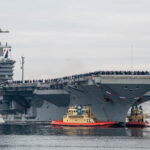
Military Sentinel, Washington – The U.S. Navy has reinforced its presence in the Middle East by positioning two nuclear-powered aircraft carriers in the Arabian Sea. The deployment of the USS George H.W. Bush and the USS George Washington brings a heavy concentration of naval aviation and strike assets close to Iranian waters.
The move is designed to expand American air power and maintain persistent combat readiness across the United States Central Command (CENTCOM) area of responsibility. By consolidating a dual-carrier posture, the U.S. military aims to project force, secure critical maritime shipping lanes, and support ongoing regional operations.

The simultaneous operation of two carrier strike groups in the same theater significantly increases the frequency and volume of tactical air sorties available to regional commanders. Each carrier air wing comprises multiple squadrons of F/A-18E/F Super Hornets, electronic warfare aircraft, and early warning systems, backed by an escort screen of guided-missile destroyers and cruisers equipped with Aegis combat systems.
Operating dual carrier groups close to strategic chokepoints like the Strait of Hormuz provides continuous combat air patrol coverage and rapid response options. This capability allows the U.S. military to conduct complex air defense missions, maintain maritime surveillance, and execute long-range precision strikes should operational requirements dictate.
The renewed dual-carrier presence reflects ongoing efforts by Washington to deter potential escalations and protect international shipping from maritime threats in the region. Tensions surrounding Iran have driven a sustained high operational tempo for the U.S. 5th Fleet, leading to extended rotations and frequent coordination with regional allies.
Defense analysts note that maintaining a two-carrier posture places a heavy burden on the broader fleet rotation schedule, requiring careful management of maintenance cycles and crew endurance. Despite these logistical pressures, the current deployment underscores the Pentagon’s commitment to sustaining a high-end conventional deterrence posture in a vital and volatile maritime theater.
As the operational deployment continues, CENTCOM is expected to monitor regional movements closely while maintaining maximum flexibility to adjust force levels in response to evolving security conditions.