Physical Address
304 North Cardinal St.
Dorchester Center, MA 02124
Physical Address
304 North Cardinal St.
Dorchester Center, MA 02124


Military Sentinel, Washington – The U.S. Navy has achieved a major aviation milestone by successfully executing the first-ever arrested landing of an F-35C Lightning II stealth fighter aboard a Gerald R. Ford-class aircraft carrier.
The operation took place on October 13, 2026, in the Western Atlantic, involving test aircraft from Air Test and Evaluation Squadron Two Three (VX-23) assigned to the Naval Air Warfare Center Aircraft Division. This milestone validates the structural and technological compatibility between the carrier’s advanced recovery systems and the naval variant of the fifth-generation strike fighter.

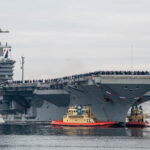
The successful landing on the future USS John F. Kennedy (CVN-79) marks a crucial technical step for the U.S. Navy’s next-generation aircraft carrier program. While the lead ship of the class, USS Gerald R. Ford (CVN-78), has been operational since 2017, its early deployments have primarily relied on air wings equipped with Boeing F/A-18E/F Super Hornets rather than regular F-35C integration.
The trials on the John F. Kennedy are designed to test the ship’s Advanced Arresting Gear (AAG) and Electromagnetic Aircraft Launch System (EMALS) under real operational conditions with stealth aircraft. Newport News Shipbuilding delivered the vessel for preliminary acceptance in late September following successful contractor sea trials, clearing the path for intensive flight deck certification events.
Integrating the F-35C onto Ford-class carriers has been a deliberate process, shaped by historical development delays associated with the ship’s novel electromechanical systems, including the AAG and Advanced Weapons Elevators. Naval aviation planners have scheduled formal delivery of the John F. Kennedy to align with ongoing evaluations of deck compatibility and catapult performance.
The F-35C features reinforced landing gear, folding wingtips, and a larger wing surface area compared to its Air Force (F-35A) and Marine Corps (F-35B) counterparts, specifically tailored for high-stress carrier arrested recoveries. During the recent trials in the Western Atlantic, test pilots from VX-23 evaluated the aircraft’s approach dynamics and recovery performance using the ship’s newly validated arresting infrastructure.
The incorporation of the F-35C into the Ford-class air wing structure is central to modernizing U.S. power projection capabilities. As peer adversaries continue to advance anti-access/area-denial (A2/AD) networks and long-range surface-to-air missile systems, the combination of a nuclear-powered Ford-class deck and low-observable strike fighters provides enhanced survivability and situational awareness.
The U.S. Navy plans to field hundreds of F-35Cs across its carrier air wings over the coming decades. However, completing the initial recovery trials is only the beginning of the operational clearance process. Fleet integration will require expanding the envelope to include high-weight maximum-effort catapult launches using EMALS, night operations, and heavy ordnance configurations before the carrier embarks on its maiden operational deployment.