Physical Address
304 North Cardinal St.
Dorchester Center, MA 02124
Physical Address
304 North Cardinal St.
Dorchester Center, MA 02124
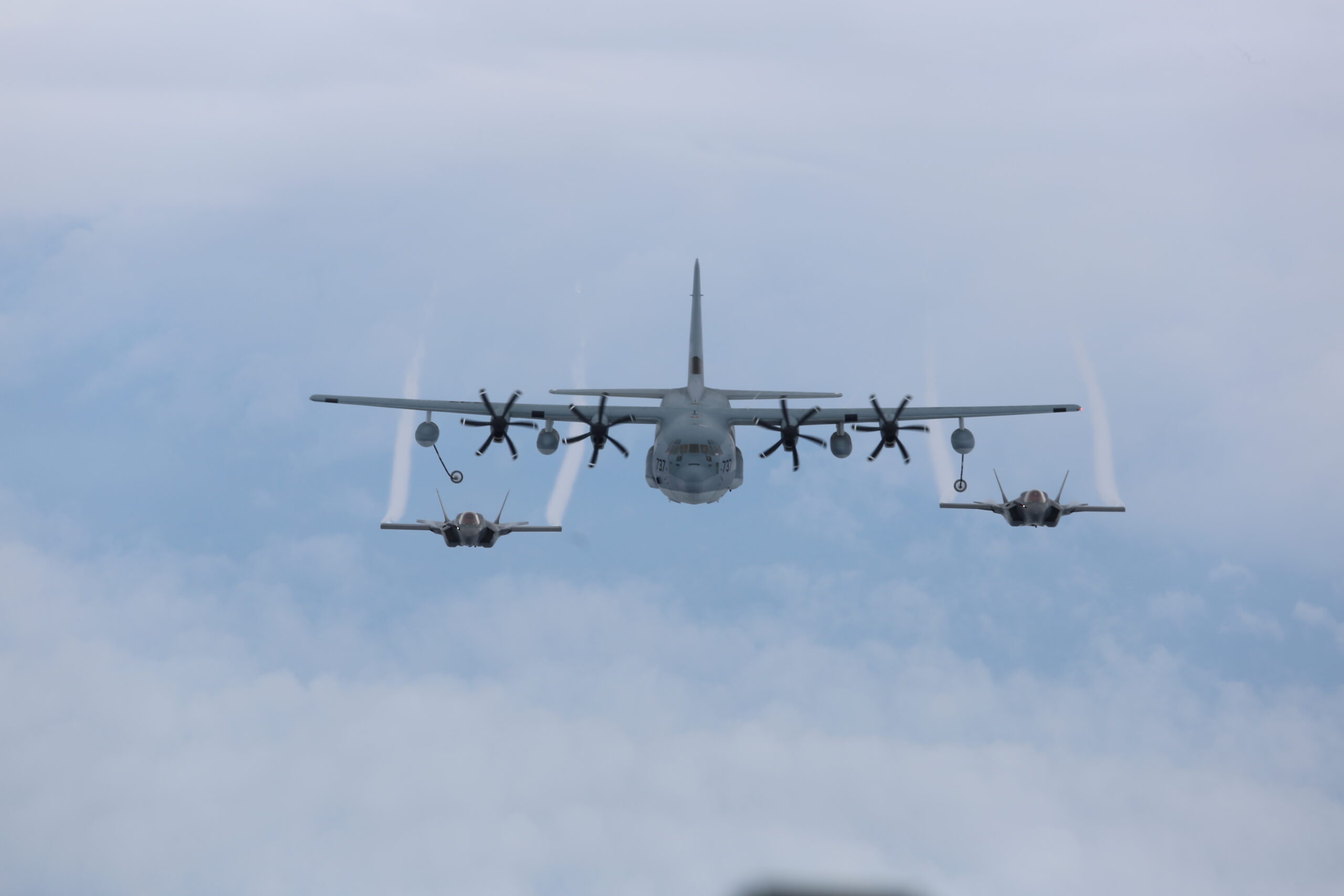
Military Sentinel, Washington – The U.S. Marine Corps has demonstrated a major operational leap in extending fifth-generation airpower across the Indo-Pacific, leveraging KC-130J Super Hercules aircraft to project F-35B combat reach across roughly 4,000 nautical miles during Operation Slingshot.
Details released by the 3rd Marine Aircraft Wing (3rd MAW) confirm that tactical tanker-transports established a rapid, island-hopping sustainment network from northern Australia through remote Pacific nodes to Hawaii. The deployment validates expeditionary logistics concepts designed to keep short takeoff and vertical landing (STOVL) strike fighters active far beyond static, heavily targeted airbases.
The 4,000-nautical-mile operational corridor does not alter the F-35B’s fixed combat radius. Rather, 3rd MAW demonstrated the capability to project, sustain, and regenerate fifth-generation sorties across strategic distances without depending on heavy strategic airlift or Air Force tanker infrastructure.
During Operation Slingshot, KC-130J crews leapfrogged forward of the strike elements, carrying aviation fuel, maintainers, critical parts, and ordnance. Upon landing at remote airfields, the turboprops served as self-contained logistics nodes, setting up Aviation-Delivered Ground Refueling (ADGR) points to rapidly service incoming F-35Bs before moving to the next objective.
F-35B Combat Radius (Internal Fuel): >450 nautical miles (approx. 833 km)
F-35B Ferry Range (Internal Fuel): >900 nautical miles
KC-130J Maximum Range: 4,275 nautical miles (with external fuel tanks)
KC-130J Maximum Fuel Capacity: 61,364 lbs
Primary Delivery Role: In-flight hose-and-drogue refueling and expeditionary ground-fuel transfer
The exercise tests core tenants of Expeditionary Advanced Base Operations (EABO) and the Marine Corps’ overarching modernization blueprint. Concentrated air hubs such as Kadena Air Base in Okinawa or Andersen Air Force Base in Guam sit well within range of adversary anti-ship and land-attack ballistic missile arsenals.
By distributing support tasks to tactical turboprops capable of touching down on austere, short, or damaged runways, the Marine Air-Ground Task Force (MAGTF) aims to dilute enemy targeting solutions. The network demonstrated that isolated locations—such as Wake Island and allied airfields in northern Australia—can be linked into flexible combat arteries rather than remaining vulnerable, fixed targets.
While Operation Slingshot underscores organic tactical independence, operating a distributed logistics web introduces operational risks. Sustained high-tempo sorties across 4,000 nautical miles remain dependent on unimpeded communications, theater-level force protection, secure maritime resupply, and diplomatic overflight clearances with allied host nations.
However, by successfully validating that the KC-130J can sustain fifth-generation assets in field conditions, the Marine Corps has established that tactical mobility assets can alleviate pressure on stressed joint-force strategic tankers like the KC-46A and KC-135. As Pacific defense postures shift toward rapid dispersal, agile sustainment networks will dictate how forward-deployed fighters maintain an active combat presence.

James Whitfield is a defense news writer at Military Sentinel, covering military technology, naval operations, military aviation, international security, and global defense developments. His work focuses on providing informative reporting, relevant context, and accessible explanations of modern military affairs and emerging defense technologies.
Contact: [email protected]