Physical Address
304 North Cardinal St.
Dorchester Center, MA 02124
Physical Address
304 North Cardinal St.
Dorchester Center, MA 02124
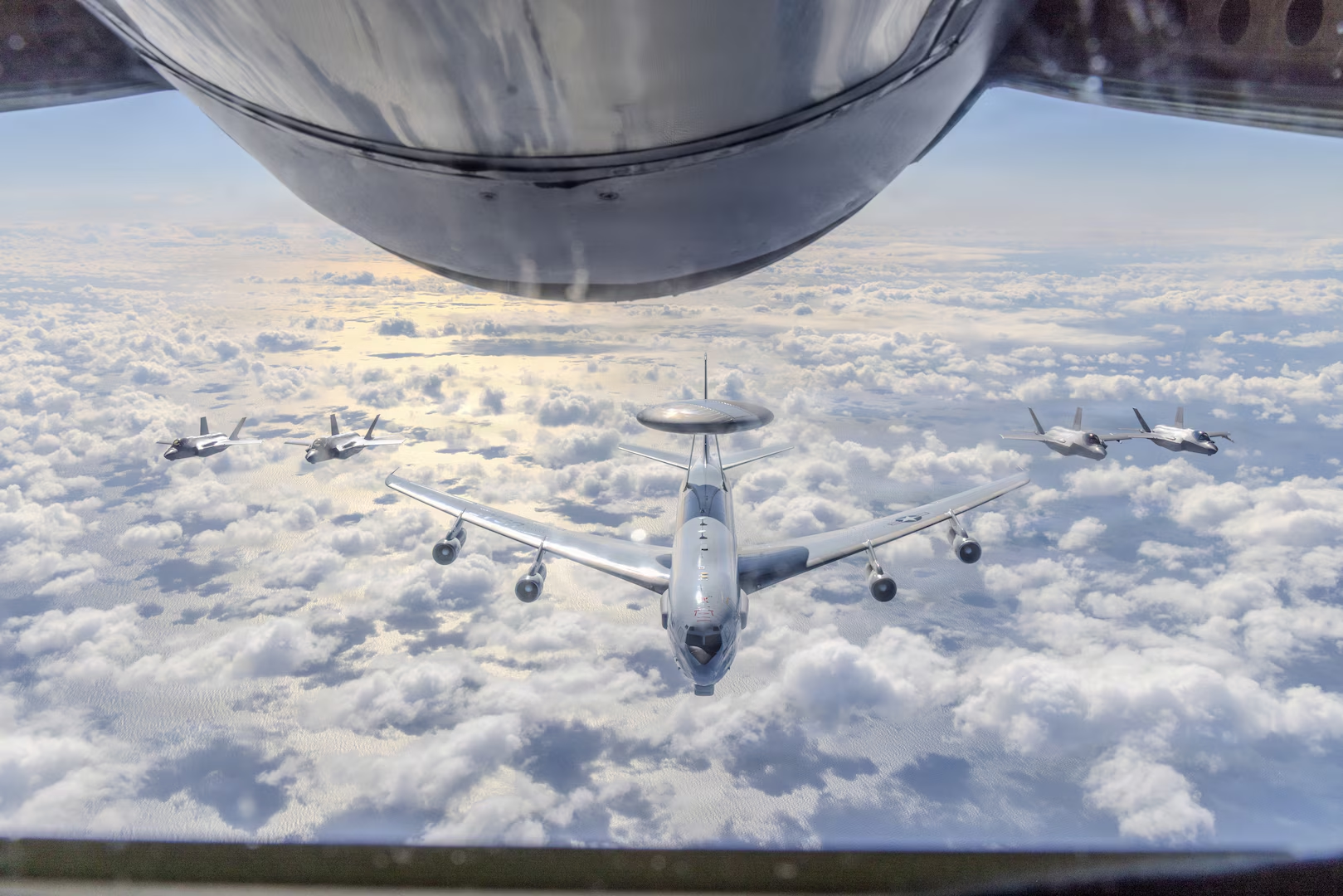
Military Sentinel, ANCHORAGE, Alaska – U.S. Air Force fifth-generation fighters and airborne early warning platforms conducted joint interoperability drills over the Bering Sea to validate multi-domain maritime strike capabilities across North America’s Arctic perimeter.
The tactical demonstration occurred during Operation TUNDRA MERLIN, a binational exercise executed between September 18 and 22 under the direction of U.S. Northern Command (USNORTHCOM) and Alaskan Command. The high-latitude drill brought together advanced strike assets, radar surveillance, tanker support, and naval surface platforms from both the United States and Canada.
The core element of the air demonstration featured Lockheed Martin F-35A Lightning II stealth multirole fighters operating alongside a Boeing E-3 Sentry Airborne Warning and Control System (AWACS). The high-value formation was sustained aloft by an Alaska Air National Guard KC-135 Stratotanker, which provided the persistent fuel margins required to operate across thousands of square miles of sub-Arctic airspace.
According to USNORTHCOM, the exercise exercised the complete maritime targeting cycle:
Find and Fix: Wide-area surveillance managed by the E-3 Sentry’s rotodome radar and distributed allied sensor nodes.
Track and Target: Relaying tactical target data through secure networks directly to fifth-generation platforms.
Engage and Assess: Executing simulated long-range stand-off maritime strikes using F-35A combat systems against designated naval threats.
The integration bridged the air and naval domains. The U.S. Coast Guard Cutter Stratton (WMSL-752) operated in concert with the Royal Canadian Navy Halifax-class frigate HMCS Ottawa (FFH 341), demonstrating integrated surface tracking and coordinated fire support.
The Bering Sea and the narrow Bering Strait represent a critical geopolitical chokepoint connecting the North Pacific Ocean to the Arctic Basin. Alaskan Command confirmed the exercise objective focused on sharpening collective domain awareness and cutting reaction times across northern approaches.
Pentagon leadership has repeatedly cited increasing strategic competition in the Arctic, emphasizing heightened Russian military infrastructure along the Northern Sea Route alongside growing Sino-Russian joint naval patrols in northern waters. Demonstrating networked interoperability via the F-35A and E-3 platforms signals to regional powers that North American defense networks can project air supremacy into remote border regions without friction.
While the F-35A brings low-observable stealth, advanced electronic warfare, and passive sensor fusion, operating in vast theaters like Alaska requires active battle management and persistent fuel endurance. The formation demonstrated how the legacy E-3 Sentry continues to act as an operational command bridge ahead of the planned fleet rollout of the Boeing E-7A Wedgetail.
As both the U.S. and Canadian armed forces expand fifth-generation fleets in northern bases, future iterations of TUNDRA MERLIN are anticipated to incorporate direct F-35 cross-talk with additional allied Arctic maritime assets.