Physical Address
304 North Cardinal St.
Dorchester Center, MA 02124
Physical Address
304 North Cardinal St.
Dorchester Center, MA 02124

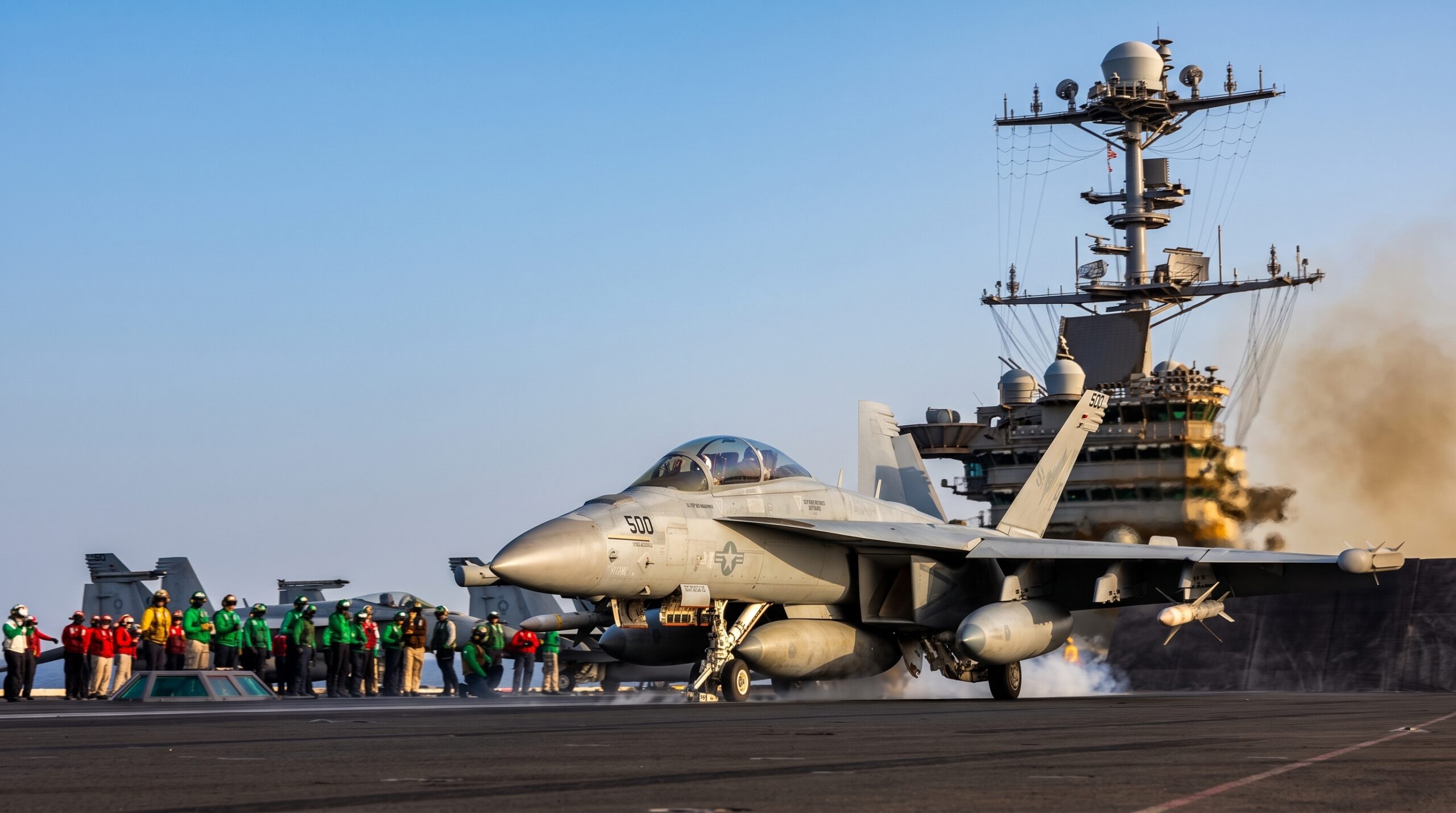
Military Sentinel, Washington – The U.S. Navy has awarded General Dynamics Mission Systems a contract valued at up to $184.25 million to transition the Next Generation Electronic Attack Unit into full-rate production, equipping the Boeing EA-18G Growler fleet with advanced onboard processing to counter dense adversary air defense radar environments.
The sole-source, indefinite-delivery/indefinite-quantity (IDIQ) contract combines firm-fixed-price and cost-plus-fixed-fee provisions. Managed by the Naval Surface Warfare Center Crane Division in Indiana, manufacturing and sustainment activities will take place at General Dynamics Mission Systems’ facility in Bloomington, Minnesota, through September 2032.
The contract structure covers key manufacturing and long-term sustainment benchmarks:
Initial Obligation: $40,056,987 allocated at award, drawn from fiscal 2026 ($29,691,536) and fiscal 2025 ($10,365,451) aircraft procurement funds.
Ceiling Value: Up to $184.25 million across the lifespan of the ordering period.
System Scope: Full-rate production of the Next Generation Electronic Attack Unit (NGEAU) and lifecycle support for the aircraft’s Advanced Capability Mission Computer.
Prime Integration Context: Supplements Boeing’s earlier $95.9 million integration and hardware kit effort, which manufactured 25 NGEAU A-Kits and associated gunbay pallets for developmental and operational flight evaluations.
While airborne electronic attack often centers on externally mounted jamming pods, the EA-18G Growler NGEAU functions as internal processing architecture integrated directly into the jet’s forward fuselage.
The system operates within the broader Growler Block II upgrade ecosystem, interfacing directly with the aircraft’s Northrop Grumman AN/ALQ-218 Airborne Electronic Attack System receiver suite.
By decoupling signal identification and digital resource assignment from older hardware limits, the NGEAU gives the crew automated, low-latency target classification. This internal computing upgrade works concurrently with external pod acquisitions, where the Navy is replacing legacy AN/ALQ-99 tactical jamming pods with Raytheon’s AN/ALQ-249 Next Generation Jammer Mid-Band (NGJ-MB) and the emerging Low-Band (NGJ-LB) increments.
As peer adversaries deploy highly agile, software-defined integrated air defense systems (IADS) and multi-static radars, standard emitter databases quickly become saturated. The NGEAU provides the computing throughput needed to process, deconflict, and jam uncharacterized or frequency-hopping waveforms in real time.
This milestone solidifies the electronic backbone that will support carrier strike groups well into the 2030s. By standardizing advanced onboard digital attack units across the fleet, naval air wings will maintain a viable electronic suppression envelope over contested airspace until sixth-generation Next Generation Air Dominance (NGAD/F/A-XX) family-of-systems platforms enter service.