Physical Address
304 North Cardinal St.
Dorchester Center, MA 02124
Physical Address
304 North Cardinal St.
Dorchester Center, MA 02124

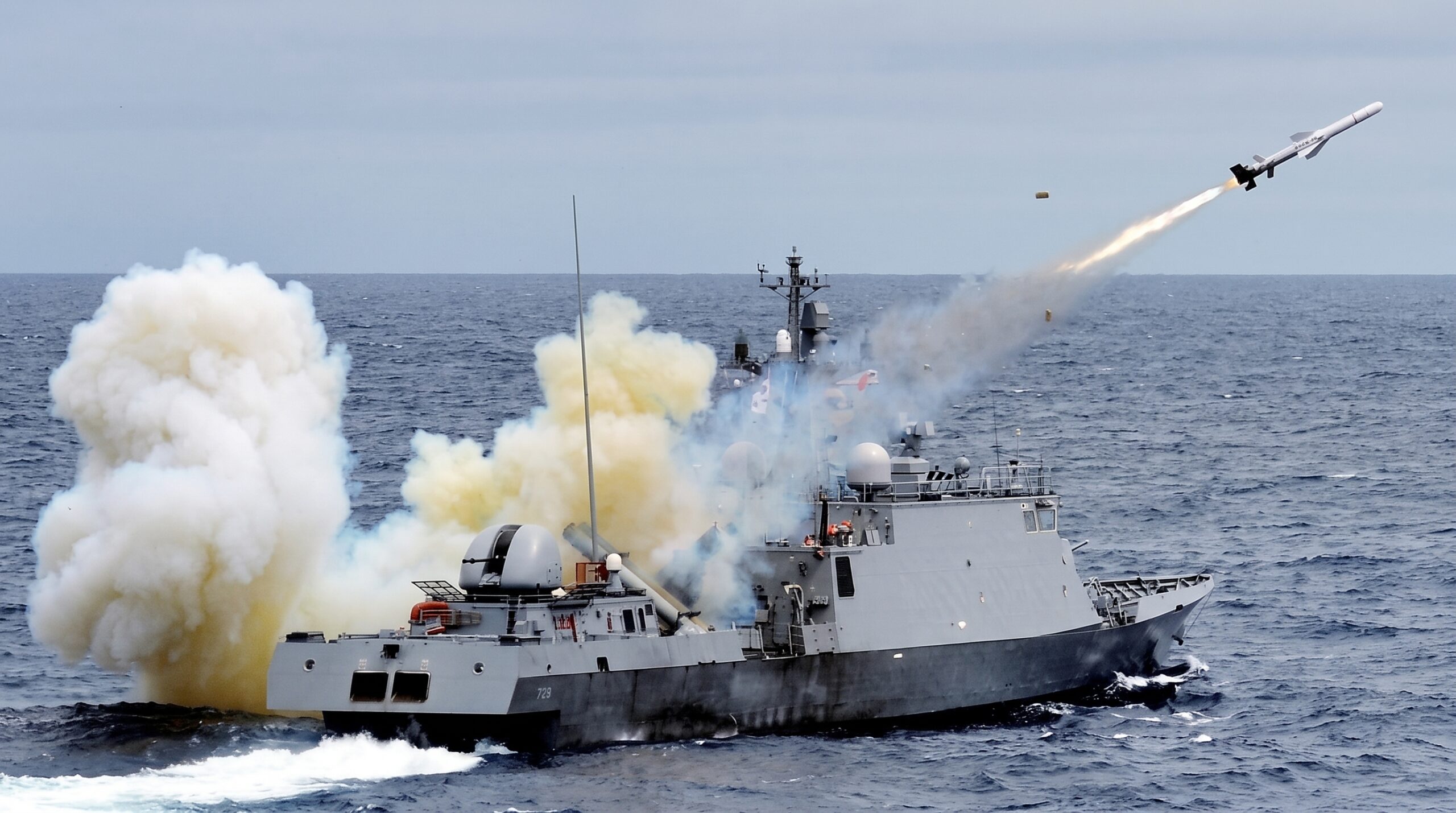
Military Sentinel, Seoul – South Korea has officially approved an estimated $1.1 billion development and procurement program for a next-generation anti-ship missile designed to double the strike reach of its future surface combatants.
The program was cleared during a session of the Defense Project Promotion Committee, according to defense reports citing South Korea’s Defense Acquisition Program Administration (DAPA). Designated the Ship-to-Ship Missile-II, the project aims to replace aging legacy munitions with a low-observable, extended-range weapon tailored for the Republic of Korea Navy’s (ROKN) planned KDDX destroyers.
The Ship-to-Ship Missile-II program spans from 2028 through 2039 with an estimated budget of 1.5 trillion won (~$1.1 billion). The development cycle is scheduled to run between 2028 and 2033 under the stewardship of the state-run Agency for Defense Development (ADD).
Following the initial development phase, mass production is slated to commence in 2034. Domestic defense primes, including LIG Nex1 and Hanwha Aerospace, are expected to manufacture the airframes, propulsion systems, and guidance units.
Primary launch platforms will include both Batch-I and Batch-II variants of the forthcoming KDDX stealth destroyers, integrating the new missile into standard vertical launching cells or specialized canister banks.
The development effort directly addresses the range constraints of the ROKN’s current frontline anti-ship missile, the SSM-700K Haeseong (C-Star), which operates out to roughly 150–180 km.
The Ship-to-Ship Missile-II program introduces key propulsion and survivability enhancements:
Operational Range: 300–360 km (substantially doubling Haeseong’s capability)
Propulsion: High-efficiency turbofan engine (replacing the older turbojet)
Flight Profile: Subsonic, high-density sea-skimming capability
Airframe Design: Low-observable (stealth) shaping to reduce radar cross-section (RCS)
Lead Developer: Agency for Defense Development (ADD)
Lead Platforms: KDDX Batch-I and Batch-II destroyers
By switching from a turbojet to a fuel-efficient turbofan engine, engineers can achieve greater operational standoff without ballooning the missile’s external dimensions. Combined with radar-absorbent materials and faceted surface geometries, the weapon is optimized to penetrate advanced naval air defense suites.
Seoul’s push for longer-range naval strike weapons reflects changing naval dynamics across Northeast Asia.
While the ROKN previously focused on littoral containment against North Korean patrol boats, Pyongyang has recently invested in larger, heavily armed surface combatants—such as the projected 5,000-ton Choe Hyon and Kang Kon classes. A 300+ km engagement envelope enables South Korean destroyers to strike adversary ships from outside the umbrella of shore-based coastal defense cruise missiles (CDCMs).
Furthermore, the capability enhances the ROKN’s strategic deterrent posture across contested maritime boundaries in the East Sea and Yellow Sea, providing blue-water destroyers with an indigenous anti-ship standoff weapon comparable to Western systems like the American AGM-158C LRASM and European naval cruise missiles.