Physical Address
304 North Cardinal St.
Dorchester Center, MA 02124
Physical Address
304 North Cardinal St.
Dorchester Center, MA 02124
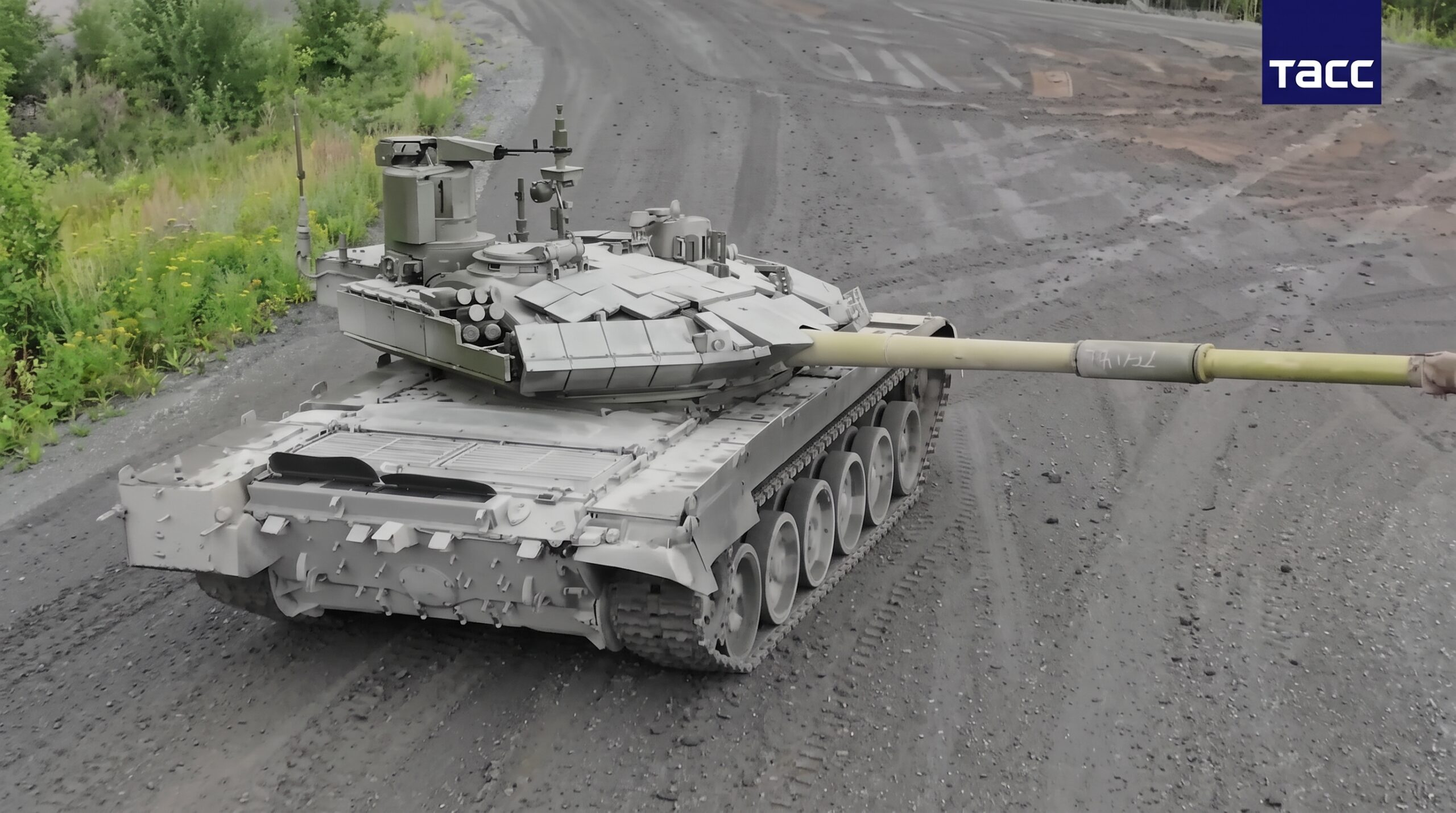
Military Sentinel, Moscow – Russian state-owned defense manufacturer Uralvagonzavod has delivered new consignments of T-90M and T-72B3M tanks to the Russian Ground Forces ahead of Tanker’s Day, underscoring Moscow’s push to replace attritional armored losses with heavily upgraded combat vehicles.
The shipment, announced by Uralvagonzavod’s parent conglomerate Rostec, consists of both newly manufactured platforms and overhauled legacy hulls. While the Russian Ministry of Defense did not disclose the precise number of vehicles in the batch, officials confirmed the armor includes survivability packages adapted directly from combat feedback in Ukraine.
The newly fielded tanks feature comprehensive all-aspect passive and active defensive modifications aimed at countering First-Person View (FPV) loitering munitions and top-attack precision threats.
T-90M ‘Proryv’: The batch represents Russia’s premier serial-production main battle tank (MBT), combining the 2A46M-5 125mm smoothbore gun, the Kalina automated fire-control system, integrated Relikt explosive reactive armor (ERA), and factory-fitted counter-drone wire mesh and electronic jamming modules.
T-72B3M: Modernized from existing Soviet-era hulls, this variant serves as a high-volume complement, incorporating Sosna-U multi-channel sights, an upgraded V-92S2F 1,130-horsepower engine, and enhanced turret bustle protection.
According to a Rostec press release, engineers implemented close to 200 minor and major modifications across both production lines over the past three years to harden sensitive areas, including engine-transmission decks and turret rings.
The simultaneous rollout of new T-90M and T-72B3M tanks highlights Moscow’s two-pronged industrial approach to armored fleet regeneration. Heavy battlefield attrition has compelled Russia to rely heavily on refurbished equipment pulled from deep storage reserves. However, as the most viable reserve hulls are consumed, storage depot yields inevitably diminish.
Modernizing T-72 platforms delivers vital numerical mass at lower production costs and shorter turnaround times. Concurrently, expanding the greenfield manufacture of T-90M hulls at Uralvagonzavod’s Nizhny Tagil facility is designed to establish a steady baseline of modern armor independent of legacy inventory constraints.
Western export controls and targeted sanctions were originally intended to strangle Russia’s high-tech manufacturing sector, particularly regarding microelectronics and optics. Continued regular deliveries demonstrate that Russian industrial supply chains have largely adjusted via domestic substitutions and third-party imports.
If Russia sustains this cadence of fresh T-90M manufacturing alongside active forward-depot vehicle repairs, the Russian Army could transition from relying on depleting Soviet-era storage to an industrially sustainable armored footprint. This shift poses long-term planning challenges for NATO planners assessing attrition rates and armored force ratios in Eastern Europe.