Physical Address
304 North Cardinal St.
Dorchester Center, MA 02124
Physical Address
304 North Cardinal St.
Dorchester Center, MA 02124

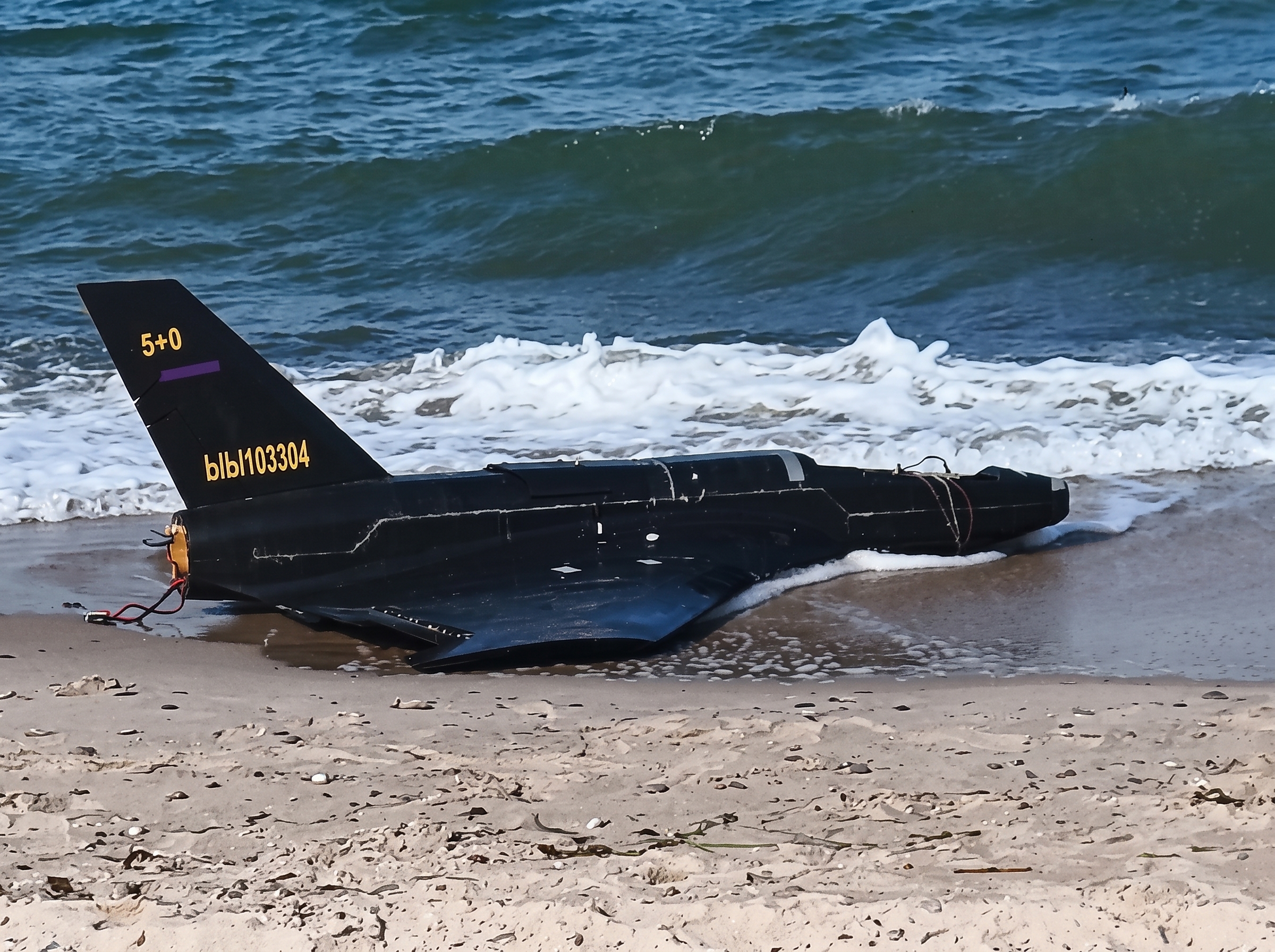
Military Sentinel, Warsaw – Polish defense officials and prosecutors confirmed that a downed Russian drone recovered along northern Poland’s Baltic coast carried an active high-explosive warhead fitted with a detonator, marking a serious escalation in airspace violations along NATO’s eastern frontier.
The unmanned aerial vehicle washed ashore near the coastal village of Rusinowo, located close to Jarosławiec in West Pomeranian Voivodeship. Military bomb disposal technicians deployed immediately to secure the wreckage. Due to the volatility of the unexploded ordnance, explosive ordnance disposal (EOD) specialists separated the payload from the airframe and conducted a controlled detonation directly on the beach.
The discovery dispels initial assessments that the platform may have been a stripped-down navigational stray or an unarmed training variant.
Military prosecutors and defense analysts identified the wreckage as a Russian Gerbera-2 unmanned aircraft. First introduced into Russian operational service as a lower-cost complement to the Shahed-136/Geran-2 series, the foam-and-composite delta platform typically serves in three configurations:
Reconnaissance & Electronic Warfare: Designed to locate air defense batteries and relay signal telemetry.
Decoy/Distraction: Built to bait ground-based interceptor radars and deplete air defense missile inventories.
Strike (Kamikaze): Outfitted with an internal high-explosive fragmentation (HE-FRAG) warhead and impact detonator for direct kinetic attack.
While Gerberas recovered over Ukraine often lack strike payloads frequently flying as unarmed decoys packed with acoustic lenses or basic transmitters the Polish recovery confirms that combat-armed strike variants are actively maneuvering in the Baltic littoral.
Col. Bartosz Okoniewski, deputy district prosecutor for military affairs at the Poznań District Prosecutor’s Office, confirmed the presence of the live charge. “The drone carried a high-explosive fragmentation warhead fitted with a detonator,” Okoniewski stated, adding that the airframe has been transported to a specialized military installation for forensics. Polish prosecutors opened a formal investigation into unauthorized border airspace breach and actions that created a public safety hazard.
Polish Deputy Prime Minister and Minister of National Defense Władysław Kosiniak-Kamysz detailed the probable flight track, stating that the drone likely crossed from Lithuania through the Russian Kaliningrad exclave before diverting over the Baltic Sea. Initial intelligence indicates the aircraft may have drifted off course during electronic jamming or Russian testing exercises originating from Kaliningrad, though offensive targeting errors have not been ruled out. Poland and Lithuania confirmed they are conducting a joint investigation into the route and guidance anomalies of the platform.
The incident adds mounting pressure on NATO’s Baltic Air Policing and integrated air-and-missile defense network. Similar uncrewed strays and cruise missile incursions have challenged the border peripheries of Romania, Moldova, and the Baltic States.
The fact that the Gerbera was armed raises the operational stakes for the alliance. Unarmed decoy intrusions present an interception dilemma regarding missile economy; however, an armed loitering munition represents an immediate kinetic danger to civilian infrastructure and military installations. Western defense planners face increasing calls to establish forward-deployed intercept protocols and lower threshold rules of engagement to neutralize low-flying, low-radar-cross-section threats before they penetrate allied sovereign airspace.