Physical Address
304 North Cardinal St.
Dorchester Center, MA 02124
Physical Address
304 North Cardinal St.
Dorchester Center, MA 02124


Military Sentinel, Brussels – Moscow has issued a formal warning to NATO that it is prepared to employ its entire military arsenal, explicitly including nuclear weapons, should Western allies attempt to isolate the heavily fortified Russian exclave of Kaliningrad.
The warning, circulated to Western capitals via a diplomatic “non-paper,” marks a sharp escalation in regional saber-rattling across the Baltic Sea theater. The communication warned that any attempt to cut off transit or blockade Kaliningrad—situated along the Baltic coast between Poland and Lithuania would be met with direct strikes against allied command-and-control infrastructure.
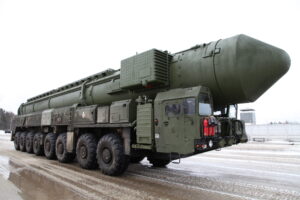
The diplomatic text explicitly states that Russia reserves the option “of Russian strikes against decision-making centers in the alliance’s member states right from the outset of the conflict” if access to the exclave is compromised.
Kaliningrad serves as the operational headquarters for the Russian Navy’s Baltic Fleet and remains Moscow’s only year-round, ice-free Baltic port. Over the last decade, Russia has transformed the territory into a forward-operating bastion equipped with layered anti-access/area-denial (A2/AD) capabilities.
Western intelligence officials and regional analysts monitor Kaliningrad closely for dual-capable strike assets, including:
9K720 Iskander-M (SS-26 Stone): Road-mobile short-range ballistic missile systems with a declared operational range of up to 500 kilometers, capable of firing conventional or tactical nuclear warheads.
K-300P Bastion-P: Coastal defense missile batteries employing supersonic P-800 Oniks anti-ship cruise missiles.
Integrated Air Defense: Layered batteries of S-400 Triumf and S-300V4 long-range surface-to-air missile systems, supported by short-range Pantsir-S1 units.
While Russian diplomatic missions maintain that Moscow harbors no hostile intent toward NATO member states, they reiterate that any disruption of overland rail or road transit across EU territory to Kaliningrad represents a red line.
NATO leadership pushed back swiftly against the rhetoric, categorizing the diplomatic salvo as an attempt to coerce Western defense policy through intimidation.
“We have sent a response, noting that NATO is a defensive alliance and none of our activities or exercises pose a risk to any part of Russia,” an alliance spokesperson stated in Brussels. “We strongly denounce the threat of force, including any irresponsible nuclear rhetoric”.
A senior European defense official noted that the explicit, written invoking of preemptive nuclear strikes against alliance command nodes represents a level of brinkmanship not observed since the height of the Cold War. Allied officials maintain that enhanced posture along the Suwałki Gap the narrow land corridor connecting Poland and Lithuania remains purely defensive.
The exchange unfolds against a broader wave of European accusations detailing Russian hybrid operations, including suspected sabotage against Baltic undersea critical infrastructure and cross-border GPS jamming across commercial aviation corridors.
The latest warning underscores the extreme friction points generated by the shifting security architecture of the Baltic Sea. With Sweden and Finland now fully integrated into NATO planning, Russia views its Kaliningrad outpost as increasingly vulnerable to containment.
As NATO prepares for subsequent rotational deployments to the Baltics and refines its Eastern Flank Deterrence Line, Moscow’s lowering of the verbal threshold for nuclear engagement indicates that tactical readiness exercises inside Kaliningrad will face intensified surveillance by Western reconnaissance assets. Future friction over commercial transit quotas or regional maritime airspace is now poised to carry direct, strategic deterrence implications.