Physical Address
304 North Cardinal St.
Dorchester Center, MA 02124
Physical Address
304 North Cardinal St.
Dorchester Center, MA 02124

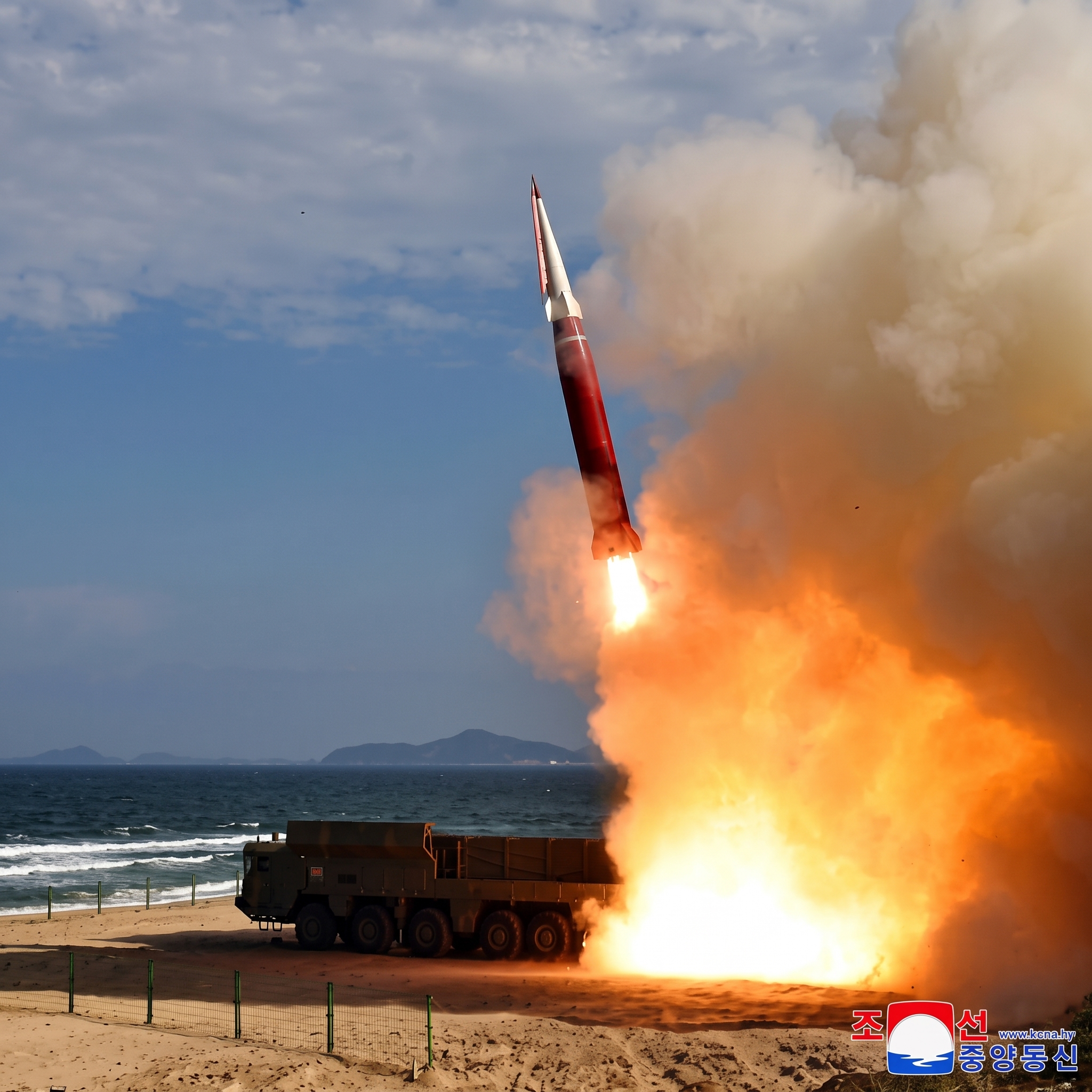
Military Sentinel, SEOUL – North Korea launched an advanced developmental ballistic missile carrying a suspected hypersonic glide vehicle into the Sea of Japan, signaling accelerating efforts by Pyongyang to field survivable, low-altitude weapons capable of defeating regional missile shield architectures.
The launch took place early Wednesday morning from an inland site near Pyongyang, according to initial tracking data released by South Korea’s Joint Chiefs of Staff (JCS). Japanese defense officials confirmed the projectile flew on a non-standard, depressed trajectory before splashing down outside Japan’s Exclusive Economic Zone (EEZ).
South Korean and Japanese radar networks closely tracked the test to determine whether the booster achieved sustained hypersonic separation. State media, via the Korean Central News Agency (KCNA), subsequently reported that the test validated the flight reliability and atmospheric glide-maneuver capabilities of a new solid-fueled booster paired with a hypersonic glide vehicle (HGV) warhead.
Defense analysts noted key flight metrics recorded during the evolution:
Estimated Range: Approximately 600 to 1,000 kilometers
Apogee: Capped between 30 and 60 kilometers, significantly lower than standard ballistic arcs
Propulsion Type: Multi-stage, high-thrust solid-propellant motor
Payload Characteristics: Wedge-shaped or conical hypersonic glide vehicle capable of pull-up maneuvers
Unlike conventional ballistic missiles that fly in a predictable Keplerian parabolic arc, hypersonic glide vehicles decouple from their booster stages at lower altitudes. By skipping and gliding along upper atmospheric layers, they make trajectory forecasting far more difficult for ground- and sea-based interceptor radars.
Officials across the Indo-Pacific condemned the launch as an escalation and a breach of binding United Nations Security Council resolutions.
“Our military maintains a full readiness posture while closely sharing North Korean ballistic missile data with United States and Japanese authorities,” South Korea’s JCS said in an official briefing.
A spokesperson for the U.S. Indo-Pacific Command reaffirmed Washington’s ironclad commitments: “We are aware of the ballistic missile launch and are consulting closely with our allies and partners. While we assess this event does not pose an immediate threat to U.S. personnel or territory, it highlights the destabilizing impact of the DPRK’s illicit weapons program.”
Defense officials in Tokyo indicated that the Japanese Maritime Self-Defense Force deployed Aegis-equipped destroyers to monitor telemetry and coordinate tracking data in real time with allied nodes.
Pyongyang’s persistent pivot toward solid-fuel propulsion combined with maneuverable hypersonic warheads presents an operational dilemma for allied militaries. Solid-fuel motors eliminate the lengthy fueling operations required by older liquid systems, drastically shortening launch-preparation times and reducing pre-launch detection windows for allied reconnaissance assets.
Furthermore, weapons that maneuver unpredictably in the mid-to-terminal phase directly target gaps between upper-tier defenses like Terminal High Altitude Area Defense (THAAD) and point defenses such as the Patriot PAC-3. As regional adversaries develop increasingly layered hypersonic inventories, the U.S. Navy and its partners face mounting pressure to accelerate distributed sensor networks, space-based tracking constellations, and dedicated glide-phase interceptor capabilities.