Physical Address
304 North Cardinal St.
Dorchester Center, MA 02124
Physical Address
304 North Cardinal St.
Dorchester Center, MA 02124
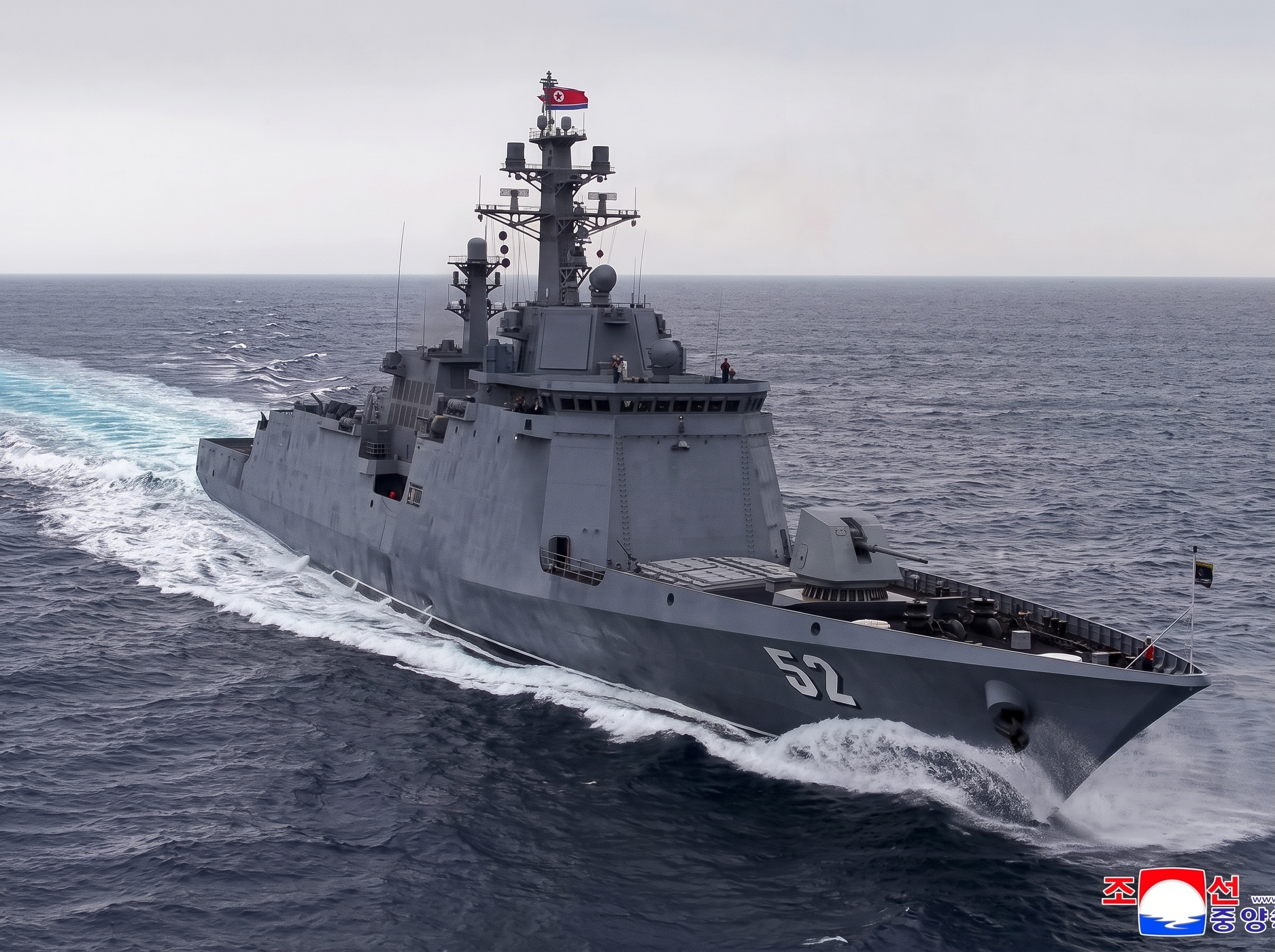
Military Sentinel, Wonsan – North Korea commissioned its second Choe Hyon-class guided-missile destroyer, the Kang Kon (52), at Wonsan on September 6, 2026, assigning the nuclear-capable warship to the East Sea Fleet roughly sixteen months after a botched launch left the hull damaged at Chongjin.
The Kang Kon’s path to service was unusually rocky. During a lateral (broadside) launch at Chongjin on May 21, 2025, the roughly 5,000-ton hull lost balance as its stern entered the water ahead of the bow, damaging the underside and leaving the ship partly capsized. Workers righted the vessel and moved it to the Rason/Rajin area for repair, but restoring buoyancy did not restore combat readiness that process took considerably longer.
According to Army Recognition’s reporting, which draws on imagery and statements attributed to North Korea’s Ministry of Defense, sea trials under the ship’s own power did not begin until June 4, 2026. Weapons and sensor testing followed on July 3, including the 127mm main gun, automatic cannon, and electronic warfare systems, culminating in twelve consecutive cruise-missile launches from the vertical launch system (VLS). Kim Jong Un reportedly assigned the ship to North Korea’s “state nuclear response system” following those July trials.
The Kang Kon now serves opposite its sister ship, the Choe Hyon (51), which was commissioned June 23, 2026, and assigned to the West Sea Fleet — splitting North Korea’s two most advanced surface combatants across its eastern and western coasts.
Per the cited reporting, the Kang Kon’s weapons fit includes:
Total shipboard missile capacity is cited at 104 across the VLS, inclined launchers, and short-range mounts, with an additional 212 decoy, torpedo, and anti-submarine positions. The ship has a stern flight deck but no enclosed hangar, limiting it to temporary embarked use of compact helicopter types rather than sustained aviation operations.
North Korea has stated a minimum target of two Choe Hyon-class or more advanced combatants per year under its current five-year defense program — a pace that, if sustained, would produce roughly a dozen destroyer-class ships within five years. A third hull is reportedly under construction at Nampo, with additional work underway at Chongjin.
Analysts have also noted a larger, roughly 10,000-ton cruiser-class successor and a separate nuclear-powered submarine program reportedly in parallel development. Sustaining either program would require expanded deep-water basing, missile-loading infrastructure, and trained crews — investments that would themselves be observable indicators of how seriously Pyongyang is pursuing the stated production tempo.