Physical Address
304 North Cardinal St.
Dorchester Center, MA 02124
Physical Address
304 North Cardinal St.
Dorchester Center, MA 02124

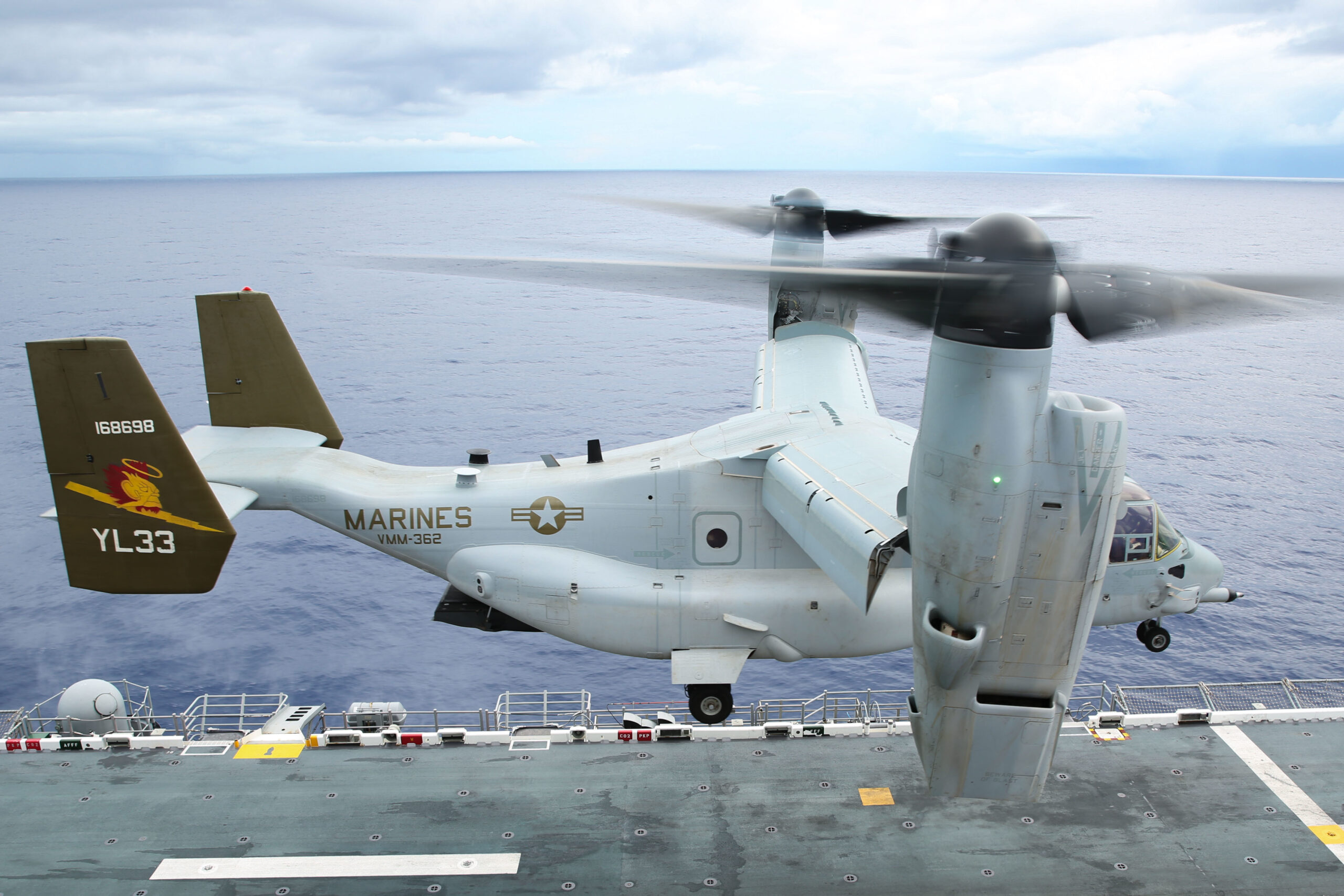
Military Sentinel, Washington – The U.S. Navy and Marine Corps have successfully demonstrated manual sonobuoy deployment from an MV-22B Osprey, qualifying the tiltrotor platform to support the military’s undersea sensor testing pipeline and expanding operational options for fleet anti-submarine warfare.
The trial, conducted off San Clemente Island, California, marked the first lot acceptance test of production sonobuoys launched from an MV-22B. The milestone established an alternative delivery platform to verify acoustic sensor performance while laying the groundwork for broader expeditionary undersea warfare missions.
The evolution brought together three key defense organizations:
Air Anti-Submarine Warfare Systems Program Office (PMA-264): Manages the Navy’s Sonobuoy Quality Assurance Program to validate sensor acoustic metrics before frontline delivery.
V-22 Joint Program Office (PMA-275): Coordinates airframe integration and tactical employment envelopes across the services.
Marine Operational Test and Evaluation Squadron 1 (VMX-1): Provided the operational aircrew and test execution framework.
Historically, the Navy relied on P-3C Orion aircraft equipped with automated pneumatic launch tubes to execute quality-assurance drops. During the San Clemente Island test, VMX-1 crew chiefs manually deployed sonobuoys from the Osprey’s open rear cargo ramp into the slipstream.
Because manual deployment produces slower drop intervals than automated carousel systems, pilots throttled back airspeed and timed releases precisely to match acoustic array spacing requirements.
“Developing repeatable procedures for manual sonobuoy deployment gives us a solid baseline for future tiltrotor support to anti-submarine warfare,” said Marine Corps Lt. Col. Brandon Pope, VMX-1 advanced projects lead.
Navy Capt. Greg Hinkle, program manager for PMA-264, emphasized that integrating the MV-22B into lot acceptance tests removes single-point-of-failure risks in the acoustic sensor supply chain, preventing quality assurance backlogs from stalling frontline deliveries.
While the trial was primarily designed to support sensor procurement assurance, the operational implications are significant for distributed maritime operations across the Indo-Pacific and North Atlantic.
The Osprey offers a unique middle ground between conventional maritime patrol platforms:
Speed and Range: Cruising at over 260 knots with a combat radius exceeding 400 nautical miles, the MV-22B covers ocean transit distances far quicker than traditional MH-60R Seahawk helicopters.
Runway Independence: Unlike fixed-wing P-8A Poseidon maritime patrol aircraft, the tiltrotor operates from amphibious assault ships (LHD/LHA), expeditionary sea bases, and austere island outposts.
The MV-22B is not currently slated to operate as an independent submarine hunter equipped with acoustic processing suites or torpedoes. Instead, military planners envision tiltrotors acting as rapid-response sensor deployment nodes. An Osprey could dash ahead to seed acoustic barriers across chokepoints, allowing shipboard combat direction systems or orbiting P-8As to monitor submarine movements without burning fixed-wing station time.
PMA-264 and PMA-275 are analyzing acoustic performance data gathered during the drop to standardize release profiles across varying sea states.
If tactics, techniques, and procedures mature, the Navy and Marine Corps could eventually test palletized or automated internal sonobuoy dispensers, expanding the Osprey’s multi-mission utility into expeditionary sea denial.