Physical Address
304 North Cardinal St.
Dorchester Center, MA 02124
Physical Address
304 North Cardinal St.
Dorchester Center, MA 02124


Military Sentinel, Kobe – Shipbuilder Kawasaki Heavy Industries has launched JS Shogei, the seventh Taigei-class diesel-electric attack submarine developed for the Japan Maritime Self-Defense Force. The ceremony took place at the company’s shipyard in Kobe, marking another major milestone in Tokyo’s ongoing program to upgrade its undersea fleet with domestically engineered conventional submarines powered by advanced lithium-ion energy storage systems.
The vessel, whose name translates to “Soaring Whale,” represents the latest evolution of Japan’s post-Soryu submarine architecture. By systematically integrating high-capacity lithium-ion battery modules, specialized sonar processing arrays, and signature-reduction technologies, the class enhances the maritime force’s capacity to conduct sustained covert surveillance and deterrence across disputed waters in the East China Sea and western Pacific approaches.
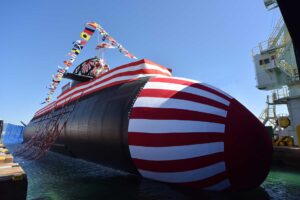
The launch event at Kobe gathered senior officials from the Japan Ministry of Defense and Maritime Self-Defense Force leadership alongside industrial executives from Kawasaki Heavy Industries. JS Shogei is the fourth submarine of the class built at the Kobe facility, with alternate hulls assembled nearby by Mitsubishi Heavy Industries under Tokyo’s split-yard procurement model.
Following its launch into the water, JS Shogei enters an intensive fitting-out phase at the shipyard. The vessel is scheduled to undergo extensive builder sea trials, acoustic testing, and sensor-integration runs before its anticipated formal commissioning into operational service in March 2027. Construction costs for the platform are estimated at approximately 70 billion yen (roughly $470 million), in line with previous budgetary allocations authorized by the Japanese legislature.
The hallmark of the Taigei class is its reliance on lithium-ion batteries rather than the Stirling-cycle Air-Independent Propulsion systems used in earlier Soryu-class boats. Manufactured by GS Yuasa, these battery banks offer substantially higher energy density and faster recharge rates from diesel generators, allowing the platform to maintain higher underwater burst speeds and operate submerged for longer durations without having to snorkel.
Beyond propulsion improvements, the submarine incorporates a fiber-optic hydrophone array integrated with the OYX-1 combat management system and the ZQQ-8 sonar suite. These systems process acoustic signatures across broader frequency spectra, improving detection capabilities in complex littoral and deep-trench acoustic environments. Floating deck structures mounted on anti-vibration dampers, combined with an optimized acoustic coating along the hull, further suppress operational machinery noise.
For weapons employment, JS Shogei features six standard 533mm bow-mounted torpedo tubes. The submarine is outfitted to fire the domestically produced Type 18 heavyweight wire-guided torpedo, which offers improved guidance countermeasures over the older Type 89, as well as the sub-surface launched UGM-84 Harpoon anti-ship missile. Japan also plans to field long-range strike capabilities on future submarine variants, which could include containerized cruise missiles as Tokyo expands its standoff defense doctrine.
Japan initiated the Taigei program to maintain a standard 22-boat active submarine fleet, a force-structure requirement established under earlier National Defense Program Guidelines. The lead vessel, JS Taigei, was laid down in 2018 and commissioned in 2022 before transitioning into a dedicated experimental testbed platform to evaluate upcoming naval sensors and weapon concepts.
Subsequent vessels—including Hakugei, Jingei, Raigei, Chogei, and now Shogei—have entered the operational pipeline on a regular, one-boat-per-year production schedule. This steady procurement rhythm ensures continuous industrial capacity at both Kawasaki and Mitsubishi yards while iteratively incorporating incremental software, composite structural improvements, and quieter diesel generators into each subsequent hull.
The steady expansion of the Taigei fleet comes amid intensifying regional maritime security concerns, particularly persistent naval and coast guard activity around the Senkaku Islands and the First Island Chain chokepoints. With regional adversaries expanding their conventional and nuclear-powered submarine fleets, silent diesel-electric boats optimized for acoustic interception provide crucial advantages in restricted maritime corridors such as the Miyako Strait and the Bashi Channel.
JS Shogei will soon begin dockside propulsion testing and open-water sea trials to validate its lithium-ion power management system under realistic sea states. As the Maritime Self-Defense Force prepares to integrate the boat into active sub-surface flotillas in 2027, Japanese defense planners are already moving forward with requirements for subsequent hulls in the class, reinforcing Tokyo’s underwater deterrence posture through the end of the decade.