Physical Address
304 North Cardinal St.
Dorchester Center, MA 02124
Physical Address
304 North Cardinal St.
Dorchester Center, MA 02124
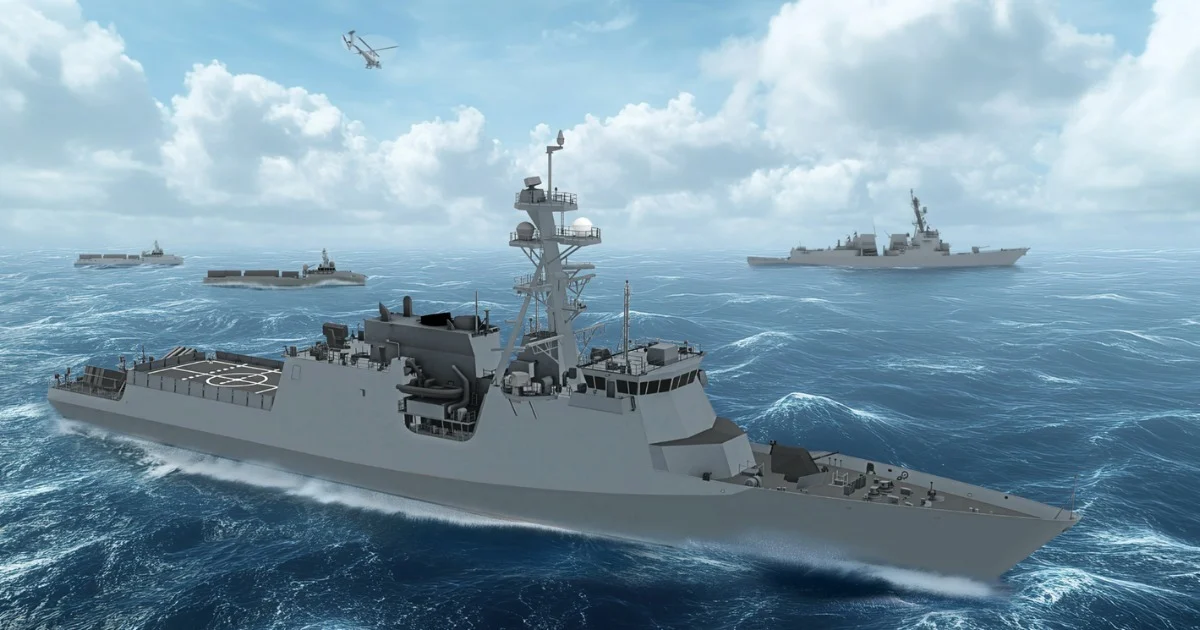
Military Sentinel, Washington – The U.S. Navy is moving forward with Huntington Ingalls Industries’ FF(X) patrol frigate design even as service leadership actively weighs allied foreign options to bridge an escalating surface combatant deficit. Following the truncation of the troubled Constellation-class (FFG-62) guided-missile frigate program, naval leadership is pursuing a dual-track strategy to place small surface combatants into the water rapidly while managing industrial base constraints.
The FF(X) effort centers on adapting Huntington Ingalls Industries’ (HII) mature National Security Cutter (NSC) parent hull already in service with the U.S. Coast Guard as the Legend class—into a low-risk, fast-to-build patrol combatant.
By shifting from the heavily altered FREMM adaptation that delayed the Constellation class, the Navy seeks to avoid redesign paralysis. Pre-production planning and long-lead activities have steadily matured at HII’s Ingalls Shipbuilding yard in Pascagoula, Mississippi, targeting a significantly compressed build cycle.
Displacement: Approximately 4,750 tons full load
Length / Beam: 421 feet (128 m) / 54 feet (16 m)
Maximum Speed: ~28 knots
Endurance: 12,000 nautical miles
Gun Armament: 1 × Mk 110 57mm naval gun; 1 × Mk 38 Mod 4 30mm secondary mount
Missile & Point Defense: 1 × 21-cell Mk 49 Rolling Airframe Missile (RAM) launcher; up to 16 × deck-mounted Naval Strike Missile (NSM) canisters
Aviation: Full hangar and flight deck supporting MH-60R Seahawk helicopters and VTOL unmanned aerial systems
Flight I configurations deliberately omit complex vertical launch systems (VLS) to expedite yard delivery, reserving full anti-submarine warfare (ASW) suites and potential modular VLS cells for a proposed Flight II iteration.
Despite domestic momentum on FF(X), Navy leadership has refused to rule out off-the-shelf foreign combatants. Senior acquisition officials confirmed that service teams are scrutinizing operational designs from allied shipbuilders in Japan (Mogami class), South Korea (Chungnam / FFX Batch III class), and Europe.
A primary operational concept under review is the hybrid build framework often referred to as the “Finland model” within naval acquisition circles. Under this approach, allied foreign yards would assemble initial hulls to establish immediate volume, followed by technical transfer and capital investment into U.S. shipyards for serial domestic production.
A formal assessment comparing domestic FF(X) delivery timelines against prospective foreign partnership models is slated for executive review later this autumn.
The Navy’s urgency reflects acute operational realities across INDOPACOM and the Red Sea. Forward fleet commanders remain over-reliant on high-end Arleigh Burke-class destroyers for maritime interdiction, escort duty, and counter-unmanned aerial system (C-UAS) patrols burning out airframe and hull life on low-end tasks.
Whether through an expedited domestic FF(X) build or an unprecedented foreign design procurement, the Pentagon must reconcile Jones Act statutory requirements and shipyard throughput with the pressing requirement to expand the fleet before the end of the decade.