Physical Address
304 North Cardinal St.
Dorchester Center, MA 02124
Physical Address
304 North Cardinal St.
Dorchester Center, MA 02124
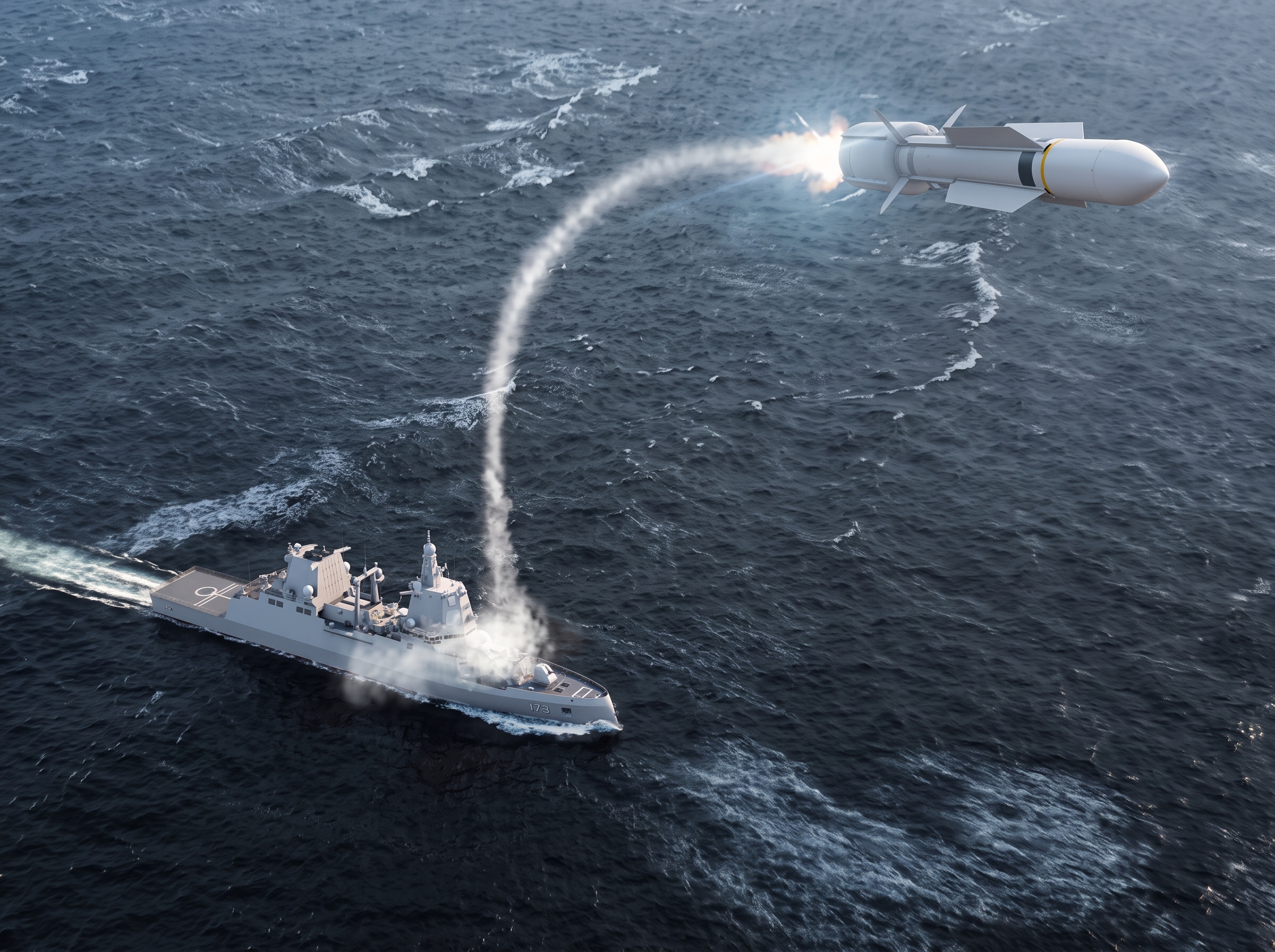
Military Sentinel, Berlin – Germany’s future F127 air defense frigate has been redesigned to add exo-atmospheric ballistic missile defense (BMD) to its fleet air defense role, shipbuilder TKMS confirmed on September 1, 2026, with the first of eight vessels now targeted for delivery in the mid-2030s if a construction contract is signed soon.
The F127 program traces back to Germany’s 2018 NGFrig-AD requirement to replace three aging F124 Sachsen-class frigates. The design has grown considerably since TKMS and Rheinmetall unveiled the original MEKO A-400 AMD concept in 2024, and the planned class size has expanded from an initial five ships plus one option to eight hulls as of September 2025. TKMS and Rheinmetall are jointly developing the vessel through the A400 FC venture, working alongside Germany’s BAAINBw procurement office, the Federal Ministry of Defence, and the German Navy.
Relative to the 2024 concept, the current F127 configuration is longer (177.99 m, up from 160 m), wider (24 m, up from 21 m), and heavier (over 12,000 tonnes, up from 10,000 tonnes). The added volume supports an increase in vertical launch capacity from 64 to 96 strike-length Mk 41 cells, plus four fixed AN/SPY-6(V)1 AESA radar faces selected by Germany in October 2025 and an AEGIS-based Integrated Combat System (ICS Mk 6 Mod X).
Key specifications:
TKMS attributed the redesign to expanded German Navy and NATO requirements for integrated air and missile defense, stating the added capacity gives the class room for cooling, power, and combat-system growth needed to counter higher-tier threats.
Program cost estimates vary significantly across sources and have not converged. German planning associated roughly €26 billion with the broader F127 program as of September 2025, while separate estimates circulating by August 2026 put per-ship costs at €5–6 billion and total program cost near €40 billion a figure TKMS publicly disputed on August 28, 2026, as not representative of the companies’ own construction costs.
Separately, the U.S. State Department approved two Foreign Military Sales cases relevant to the program: one in April 2026 covering roughly $11.9 billion in combat systems and integration support, and one in November 2025 covering 750 Standard Missiles (577 SM-2 Block IIIC, 173 SM-6 Block I) valued at approximately $3.5 billion.
If contracted as planned, the F127 would give the German Navy an exo-atmospheric BMD capability it does not currently field, aligning with NATO’s broader push toward integrated air and missile defense against long-range and ballistic threats. However, the 96-cell magazine will face real allocation tradeoffs: dedicating cells to large BMD interceptors reduces capacity available for anti-air, anti-ship, and strike missions, meaning the composition of each ship’s loadout not just total cell count will shape what any single F127 can actually defend against in a sustained engagement. Whether Berlin signs a construction contract in the near term, and how costs are ultimately reconciled, remain open questions.

James Whitfield is a defense news writer at Military Sentinel, covering military technology, naval operations, military aviation, international security, and global defense developments. His work focuses on providing informative reporting, relevant context, and accessible explanations of modern military affairs and emerging defense technologies.
Contact: [email protected]