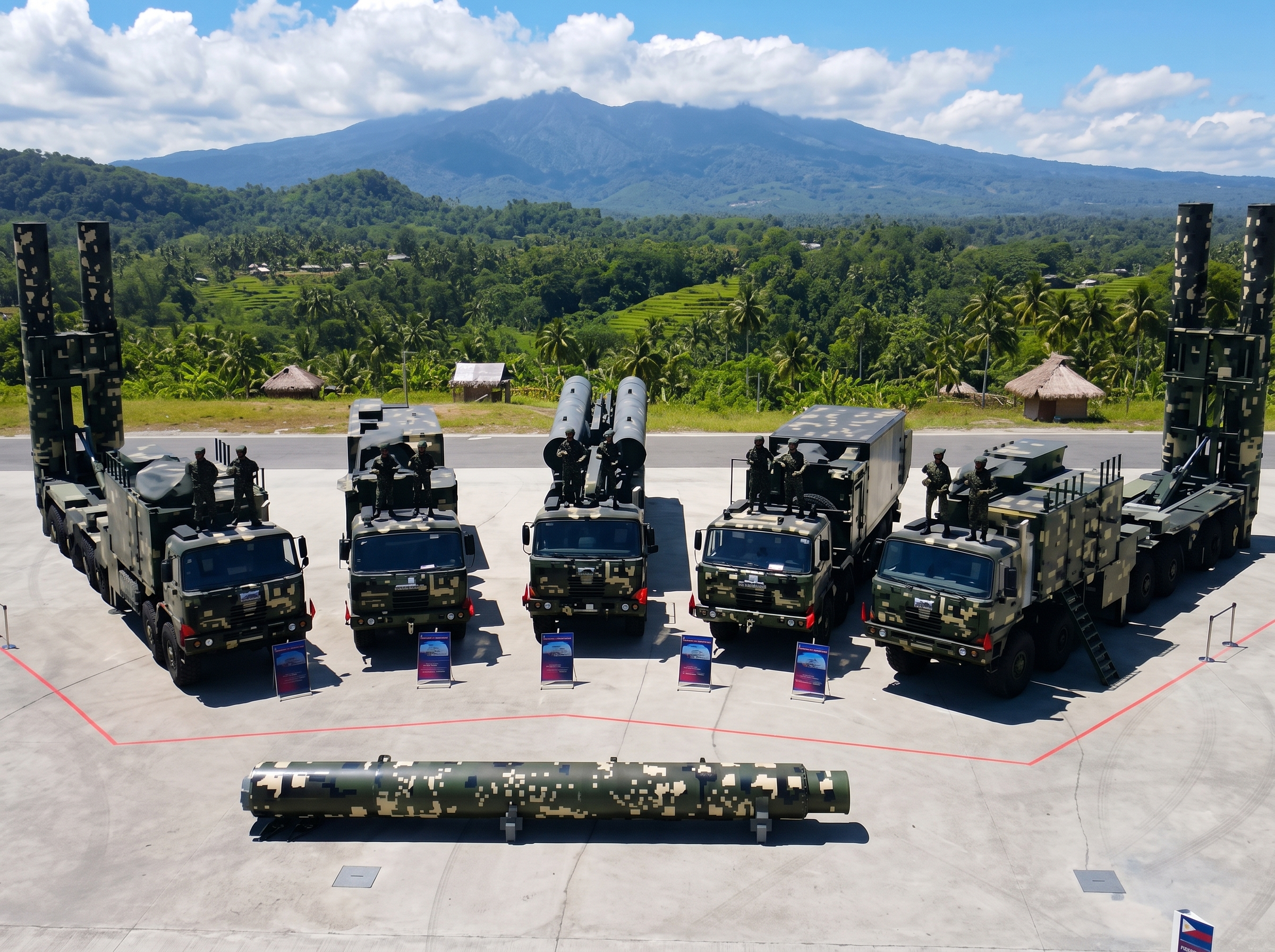
Military Sentinel, Manila – U.S. and Philippine Marines have successfully integrated unmanned aerial surveillance with shore-based supersonic strike procedures, linking Philippine Air Force Hermes drones to simulated BrahMos anti-ship missile engagements against a mock Chinese surface task group. The joint planning rehearsal demonstrates how allied forces intend to establish a distributed anti-access/area-denial (A2/AD) network across northern Luzon and the critical Luzon Strait.
Closing the Sensor-to-Shooter Loop
The exercise took place at Camp Bojeador in Ilocos Norte under the bilateral Archipelagic Coastal Defense Continuum (ACDC 26.4). Personnel from the Philippine Coastal Defense Regiment worked alongside an Air Naval Gunfire Liaison Company (ANGLICO) detachment from Marine Rotational Force–Southeast Asia to complete the end-to-end simulated kill chain.
During the exercise, Philippine Air Force Hermes unmanned aerial vehicles tracked an opposing naval formation. Allied fire-control teams ingested the live telemetry, generated targeting solutions, and planned coordinated fire missions for Philippine road-mobile missile batteries.
Planners modeled the opposing force on frontline People’s Liberation Army Navy (PLAN) combatants rather than generic targets:
-
Two Type 052D guided-missile destroyers
-
One Type 054A guided-missile frigate
-
One Type 901 fast combat support ship
Integrating fleet replenishment ships into the scenario required targeting cells to prioritize high-value logistical nodes while countering heavily defended escorts capable of active air defense and electronic countermeasures.
Technical & Tactical Parameters
The BrahMos anti-ship missile serves as the primary offensive capability within Manila’s Comprehensive Archipelagic Defense Concept.
-
Strike Capabilities: The export variant delivers a roughly 200 kg warhead at speeds near Mach 3 out to an estimated operational range of 290 kilometers.
-
Survivability: Road-mobile autonomous launcher platforms (two ready-to-fire canisters each) allow batteries to exploit northern Luzon’s rugged terrain, fire, and relocate before retaliatory strikes materialize.
-
ISR Layer: The Philippine Air Force operates medium-altitude, long-endurance (MALE) Hermes 900 and tactical Hermes 450 platforms equipped with electro-optical/infrared (EO/IR) and maritime radar payloads to maintain continuous track continuity.
Strategic Implications for the First Island Chain
Linking unmanned ISR with shore-based supersonic firepower addresses the geographic challenge of defending vast archipelagic waters without matching the size of a conventional blue-water surface fleet.
Positioning networked BrahMos batteries in northern and western Luzon enables allied planners to create interlocking engagement envelopes over both the Luzon Strait a vital transit corridor to the Western Pacific and the approaches toward Scarborough Shoal. Moving forward, deeper sensor integration between U.S. Indo-Pacific Command assets and Philippine ground-based strike units will anchor allied efforts to deny contested littoral choke points across the First Island Chain.