Physical Address
304 North Cardinal St.
Dorchester Center, MA 02124
Physical Address
304 North Cardinal St.
Dorchester Center, MA 02124

Military Sentinel, Manila – Chinese coast guard cutters and People’s Liberation Army Navy (PLAN) warships intercepted and blocked a Philippine resupply mission destined for Second Thomas Shoal on Thursday, marking a major escalation at the disputed South China Sea outpost.
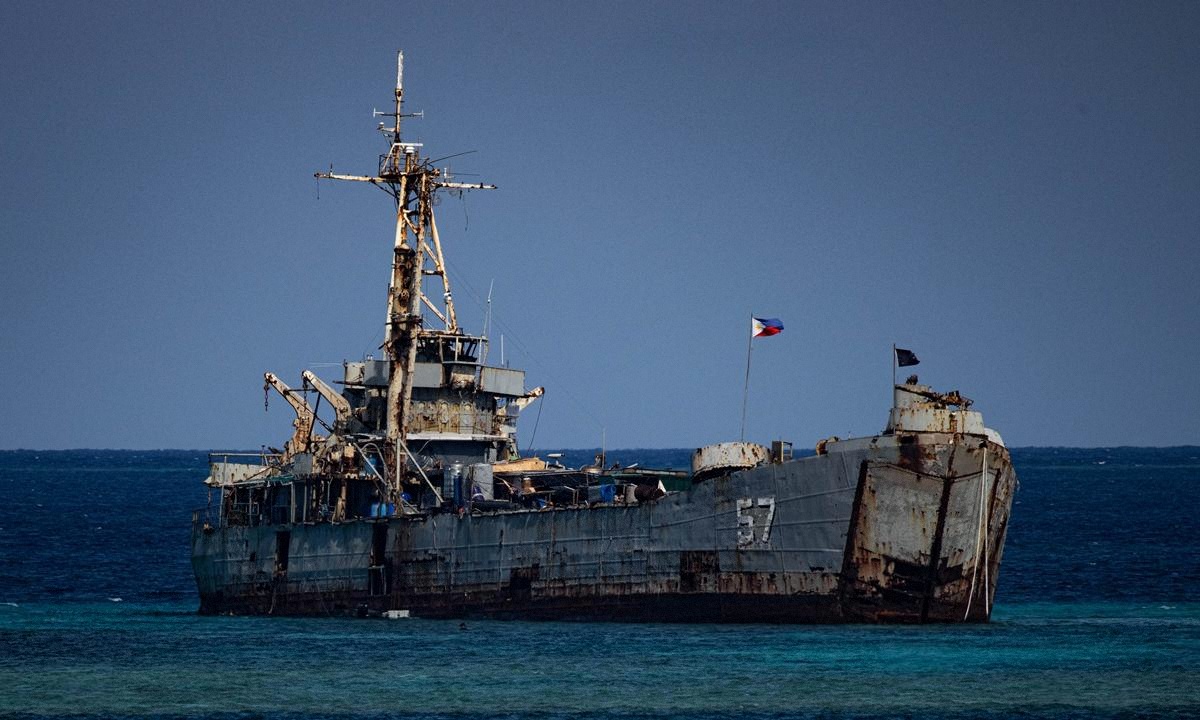
The maritime encounter unfolded as Philippine vessels attempted a scheduled rotation and reprovisioning run to the BRP Sierra Madre (LT-57), a grounded World War II-era landing ship that serves as a permanent Philippine military station in the Spratly Islands.
According to open-source naval tracking and preliminary operational reporting, the interdiction featured coordinated cordoning maneuvers by China Coast Guard (CCG) vessels supported by PLAN surface combatants operating in nearby waters.
Target Outpost: Second Thomas Shoal (Ayungin Shoal), located approximately 105 nautical miles west of Palawan, situated well within the Philippine Exclusive Economic Zone (EEZ).
Chinese Vessels Involved: CCG cutters alongside PLAN gray-hull warships providing overwatch and screening.
Mission Objective: Supply delivery of food, water, and fuel, alongside personnel rotation for Philippine Marines garrisoned aboard the rust-worn outpost.
Rather than relying purely on civilian-crewed maritime militia vessels, the active positioning of PLAN warships alongside white-hulled CCG cutters demonstrates Beijing’s continued tightening of its operational perimeter around the shoal.
Neither the Armed Forces of the Philippines (AFP) nor the Chinese Ministry of National Defense released comprehensive damage or casualty assessments immediately following Thursday’s interception.
However, official statements from Manila consistently emphasize that resupply missions to sovereign garrisons within the nation’s 200-nautical-mile EEZ are non-negotiable domestic operations. Philippine maritime authorities have repeatedly condemned aggressive maneuvers including previous deployments of high-pressure water cannons and acoustic devices—as dangerous and in direct contravention of the 1982 United Nations Convention on the Law of the Sea (UNCLOS) and the 2016 Permanent Court of Arbitration ruling.
Conversely, Beijing maintains expansive claims under its ten-dash line concept. Statements issued through the CCG consistently assert that maritime enforcement operations are legal measures taken to prevent foreign states from transporting structural construction materials designed to permanently fortify the deteriorating hull of the BRP Sierra Madre.
The deployment of surface combatants alongside law enforcement cutters significantly narrows the operational threshold between gray-zone coercion and active military confrontation. The presence of PLAN front-line warships introduces new escalation variables for regional actors and treaty allies:
Treaty Threshold Risks: The 1951 U.S.-Philippines Mutual Defense Treaty covers armed attacks on Philippine armed forces, public vessels, or aircraft in the South China Sea. Sustained interdictions force allied planners to calibrate deterrence measures without triggering wider regional escalation.
Logistical Strain on Manila: As maritime access narrows, the logistical lifespan of the Sierra Madre becomes an urgent operational concern, requiring Manila to weigh contested sea runs against aerial airdrops.
Regional Naval Posture: Allied forces operating in the Western Pacific, including the U.S. 7th Fleet, will likely increase maritime domain awareness flights and freedom-of-navigation surveillance sorties in response to the tightening perimeter.
Moving forward, the operational status of the Philippine resupply mission corridor will determine whether Beijing successfully establishes a de facto blockade over Second Thomas Shoal or if Manila and allied navies shift toward multilateral escort models to guarantee logistical continuity.

James Whitfield is a defense news writer at Military Sentinel, covering military technology, naval operations, military aviation, international security, and global defense developments. His work focuses on providing informative reporting, relevant context, and accessible explanations of modern military affairs and emerging defense technologies.
Contact: [email protected]