Physical Address
304 North Cardinal St.
Dorchester Center, MA 02124
Physical Address
304 North Cardinal St.
Dorchester Center, MA 02124

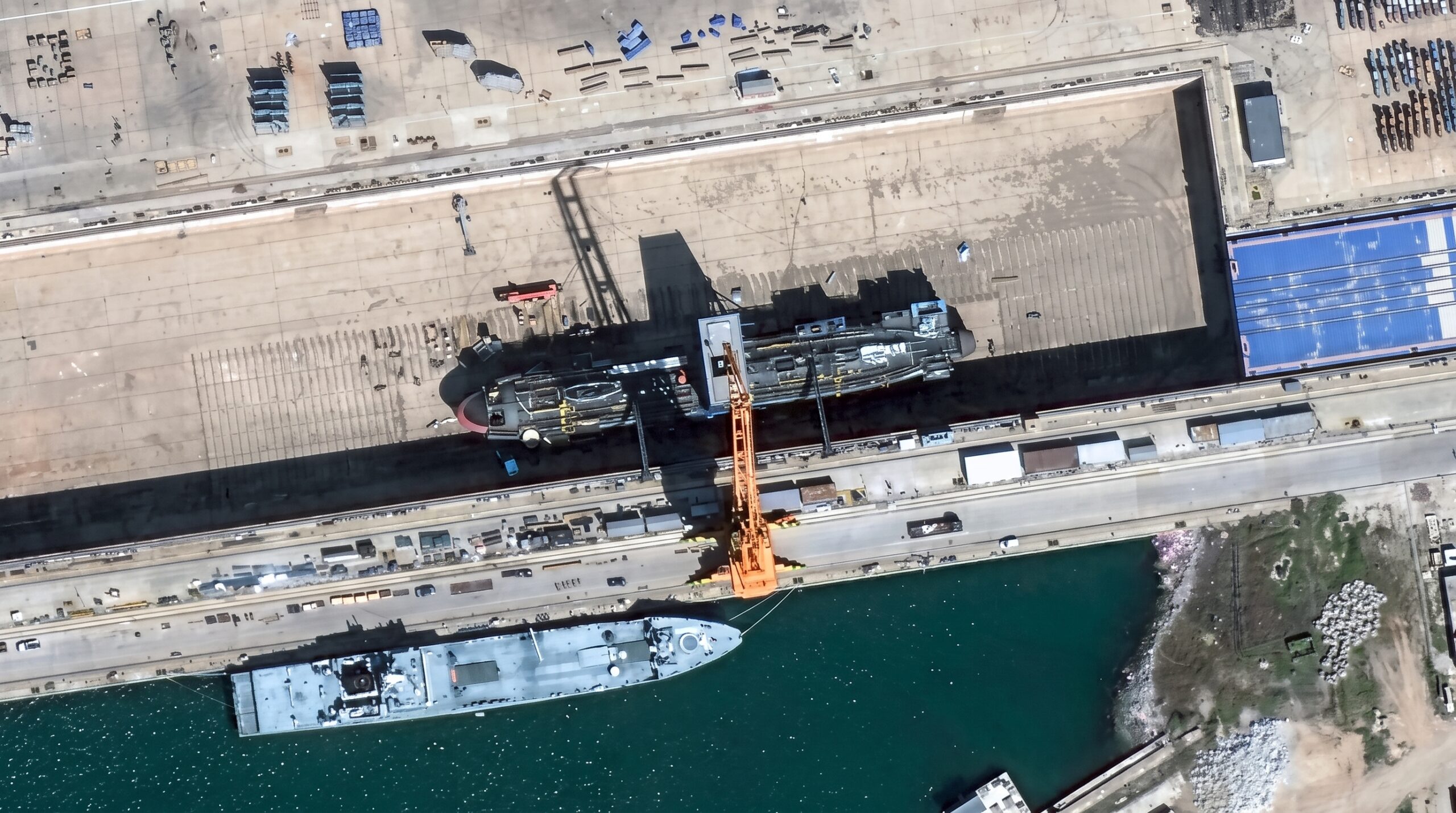
Military Sentinel, Washington – Commercial satellite imagery has revealed a newly identified nuclear-powered attack submarine under construction at China’s Bohai Shipyard in Huludao, offering Western defense analysts their clearest look yet at what is likely the People’s Liberation Army Navy’s prospective Type 095 nuclear submarine.
The imagery, captured on September 18 by commercial satellite provider Vantor and initially reported by The War Zone, shows the hull drydocked at the expansive northern shipyard—the epicenter of China’s nuclear submarine manufacturing. While earlier orbital imagery of the hull left design details ambiguous, defense intelligence analysts from Janes have now assessed the hull to represent China’s next-generation nuclear-powered attack submarine (SSN).
According to open-source naval analysts, the imagery reveals several significant departures from legacy Chinese designs:
Pumpjet Propulsion: The vessel features an integrated pumpjet propulsor rather than a traditional multi-blade propeller. Pumpjets significantly mitigate cavitation, delivering superior acoustic quieting and greater propulsive efficiency during high-speed submerged transit.
X-Shaped Stern Planes: Moving away from the cruciform rudders found on older Type 093 variants, the boat adopts an X-plane configuration. This layout enhances low-speed maneuverability, provides redundancy against steering gear damage, and lowers acoustic detection profiles.
Hull Dimensions: Analysts estimate the submarine’s overall length at approximately 120 meters.
Internal Compartment Openings: Imagery from early September captured an open rectangular section aft of the sail. While potentially related to reactor maintenance or modular hull fabrication, analysts suspect this bay may house a vertical launch system (VLS) for anti-ship and land-attack cruise missiles.
Bow Apertures: At least two distinct, large circular cutouts were observed in the forward bow, likely intended for specialized sonar arrays or advanced torpedo tubes.
Naval observers emphasize caution regarding unconfirmed internal systems. Independent naval analyst Alex Luck noted that orbital imagery alone cannot definitively verify whether the dorsal hull cavity serves as a VLS bay or merely an access cutaway for machinery installation.
Nevertheless, the development highlights Beijing’s steady transition away from its legacy fleet of diesel-electric boats toward long-range nuclear platforms. According to Department of Defense assessments, the PLAN has grown into the world’s second-largest operator of nuclear submarines, trailing only the United States Navy.
The emergence of the Type 095 nuclear submarine coincides with concurrent testing of other unconventional undersea platforms, including the hybrid Type 041 Zhou-class and a compact-sail prototype identified at Shanghai’s Jiangnan Shipyard.
If Beijing successfully integrates modern reactor designs, advanced sound-damping mounts, and flanking sonar suites into serial production, the Type 095 could markedly erode the U.S. Navy’s historical acoustic advantage across the First and Second Island Chains heading into the 2030s.

James Whitfield is a defense news writer at Military Sentinel, covering military technology, naval operations, military aviation, international security, and global defense developments. His work focuses on providing informative reporting, relevant context, and accessible explanations of modern military affairs and emerging defense technologies.
Contact: [email protected]