Physical Address
304 North Cardinal St.
Dorchester Center, MA 02124
Physical Address
304 North Cardinal St.
Dorchester Center, MA 02124


Military Sentinel, United States – Newly released imagery and test footage show the Blackbeard hypersonic missile being launched from a tactical ground-based launcher, marking an important step forward in the development of low-cost, surface-launched high-speed strike weapons. The demonstration, conducted by American defense startup Castelion, highlights an intensifying industry effort to transition hypersonic technology from expensive, low-inventory prototypes into scalable, mass-producible munitions designed for distributed combat operations.
The test sequence captures the missile clearing its box-like ground launcher before its solid-fuel rocket booster ignites, propelling the test vehicle into its high-velocity ascent trajectory. By validating launcher integration and initial launch dynamics from an expeditionary surface platform, the event demonstrates that advanced high-speed strike capabilities can be deployed from mobile, modular ground equipment rather than relying exclusively on fixed infrastructure or specialized aerial strike assets.
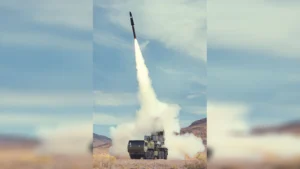
The visual documentation reveals the Blackbeard vehicle housed within a compact, containerized launch module mounted on a transportable ground trailer. During the launch sequence, the missile is expelled from the canister, clearing the launcher structure before the primary booster propellant initiates full thrust, leaving a distinct acoustic and thermal plume as it climbs rapidly downrange.
The test was designed to gather critical telemetry on the mechanical separation process, ignition reliability, booster motor performance, and immediate post-launch stability. Ground-based firings of this nature subject both the weapon casing and the launch container to severe thermal, acoustic, and vibrational forces. Successfully capturing operational data across these regimes allows engineers to validate digital aerodynamic models against physical telemetry gathered under real-world firing conditions.
While specific range and apogee metrics from the event have not been publicly disclosed, the firing demonstrates that the missile’s launch canister can function as a standalone, deployable fire unit. This modular container approach aligns directly with military demands for rapid setup, launch, and relocation capabilities in hostile environments.
The Blackbeard system is designed to address one of the most persistent vulnerabilities in Western hypersonic procurement: high unit costs and restricted production volumes. Traditional hypersonic weapons, such as the U.S. Army’s Long-Range Hypersonic Weapon (LRHW) or air-launched boost-glide concepts, typically feature bespoke composite materials, intricate guidance components, and unit prices reaching tens of millions of dollars per round.
In contrast, the Blackbeard architecture utilizes simplified manufacturing methodologies, streamlined aerodynamic structures, and commercially sourced manufacturing techniques to reduce production overhead. The missile pairs a high-output solid rocket booster with a high-speed strike vehicle engineered to sustain hypersonic velocities while executing course corrections during terminal flight.
This emphasis on simplicity does not negate capability. By operating at speeds exceeding Mach 5, the weapon significantly compresses the reaction timeline of adversarial integrated air and missile defense networks. The integration of containerized launch hardware allows field commanders to disperse batteries across varied terrain, minimizing logistical footprints while complicating enemy counter-battery targeting.
Founded by former aerospace engineers with experience at commercial launch firms and defense contractors, Castelion entered the defense technology sector with the specific objective of accelerating weapon development cycles. Drawing inspiration from rapid prototyping practices established in commercial rocketry, the company moved from initial design studies to physical test articles in a fraction of the time typically required by legacy defense primes.
Earlier developmental milestones included static motor firings and subscale flight tests aimed at verifying thermal protection materials, aerodynamic control surfaces, and internal avionics packages. The transition to a full-system firing from an operational containerized ground launcher reflects an aggressive testing schedule, intended to demonstrate practical battlefield utility to military procurement authorities.
This rapid-iteration strategy mirrors a broader shift across the defense sector toward non-traditional suppliers. As defense departments seek to replenish depleted stockpiles and prepare for potential high-intensity confrontations, smaller technology firms are increasingly tapped to provide attritable, cost-effective weapons capable of being fielded in significant numbers.
The demonstration of a practical, ground-launched hypersonic missile carries significant operational implications for regional defense strategies, particularly in the Indo-Pacific and along NATO’s eastern flank. In anti-access and area-denial (A2/AD) environments, static military bases and forward airfields face constant threat from long-range ballistic and cruise missile strikes. Mobile, road-transportable launchers provide survivable strike options that can operate independently of damaged runway infrastructure.
Deploying hypersonic fires from standard tactical trucks or ISO-standard container frames enables forces to utilize highway networks, commercial ports, and dispersed island positions. This dispersal creates severe targeting dilemmas for hostile surveillance assets, forcing adversaries to divert valuable reconnaissance resources to hunt mobile launch nodes across vast expanses of terrain.
Looking ahead, the development trajectory for the Blackbeard program will focus on expanding flight testing parameters, integrating operational guidance and navigation packages, and demonstrating terminal precision against realistic surrogate targets. Continued successful firings from mobile launchers will prove crucial as defense planners evaluate whether low-cost hypersonic systems can transition from experimental prototypes into combat-ready inventory.