Physical Address
304 North Cardinal St.
Dorchester Center, MA 02124
Physical Address
304 North Cardinal St.
Dorchester Center, MA 02124

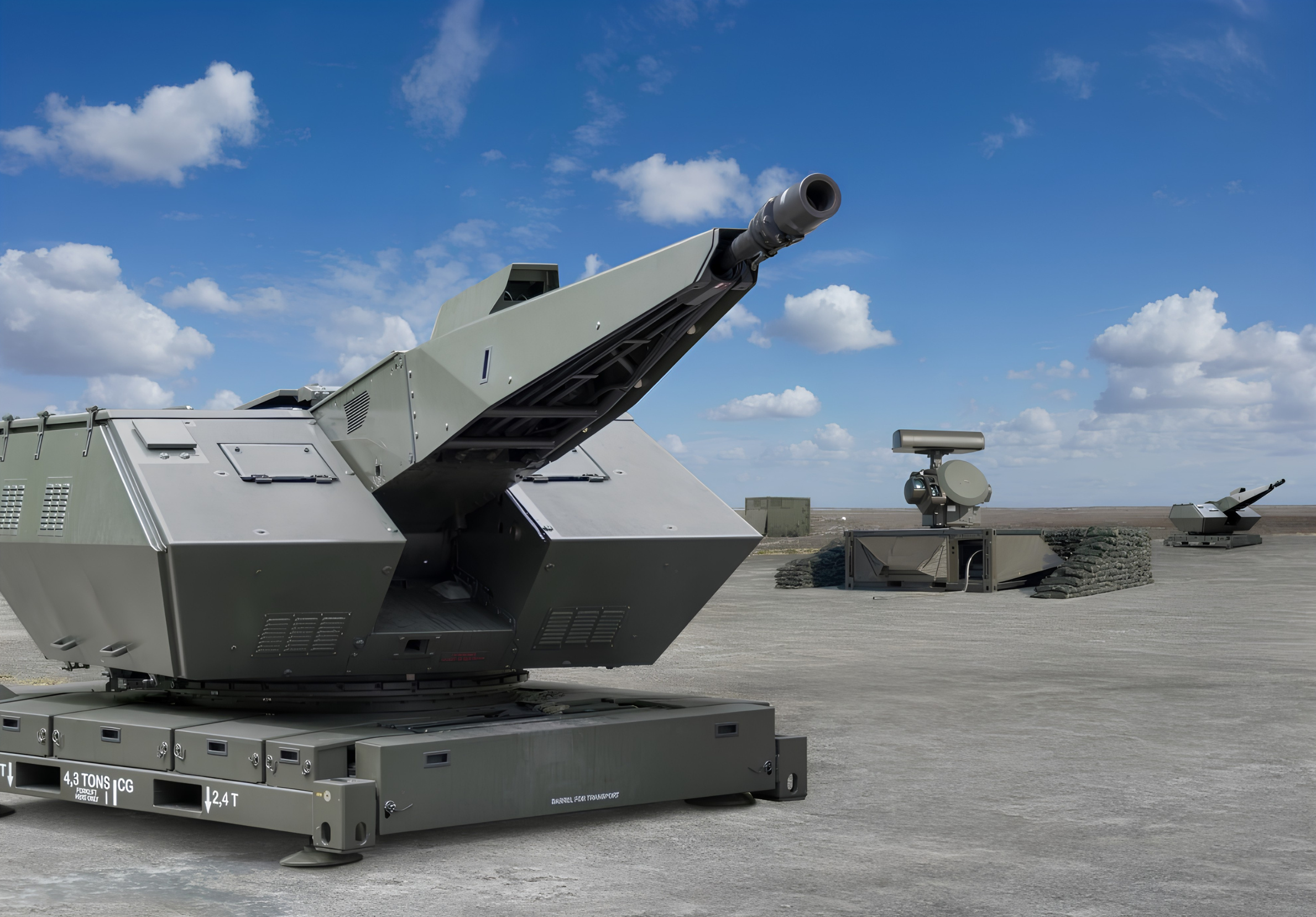
Military Sentinel, Washington – The U.S. Air Force issued a formal Request for Information this week seeking a ground-based, medium-caliber gun system to defend its overseas air bases against drones and subsonic cruise missiles, marking a step toward the service fielding its own organic air defenses rather than relying solely on the Army.
The RFI, posted to the federal government’s contracting portal, calls for a system that fires affordable munitions and provides persistent defense against unmanned aircraft and cruise missile threats. The Air Force does not currently operate any such gun-based air defense systems — that mission has traditionally belonged to the Army.
The notice does not specify an exact caliber, though the Army’s own medium-caliber category spans 20mm, 25mm, 30x113mm, 30x173mm, and 40mm rounds. The Air Force says it will judge competing designs against 15 baseline performance criteria, starting with each system’s salvo probability of kill against cruise missiles and Group 1 through 5 drones at maximum range and altitude — a measure of how effectively a burst of fire, rather than a single round, destroys an incoming target.
Beyond lethality, the service wants a lightweight, modular system that can be moved quickly into austere overseas locations aboard its existing C-130, C-17, or C-5 transport fleet, and equipped with a mix of radar, electro-optical, infrared, or radio-frequency sensors for reliable target tracking in poor weather. Cost-per-engagement is also a stated evaluation factor, reflecting concern about the price gap between cheap attack drones and expensive interceptor missiles.
Air Force Secretary Troy Meink told Congress in May that defending its own bases has become an increasingly high priority for the service, citing ongoing work on counter-drone systems and the Air Base Air Defense System (ABADS). The Air Force requested roughly $1.4 billion for an ABADS missile-defense variant in its Fiscal Year 2027 budget request, on top of $51.8 million sought for small counter-drone systems in FY2026.
The push follows the recent war with Iran, during which Tehran launched thousands of drones and hundreds of ballistic missiles at U.S. and partner bases across Bahrain, Iraq, Jordan, Kuwait, Qatar, Saudi Arabia, and the United Arab Emirates, killing at least nine U.S. troops and destroying aircraft and radar systems. That fight, along with Russia’s continuing drone and missile campaign against Ukraine, has renewed concern in Washington about depleted interceptor stockpiles and the cost of using multimillion-dollar missiles against low-cost drones.
The U.S. military currently fields three gun-based short-range air defense systems: the Army’s Centurion C-RAM (a ground-mounted version of the Phalanx naval gun), the Stryker-based Sgt. Stout, and the Marine Corps’ MADIS. The Army is separately seeking a 50mm system of its own, a category Northrop Grumman entered in August with its Raid Hunter design. Foreign options exist too, including Rheinmetall’s towed and vehicle-mounted Skyranger 35 and Skyshield systems, both already in service with Ukraine and other NATO members.
The RFI is a market-research step, not a funded acquisition program, so it does not guarantee the Air Force will buy or field a specific system; a formal down-select or contract would need to follow separately, and no such timeline has been announced.
Industry has until 5 p.m. Oct. 9 to respond to the RFI. Given the narrow field of mature gun-based systems and the Air Force’s stated urgency, the response could shape whether the service pursues a domestic design, adapts an existing Army program, or turns to an allied system already proven in Ukraine.