Physical Address
304 North Cardinal St.
Dorchester Center, MA 02124
Physical Address
304 North Cardinal St.
Dorchester Center, MA 02124


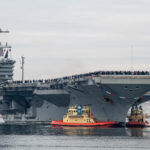
Military Sentinel, Laem Chabang, Thailand – The USS Abraham Lincoln (CVN-72), a Nimitz-class aircraft carrier, arrived at Thailand’s Laem Chabang port on September 2, 2026, with visible rust and algae streaking its hull from bow to stern, ending a record-setting 264 consecutive days at sea without a port call. The ship’s condition, widely circulated on social media, has prompted commentary questioning the appearance of a frontline US warship, though Navy-affiliated experts say the corrosion reflects the ship’s operational tempo rather than neglect.
The Lincoln departed its homeport of San Diego on November 21, 2025, and by the time it reached Thailand had logged 286 days deployed, much of it spent supporting US combat operations against Iran in the Middle East. The carrier strike group’s presence in US Central Command’s area of operations was tied to Operation Epic Fury, described by the Navy as involving one of the largest naval blockades in decades. That sustained tempo, according to naval analysts, is the direct cause of the ship’s appearance: the 264-day stretch without a port call was itself described as record-breaking.
Carl Schuster, a former US Navy captain who completed three tours aboard Nimitz-class carriers, told CNN that rust along a ship’s waterline is unremarkable after 60 or more continuous days at sea. He said tackling the corrosion isn’t feasible while underway, particularly during combat operations, and that crews must be lowered to the waterline to sand off rust before applying two coats of rust-preventative primer and two coats of naval gray paint.
Schuster estimated roughly 30 days of preservation work would be needed to fully remove the rust visible on the Lincoln, though crews prioritized high-impact areas the bow and forward hull during the ship’s shorter port visit, since those sections absorb the most punishment from moving through salt water and choppy seas. Separately, Schuster cautioned that corrosion “spreads” like a contagious problem and, left unaddressed, can weaken structural elements including decks, walkways, and lifelines.
The episode also revives a recurring political sore point for the Navy. Visible corrosion on US warships has drawn criticism in the past, including from President Donald Trump, and from Navy Secretary John Phelan, who told Congress last year that photos of a worn-looking Arleigh Burke-class destroyer, USS Dewey, during a Singapore stopover were “terrible” and that “they should be ashamed”. As of publication, the White House had not issued a statement specifically addressing the Lincoln’s appearance in Thailand a notable silence given the precedent, though on any forthcoming administration comment.
Rust on Navy hulls is not a Lincoln-specific issue. Warships across navies routinely return to homeport showing significant corrosion, and the Navy faced a similar spike in rust complaints during the COVID-19 pandemic, when ships avoided ports for longer stretches to limit infection risk. The scale of the problem was significant enough that a “MegaRust” conference in San Diego this year specifically examined seawater corrosion on steel vessels.
The visual is unlikely to reflect a genuine readiness problem corrosion of this kind is cosmetic and structural risk is manageable if addressed at the next major maintenance period. But the incident underscores a real strategic tension: sustaining a carrier at sea for nine months with minimal port access, as Middle East operations against Iran required, comes at a direct material cost that will need to be paid down in shipyard time once the Lincoln returns home. With multiple carrier strike groups already stretched thin, how the Navy schedules that restoration work and whether similarly extended deployments become more common is likely to matter more for fleet readiness than the optics of a single port call.