Physical Address
304 North Cardinal St.
Dorchester Center, MA 02124
Physical Address
304 North Cardinal St.
Dorchester Center, MA 02124


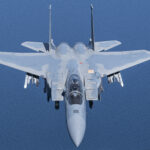
Military Sentinel, Washington – The U.S. Air Force has issued a formal market survey seeking an electro-optical missile warning system for its new F-15EX Eagle II fleet, initiating steps to address a critical defensive survivability gap left by initial cost-cutting decisions.
The Air Force Life Cycle Management Center published a sources-sought notice on Sept. 29, 2026, requesting industry feedback on production-ready or operational systems capable of drop-in integration. Responses are due by Nov. 12, 2026. While the notice represents market research rather than a formal procurement commitment, it signals a significant shift toward outfitting the twin-engine heavyweight fighter with optical detection capabilities against heat-seeking surface-to-air and air-to-air missiles.
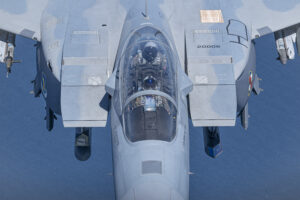
When the Air Force procured the Boeing F-15EX Eagle II, it omitted active electro-optical missile approach sensors from the baseline production package despite retaining the internal infrastructure for them.
The aircraft currently features BAE Systems’ AN/ALQ-250 Eagle Passive Active Warning Survivability System (EPAWSS), which handles digital radar warning, geolocation, and RF jamming countermeasures. However, EPAWSS focuses primarily on radio-frequency threats. Purely infrared-guided missiles—including low-altitude man-portable air-defense systems (MANPADS) and passive surface-to-air weapons generate no RF emissions. Without an optical warning system to spot rocket plume signatures, pilots receive no automated cueing to dispense defensive flares or execute evasive maneuvers.
Foreign variants of the Advanced Eagle platform, including Saudi Arabia’s F-15SA and Qatar’s F-15QA, fly with operational missile warning systems installed. Singapore’s F-15SG also features an optical warning array. The domestic Eagle II fleet, by contrast, has flown with blanked-over sensor ports despite operating with pre-installed provisions.
The Air Force requires any proposed F-15EX missile warning system to leverage the airframe’s existing structural architecture without extensive redesign:
Mounting provisions: Must install directly into the six pre-existing sensor locations, including apertures on the forward fuselage sponsons and tail surfaces.
Utility compatibility: Must utilize factory-installed internal data routing, power cables, and liquid/air cooling connections.
Architecture: Must interface directly with the aircraft’s defensive countermeasures dispenser system and core mission computers.
Maturity: The Air Force is seeking an operationally qualified hardware solution rather than funding clean-sheet developmental hardware.
Candidates could include variants of BAE Systems’ Common Missile Warning System (CMWS) widely deployed on U.S. Army tactical helicopters and specialized fixed-wing assets or newer high-resolution distributed optical sensor architectures.
The decision to reconsider the missile warning system reflects evolving combat realities in contested operating environments. Unmanned and non-stealthy strikes over heavily defended territory in recent operational theaters have demonstrated the lethal threat posed by passive, IR-guided surface-to-air missiles and shoulder-fired munitions.
With the service currently maintaining 22 F-15EX aircraft and an envisioned program of record reaching 267 airframes, survivability against multi-spectral threats is paramount. Operating as a long-range standoff missile truck and forward electronic weapons director, the Eagle II cannot rely entirely on fourth-generation speed and standoff distance to counter passive optical threats. If the Air Force proceeds with a contract award following the evaluation window, the retrofit will eliminate one of the Eagle II’s most scrutinized equipment omissions.