Physical Address
304 North Cardinal St.
Dorchester Center, MA 02124
Physical Address
304 North Cardinal St.
Dorchester Center, MA 02124


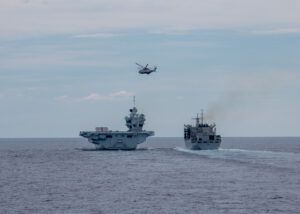
Military Sentinel, London – When the Royal Navy aircraft carrier HMS Prince of Wales departed Portsmouth on August 27, 2022, for a high-profile deployment to North America, expectations were high for the 65,000-tonne capital ship. Just two days later, however, the £3 billion flagship was forced to anchor off the Isle of Wight after a catastrophic mechanical failure disabled her starboard propeller shaft.
The resulting investigation revealed a structural defect built into the vessel before it ever entered active service. Sending the ship back out to sea after only 48 hours triggered a massive engineering crisis that kept the carrier locked inside the dry dock at Rosyth for 328 days.
The primary culprit behind the protracted dockyard stay was an external shaft coupling on the starboard propeller line. Investigators later established that alignment issues had been flagged during the carrier’s initial construction phase.
Rather than halting work to correct the core installation error, program managers opted to proceed toward sea trials while scheduling ongoing monitoring. When the vessel encountered heavy open-ocean stresses shortly after leaving port, that uncorrected misalignment proved fatal to the assembly.
The coupling failure inflicted heavy localized damage on both the shaft itself and the surrounding propeller components, while also causing secondary impacts to the ship’s steering structure. Subsequent inspections in dock uncovered similar alignment discrepancies on the port propeller shaft, forcing engineers to overhaul both propulsion lines simultaneously.
The remediation effort carried a heavy price tag. Repairing the propulsion systems at the Rosyth facility cost approximately £25 million. Because standard warranty coverage would have cost even more than managing the repairs independently, the Ministry of Defence absorbed the bill directly.
The lengthy dockyard period severely disrupted the Royal Navy’s training schedule and forced the cancellation of critical aviation trials during the planned WESTLANT 22 deployment. Defense analysts pointed to the incident as a stark illustration of the vulnerability introduced when a navy relies on just two capital ships to maintain continuous sovereign carrier strike capability.
Despite the initial setback, the Royal Navy utilized the mandatory downtime to accelerate scheduled flight-deck modifications, communication suite overhauls, and combat system upgrades.
The 2022 propulsion failure sits as a cautionary case study in modern naval procurement and quality control. Although the ship successfully secured its naval and classification certificates prior to commissioning, the incident exposed gaps in how construction tolerances are verified before operational handoff.
The extensive repairs ultimately proved effective, enabling the carrier to complete demanding global deployments in subsequent years. Yet the legacy of those 328 days in dock serves as a persistent reminder that minor oversights during assembly can translate into massive operational penalties once a fleet flagship heads out to sea.