Physical Address
304 North Cardinal St.
Dorchester Center, MA 02124
Physical Address
304 North Cardinal St.
Dorchester Center, MA 02124

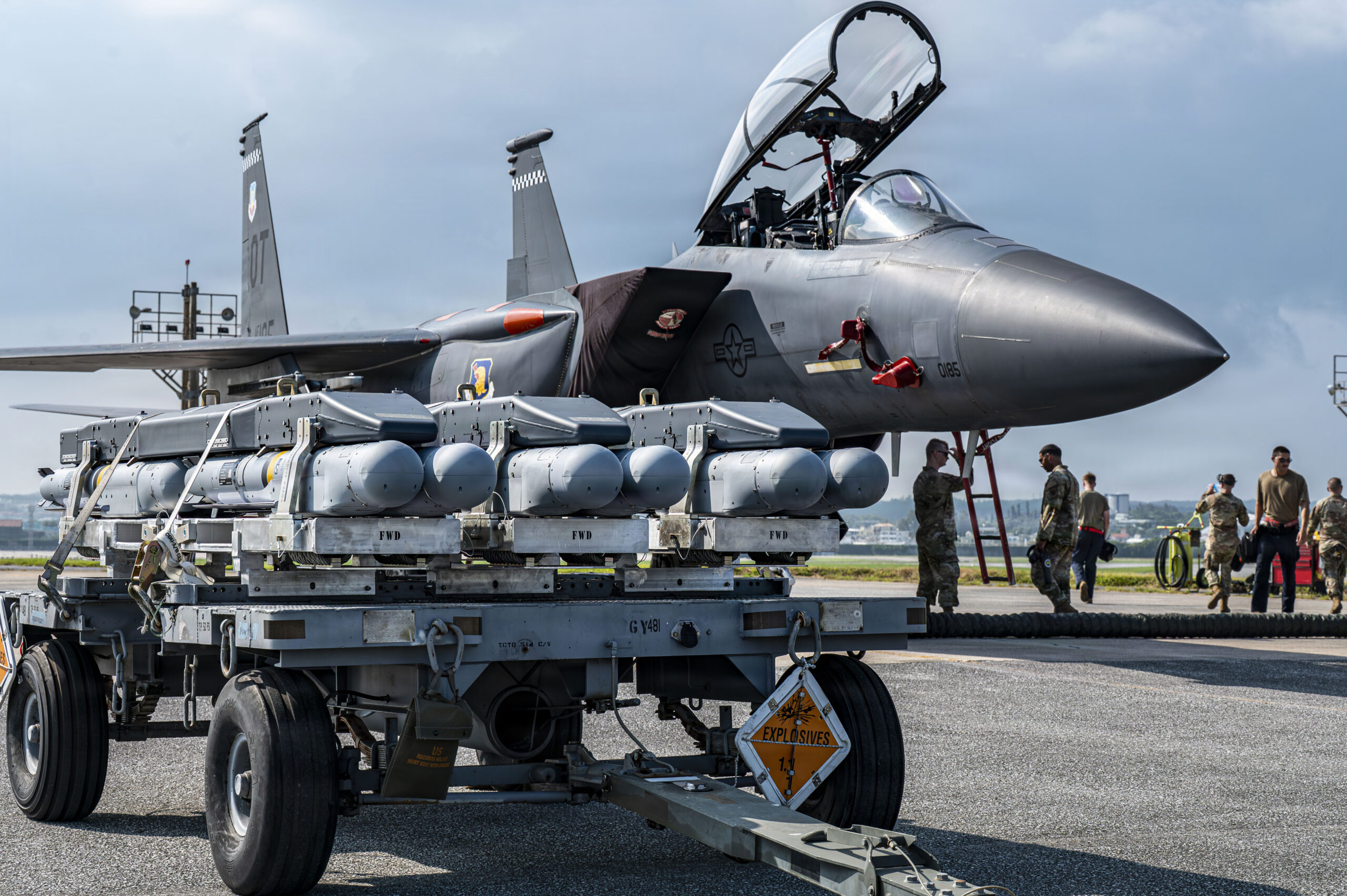
Military Sentinel, Washington – Iran bypassed U.S. carriers to strike fixed regional installations, exposing how vulnerable bases threaten forward-deployed military power in modern conflict. Imagine a chess grandmaster fielding an impenetrable queen and two towering rooks, only for the opponent to repeatedly kick the legs off the table.
That dynamic captures the core asymmetric dilemma now confronting American operational posture in the Middle East. For decades, Western expeditionary doctrine leaned heavily on cutting-edge platforms—fifth-generation stealth fighters, guided-missile destroyers, and nuclear-powered supercarriers. Yet an adversary equipped with precision-guided ballistic missiles, one-way attack drones, and loitering munitions does not need to pierce the defensive perimeter of a carrier strike group to paralyze theater operations. It simply targets the immobile concrete aprons, fuel farms, and maintenance docks that keep those exquisite platforms combat-ready.
Modern military airfields and naval facilities are massive, immovable footprints whose coordinates have been mapped down to the millimeter for years. While a carrier strike group maneuvers across thousands of square miles of blue water, an air base or naval support installation in the Persian Gulf cannot relocate when a launch salvo appears on radar.
During recent confrontations, adversaries recognized that taking down an F-35 in flight or sinking a capital warship entails overcoming layered, state-of-the-art defenses. In contrast, targeting forward logistic nodes and fixed installations accomplishes the same operational goal denying air and naval sorties at a fraction of the cost. When support facilities like maintenance hangars, runway intersections, and shore support piers in hubs like Bahrain sustain critical strikes, fleet turnaround times crater and forward deployments become untenable.
The current operational calculus heavily favors saturation fire over kinetic interception. Theater defenses like the MIM-104 Patriot and Terminal High Altitude Area Defense (THAAD) boast high interception rates, but they remain bound by unyielding logistics:
Interceptor Cost vs. Threat Cost: A single Patriot PAC-3 MSE interceptor costs roughly $4 million to $5 million, while standard Iranian-designed Shahed-series suicide drones cost an estimated $20,000 to $40,000.
Magazine Capacity: Surface-to-air missile (SAM) batteries carry finite ready-to-fire cells, and reloading launchers under active saturation fire is hazardous and slow.
Production Bottlenecks: Western defense industrial bases produce only several hundred advanced air defense interceptors annually, while regional powers can manufacture thousands of low-cost drones and ballistic rockets each year.
When salvos mix ballistic trajectories, low-altitude cruise missiles, and swarms of loitering drones, defensive batteries deplete their magazines. Once interceptor stocks dwindle, subsequent weapons waves reach their terminal descent unobstructed.
The lessons drawn from vulnerable bases in the Middle East extend far beyond the Persian Gulf. If a mid-tier regional power can inflict severe infrastructural attrition on forward operating locations, the challenge escalates exponentially in a peer confrontation.
In the Western Pacific, U.S. operational plans have long anchored to major hubs such as Kadena Air Base on Okinawa, Andersen Air Force Base on Guam, and naval infrastructure across Japan. The People’s Liberation Army Rocket Force (PLARF) fields an inventory of theater-range ballistic and hypersonic missiles including the DF-21D and DF-26 engineered specifically to crater runways and shatter static command nodes.
To mitigate this operational vulnerability, service branches are accelerating dispersed basing initiatives, notably the U.S. Air Force’s Agile Combat Employment (ACE) concept and expeditionary forward arming and refueling points (FARP). However, dispersal demands vast logistics footprints, mobile air defense detachments, and resilient communications networks. Without a rapid expansion of directed-energy defenses, hard-kill base protection, and hardened shelters, static outposts will remain the central operational choke point of power projection.