Physical Address
304 North Cardinal St.
Dorchester Center, MA 02124
Physical Address
304 North Cardinal St.
Dorchester Center, MA 02124

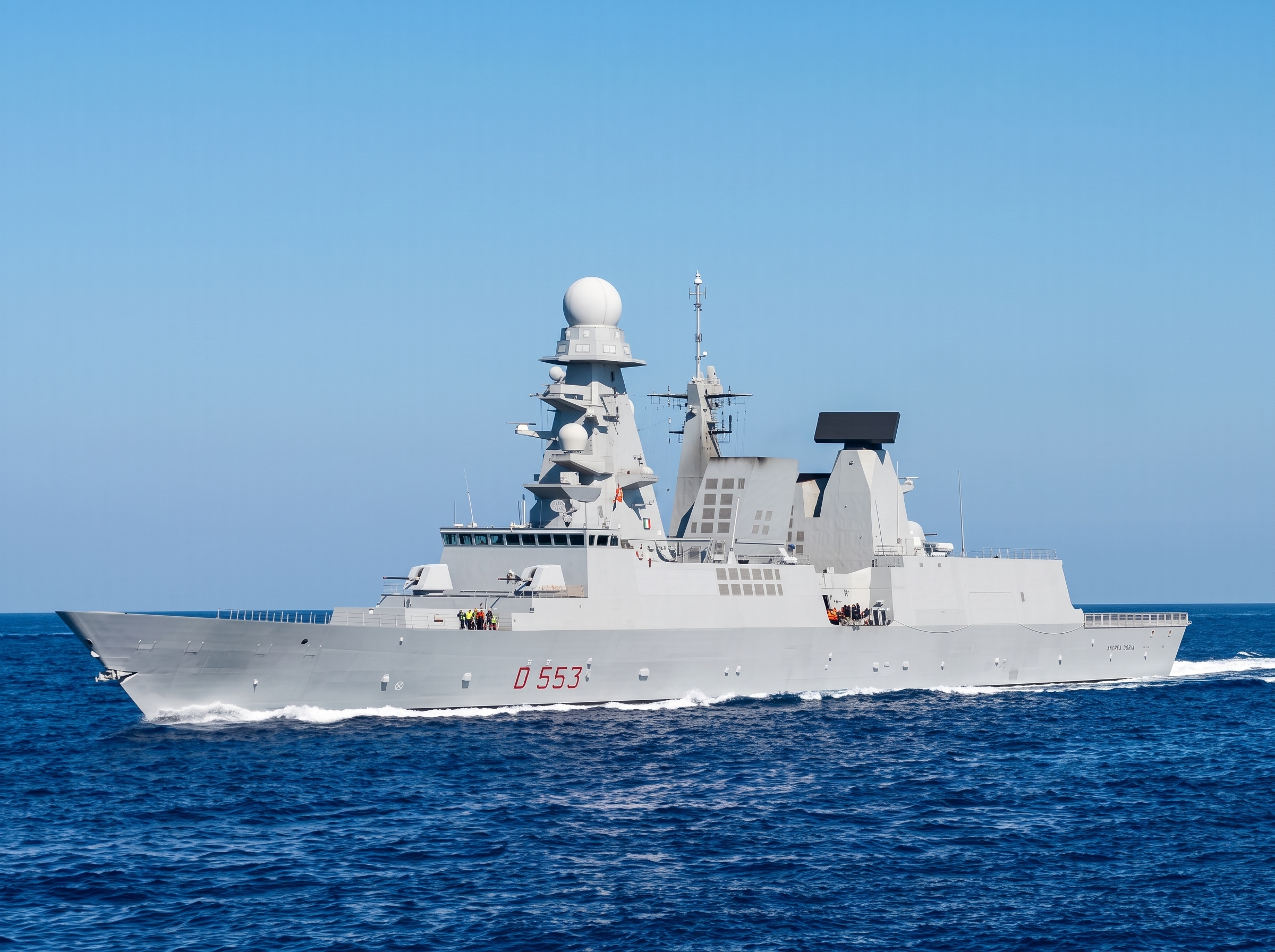
Military Sentinel, Rome – The Italian Ministry of Defence, operating through European procurement agency OCCAR, has awarded a €3.7 billion ($4.2 billion) contract to Orizzonte Sistemi Navali for the construction of two next-generation DDX destroyers, cementing one of the largest naval surface combatant procurements in modern European history.
The deal formally initiates the development, production, and initial logistical support for the two heavyweight warships. Platform deliveries to the Italian Navy (Marina Militare) are scheduled for 2033 and 2035. The contract was signed with Orizzonte Sistemi Navali (OSN), a joint venture between shipbuilder Fincantieri (51%) and aerospace/defense contractor Leonardo (49%). Under the industrial division of labor, Fincantieri will act as the vessel integrator with an estimated €1.8 billion workshare, while Leonardo will execute €1.7 billion focused on the combat management suite, sensors, and weapon systems.
Displacing roughly 13,500 metric tons with an overall length of 180 meters, the new DDX platforms will rank among the largest surface combatants built in Western Europe since the Second World War. Designed to replace the aging Orizzonte (Horizon)-class destroyers Andrea Doria and Caio Duilio, the DDX hulls will operate as long-range command-and-control flagships equipped with theater air and missile defense capabilities.
Displacement: Approximately 13,500 tonnes
Length: 180 meters
Crew Complement: 251 personnel
Operating Range: 4,000 nautical miles
Command & Control: Leonardo SADOC 5 C5I architecture
Sensor Suite: High-power 3D digital S-band Active Electronically Scanned Array (AESA) radar combined with multi-band tracking arrays
Offensive & Defensive Weapons: MBDA missile systems (including Aster 30 Block 1NT/B1NT for anti-ballistic and hypersonic threat engagement), deep-strike land-attack cruise missiles, and medium-caliber naval artillery with smart guided munitions
Power Distribution: High-voltage DC electrical sub-network with integrated energy storage to support directed-energy weapons and electronic warfare systems
The formal signing transitions the DDX project from requirements drafted in the 2020 Multi-Year Defense Planning Document (DPP) into active construction. The DDX complements ongoing recapitalization across the Marina Militare, which includes new FREMM EVO multi-role frigates, multi-purpose offshore patrol vessels (PPA), the amphibious assault ship Trieste, and next-generation submarines.
Navy planners designed the ships with modular multi-mission payloads, allowing the flight deck and stern mission bays to deploy and recover uncrewed surface vehicles (USVs) and autonomous underwater vehicles (UUVs).
The formal greenlight for the DDX program highlights Europe’s structural shift toward larger, heavily armed warships capable of surviving dense anti-access/area-denial (A2/AD) bubbles. As recurring anti-ship ballistic and cruise missile engagements in the Red Sea and Eastern Mediterranean reshape Western naval procurement, Rome is prioritizing magazine depth, power reserves, and anti-ballistic missile interception over lightweight littoral vessels. When the first DDX enters service in 2033, it will significantly boost NATO’s southern flank with persistent maritime air and missile defense coverage.