Physical Address
304 North Cardinal St.
Dorchester Center, MA 02124
Physical Address
304 North Cardinal St.
Dorchester Center, MA 02124

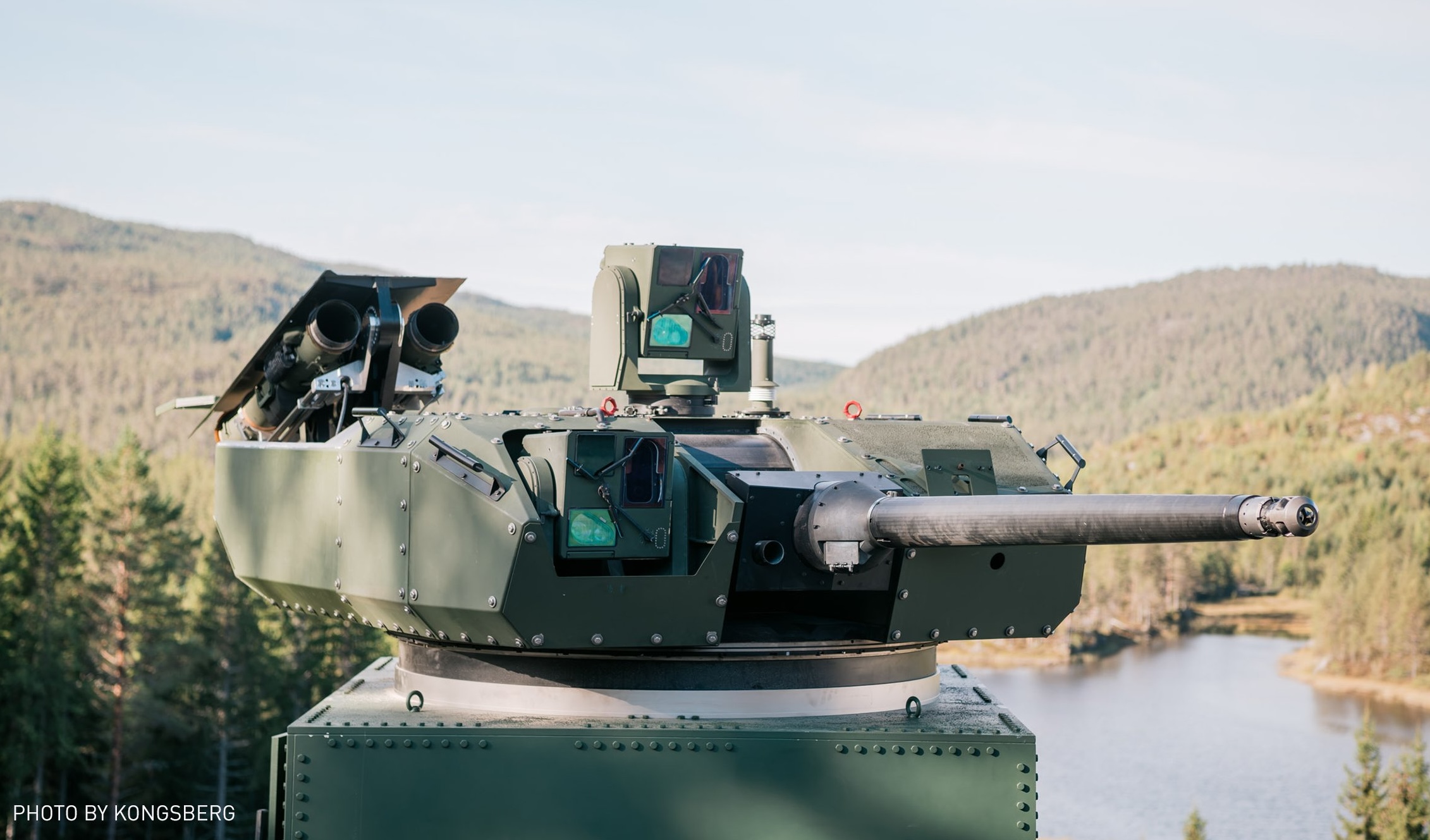
Military Sentinel, Oslo – The Javelin Joint Venture and Norwegian defense contractor Kongsberg have successfully carried out a simulation demonstration in Norway featuring a Medium-Caliber Turret equipped with a prototype dual launcher for the FGM-148 Javelin anti-tank guided missile, marking a critical milestone in expanding mounted anti-armor firepower for modern combat vehicles.
The collaborative evaluation represents the first phase of an initiative to integrate Javelin anti-tank capability directly into vehicle-mounted turret systems. Kongsberg and the Javelin Joint Venture a partnership between Lockheed Martin and Raytheon, an RTX business aim to offer armored vehicle crews an immediate multi-shot missile capability without forcing gunners to expose themselves to reload under fire.
Kongsberg’s Medium-Caliber Turret is widely fielded in allied fleets, serving notably as the primary turret system on the U.S. Army’s Stryker Dragoon (M1296) infantry carrier vehicles, where it pairs a 30 mm Bushmaster autocannon with a coaxial machine gun. While Kongsberg turrets have previously accommodated single Javelin launch tubes either on auxiliary remote weapon stations or alongside the main armament, the new dual-pod assembly doubles ready-to-fire ordnance.
Key elements of the integrated configuration include:
Dual Ready-to-Fire Pods: Enables back-to-back missile engagements against heavily armored targets before requiring manual reloading.
Layered Lethality: Pairs the standoff punch of fire-and-forget top-attack anti-tank missiles with the rapid-fire suppression of a 30 mm autocannon.
Platform Agility: Designed to integrate onto wheeled and tracked combat platforms without degrading baseline turret drive performance.
Kongsberg and the Javelin team have explored vehicle-mounted missile applications since at least 2012, when test crews successfully fired Javelins from a Protector Remote Weapon Station mounted on a GDLS Piranha V in Norway. More recently, the companies have focused on uncrewed systems, including a 2024 U.S. Army trial where Javelin rounds were launched simultaneously from two autonomous ground platforms.
The U.S. Army remains the primary customer for the Javelin system, currently operating under a multi-year indefinite-delivery, indefinite-quantity production contract valued at up to $7.2 billion through fiscal year 2026. In parallel, modernized hardware such as the Lightweight Command Launch Unit entered field deliveries earlier this year.
Neither contractor has announced a formal program of record or a designated vehicle platform for the twin-launcher variant, describing the Norwegian trials strictly as an early development phase.
However, high-intensity conflicts in Eastern Europe have reinforced the necessity of mechanized formations possessing organic, long-range anti-armor capability. Equipping medium-caliber armored vehicles with a twin Javelin turret directly bridges the gap between light scout carriers and dedicated main battle tanks, giving frontline units the ability to decisively counter hostile armor while maintaining high operational mobility.

James Whitfield is a defense news writer at Military Sentinel, covering military technology, naval operations, military aviation, international security, and global defense developments. His work focuses on providing informative reporting, relevant context, and accessible explanations of modern military affairs and emerging defense technologies.
Contact: [email protected]