Physical Address
304 North Cardinal St.
Dorchester Center, MA 02124
Physical Address
304 North Cardinal St.
Dorchester Center, MA 02124
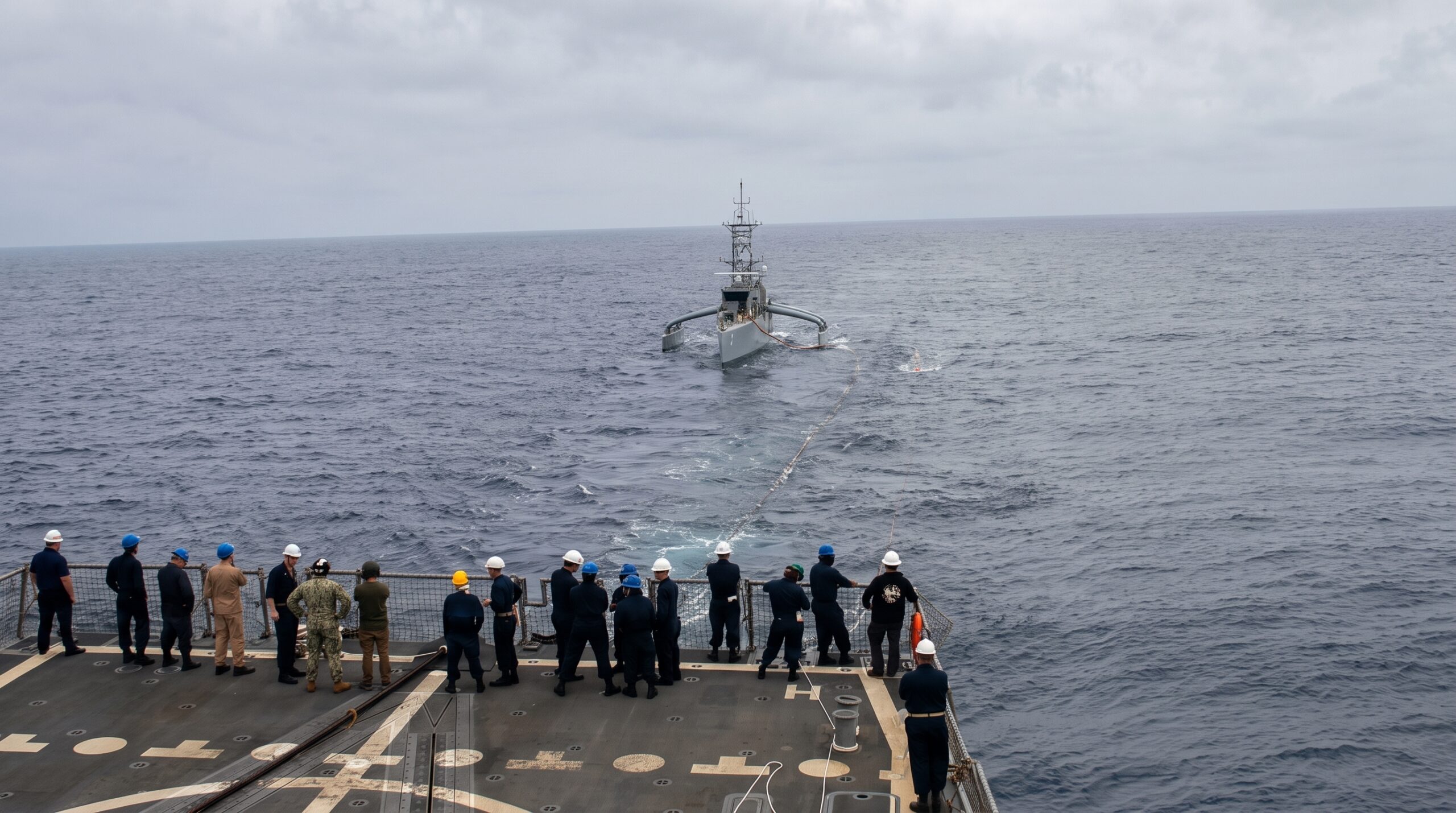
Military Sentinel, San Diego – The U.S. Navy has successfully conducted an underway fueling evolution between an Arleigh Burke-class guided-missile destroyer and the Seahawk USV in the Pacific Ocean, marking a critical milestone in extending the operational reach of uncrewed surface vessels without tethering them to dedicated logistics fleets.
According to reports from USNI News, the guided-missile destroyer USS Chafee (DDG 90) linked up with the medium unmanned surface vessel (MUSV) Seahawk in early September 2026 to evaluate tactical fuel transfer techniques. The test directly addresses one of the most stubborn friction points in distributed maritime operations: keeping autonomous picket and sensor vessels on station indefinitely without relying solely on large, vulnerable replenishment oilers.
The fueling event builds upon previous replenishment trials conducted by Military Sealift Command and naval research commands. While fleet replenishment oilers like the USNS Guadalupe and test support craft like the USNS Vindicator have previously demonstrated at-sea refueling using towed capture devices, this Pacific evolution proved that frontline surface combatants can refuel uncrewed assets organically while underway.
Service officials have repeatedly emphasized that uncrewed systems must integrate into standard fleet evolutions to deliver actual combat utility. Without organic underway replenishment, uncrewed vessels face severe operational trade-offs, requiring frequent transits back to port or drawing dedicated logistics assets away from aircraft carrier strike groups.
Originally developed under the Office of Naval Research and built by Leidos as a follow-on to DARPA’s Sea Hunter, Seahawk serves as an operational testbed for long-range autonomy, surveillance, and distributed sensor networking:
Hull Type: Trimaran composite design with twin outriggers
Displacement: Approximately 142 metric tons (full load)
Overall Length: ~132 feet (40.2 meters)
Fuel Capacity: ~14,000 gallons of internal diesel fuel
Autonomy Profile: Designed for months-long endurance at sea with minimal human intervention
The vessel is engineered specifically for “dull, dirty, and dangerous” missions—primarily maritime domain awareness, persistent surface search, and electronic warfare payload hosting.
Naval planners view the ability of standard warships to refuel uncrewed teammates as essential for high-end littoral and blue-water scenarios, particularly in vast operational theaters like the Western Pacific.
By offloading early detection and screening to forward-deployed drone ships, destroyers can operate with minimized emissions while uncrewed hulls push deeper into contested missile envelopes. The successful hookup between USS Chafee and Seahawk signals that the U.S. Navy is steadily moving robotic logistics from specialized research trials into everyday fleet doctrine.
Looking ahead, naval development commands are focusing on fully autonomous rendezvous, docking, and hose connection procedures. Future iterations aim to eliminate manual line-handling entirely, allowing combatant crews to refuel robotic scouts through automated positioning algorithms and localized data links.