Physical Address
304 North Cardinal St.
Dorchester Center, MA 02124
Physical Address
304 North Cardinal St.
Dorchester Center, MA 02124

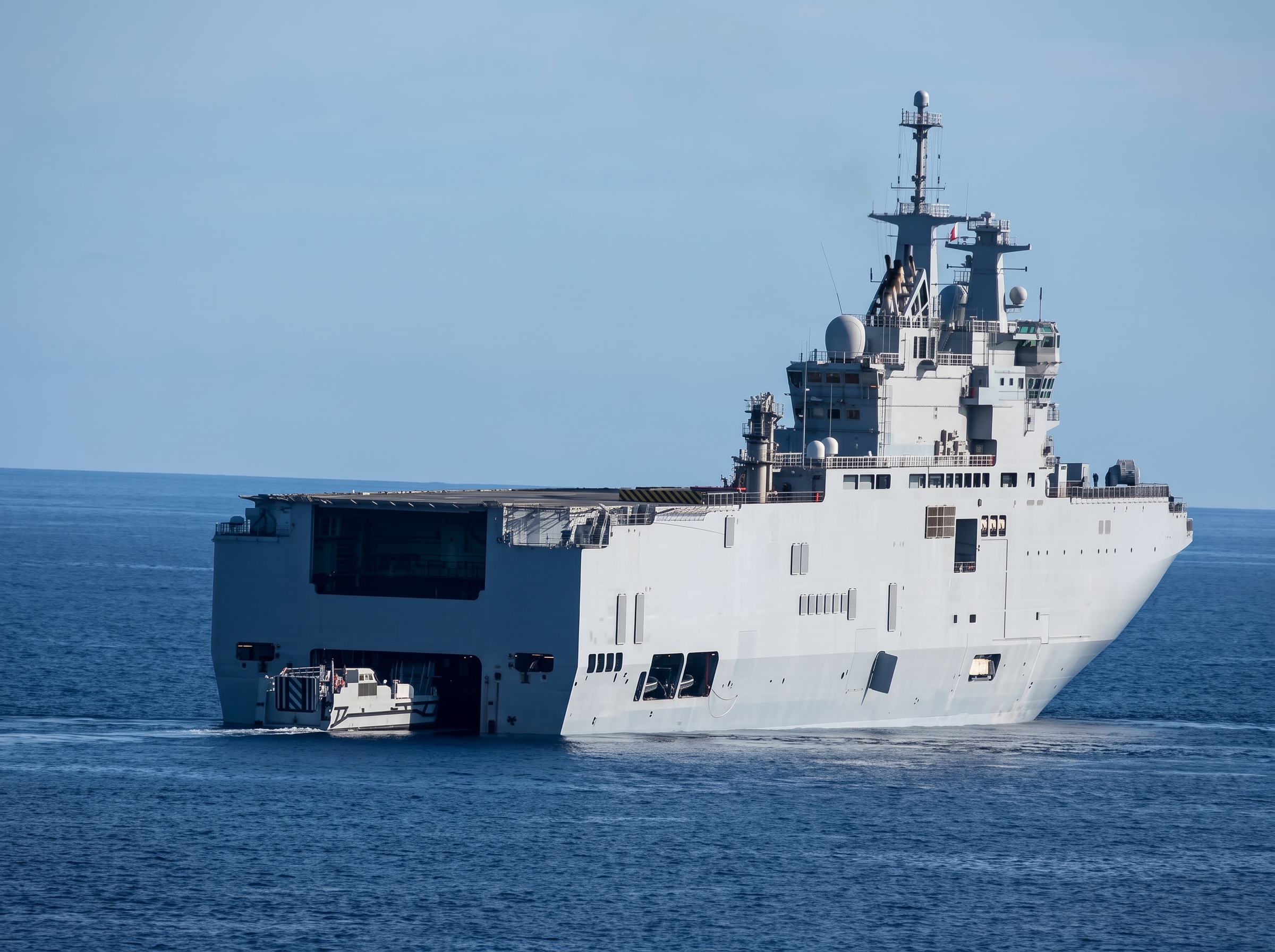
Military Sentinel, Toulon – The French Navy has commenced shipboard integration trials of Naval Group’s Rampart launcher aboard a Mistral-class amphibious assault ship off the coast of Toulon, marking an essential step toward hardening major surface combatants against asymmetric uncrewed aerial and surface threats.
Images originally documented by naval tracking account @WarshipCam revealed the modular launcher installed on the forward starboard sponson of a Mistral-class vessel during fleet maneuvers. The trial marks the first operational shipboard deployment of the system, confirming a development timeline previously reported by French naval outlet Mer et Marine.
Developed by Naval Group from its earlier Lanceur Modulaire Polyvalent (LMP) initiative, the Rampart is a non-penetrating, two-axis deck-mounted turret engineered to engage targets across a close-range defense envelope of approximately 8 kilometers. The launcher features four interchangeable payload cells designed to host a mix of guided munitions, unguided rockets, decoys, or loitering effectors.
Total Weight: Approximately 4 tonnes (non-penetrating mount)
Munition Payload: Approximately 1,000 kg across four modular cells
Primary Armament: 68 mm Thales guided/unguided rockets (up to 20 rounds per cell; 80 total ready-to-fire)
Alternative Payload: 70 mm rockets (12 rounds per module; 48 total) or Mistral 3 short-range surface-to-air missiles
Engagement Range: Up to 5 km with laser-guided 68 mm rockets, extending to ~8 km depending on effector selection
Integration: Standalone autonomous console or direct connection to shipboard Combat Management Systems (CMS)
The sea-trial installation leverages structural positions historically designated for the ship’s twin-rail SIMBAD Mistral surface-to-air missile mounts, allowing drop-in capability without major deck penetration or extensive structural redesigns.
The French Navy’s three 21,500-tonne Mistral-class amphibious assault ships Mistral, Tonnerre, and Dixmude—serve as vital power-projection flagships capable of carrying up to 16 helicopters and hundreds of marine troops. Despite their strategic footprint, the class maintains comparatively modest organic self-defense capabilities, historically relying on escort frigates, two SIMBAD systems, and 20 mm remote weapon stations.
Recent littoral engagements in the Red Sea and Black Sea have demonstrated that saturation tactics using first-person view (FPV) drones, one-way attack loitering munitions, and uncrewed explosive boats (USVs) can rapidly exhaust conventional magazine depths. Employing high-tier Aster 15 or Aster 30 interceptors against $20,000 uncrewed craft creates an unsustainable cost-exchange ratio. The Rampart configuration addresses this magazine exhaustion by providing a deep inventory of low-cost, laser-guided rockets capable of neutralizing simultaneous incoming contacts.
Naval Group validated the launcher’s multi-target handling during May 2026 land trials at the Canjuers military training grounds. During those live-fire evaluations, the system demonstrated salvo firing against multiple simulated targets, including successful engagements using designation handoffs from a Dassault Rafale fighter and dismounted forward ground spotters.
The current dockside and underway trials in the Mediterranean serve as risk-reduction work ahead of France’s upcoming Wildfire counter-drone exercise scheduled for October 2026. During Wildfire, the French Navy plans to test the Rampart’s closed-loop tracking and engagement algorithms against live, dynamic aerial targets and maneuverable sea-surface drones.
If successful, the trials could accelerate formal procurement across France’s amphibious fleet and auxiliary supply vessels, offering a replicable blueprint for NATO navies seeking modular close-in weapon systems to counter saturated drone threats in contested littoral waters.