Physical Address
304 North Cardinal St.
Dorchester Center, MA 02124
Physical Address
304 North Cardinal St.
Dorchester Center, MA 02124

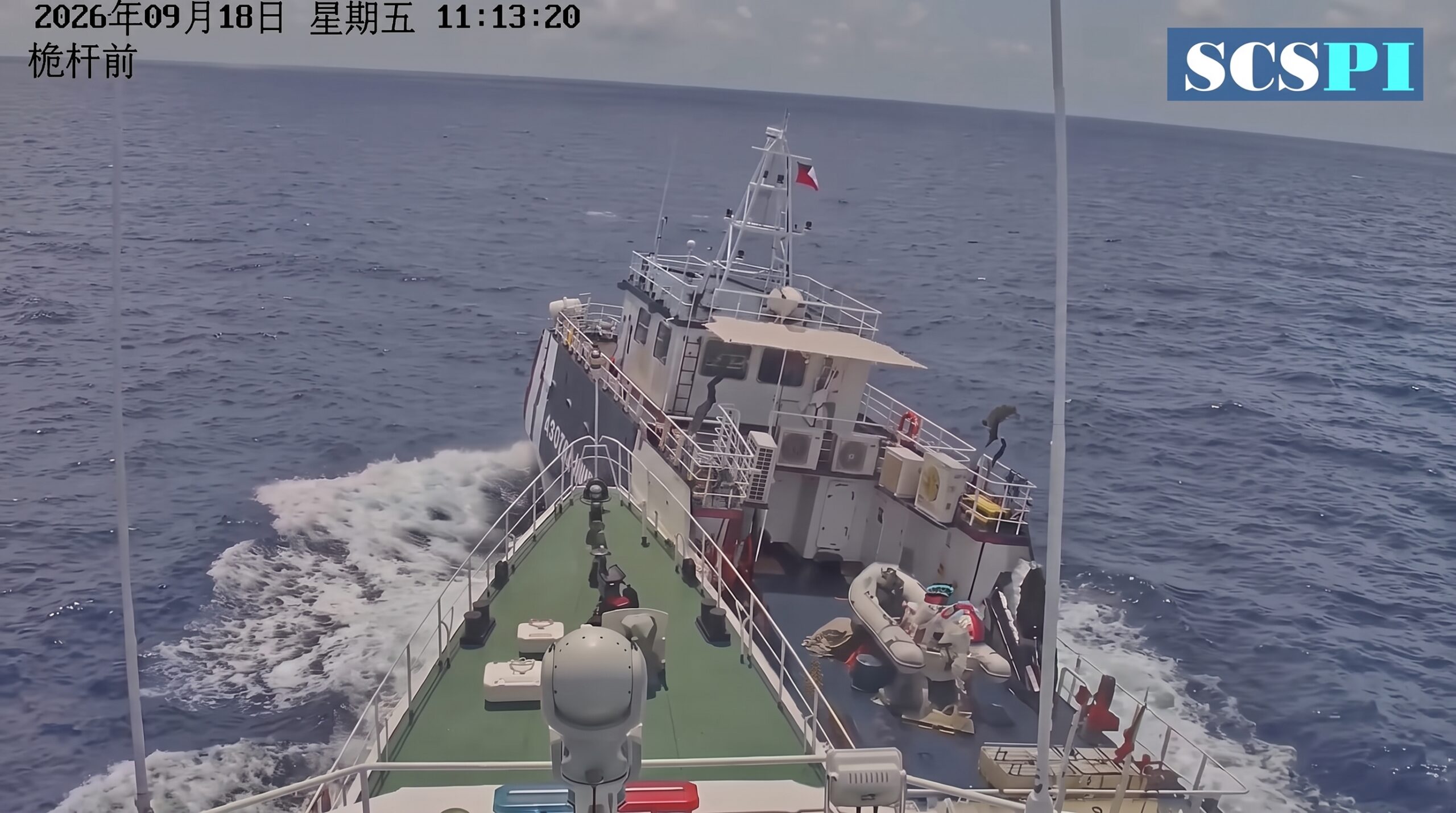
Military Sentinel, Manila – A China Coast Guard cutter rammed a Philippine civilian fisheries patrol boat conducting a resupply operation in the South China Sea on Friday morning, escalating maritime friction within Manila’s exclusive economic zone.
The collision occurred roughly 54 nautical miles off the coast of Palawan province as the Philippine Bureau of Fisheries and Aquatic Resources (BFAR) vessel BRP Datu Magat Salamat (MMOV 3015) attempted to deliver fuel subsidies to local fishermen. According to officials from the Philippine Coast Guard (PCG), the Chinese vessel engaged in aggressive tactical maneuvering before making direct contact.
Philippine Coast Guard spokesperson Rear Adm. Jay Tarriela stated that China Coast Guard cutter CCG-21585 first executed a dangerous crossing at 11:04 a.m., cutting across the stern of the BRP Datu Magat Salamat at a distance of approximately 10 meters.
Nine minutes later, the Chinese cutter repeated the aggressive maneuver, impacting the starboard side of the Philippine patrol craft. Onboard video footage released by the PCG captured personnel shouting “brace for impact!” just before hull contact occurred.
The Philippine craft sustained localized damage:
Deformed structural stanchions along the starboard quarter
Detached and bent perimeter safety railings
Displaced deck equipment and shattered surface fixtures
No casualties among the Philippine crew were reported. Following the impact, CCG-21585 reportedly passed dead astern at a distance of five meters, prompting Philippine Coast Guard Commandant Adm. Ronnie Gil Gavan to dispatch surface and aerial assets to escort the damaged vessel back to Coron for seaworthiness evaluations.
Philippine authorities strongly condemned the interception, characterizing it as a deliberate ramming of a non-military craft engaged in a humanitarian and economic support mission.
“The China Coast Guard deliberately rammed a civilian government vessel on a humanitarian and livelihood mission, endangering the lives of its Filipino crew,” Tarriela said, citing breaches of the 1972 Convention on the International Regulations for Preventing Collisions at Sea (COLREGs) and the 2016 Permanent Court of Arbitration ruling.
Beijing countered that its maritime law enforcement forces acted within legal boundaries near Xianbin Jiao (Sabina Shoal). In a statement released by the China Coast Guard, Beijing claimed the Philippine vessel “disregarded repeated solemn warnings, deliberately altered its course, and suddenly accelerated to cut across the bow of our vessel,” asserting that Manila bears full responsibility for the collision.
The engagement highlights China’s expanding gray-zone playbook designed to assert administrative control over disputed shoals without triggering formal military retaliation under the U.S.–Philippines Mutual Defense Treaty.
By targeting non-commissioned civilian agencies like BFAR with physical coercion rather than kinetic weaponry, Beijing tests Manila’s operational resolve at sea while challenging international navigation norms in critical Indo-Pacific shipping lanes. With clashes moving increasingly closer to mainland Palawan, regional forces face heightened risks of operational miscalculation and inadvertent escalation during routine logistics sorties.