Physical Address
304 North Cardinal St.
Dorchester Center, MA 02124
Physical Address
304 North Cardinal St.
Dorchester Center, MA 02124

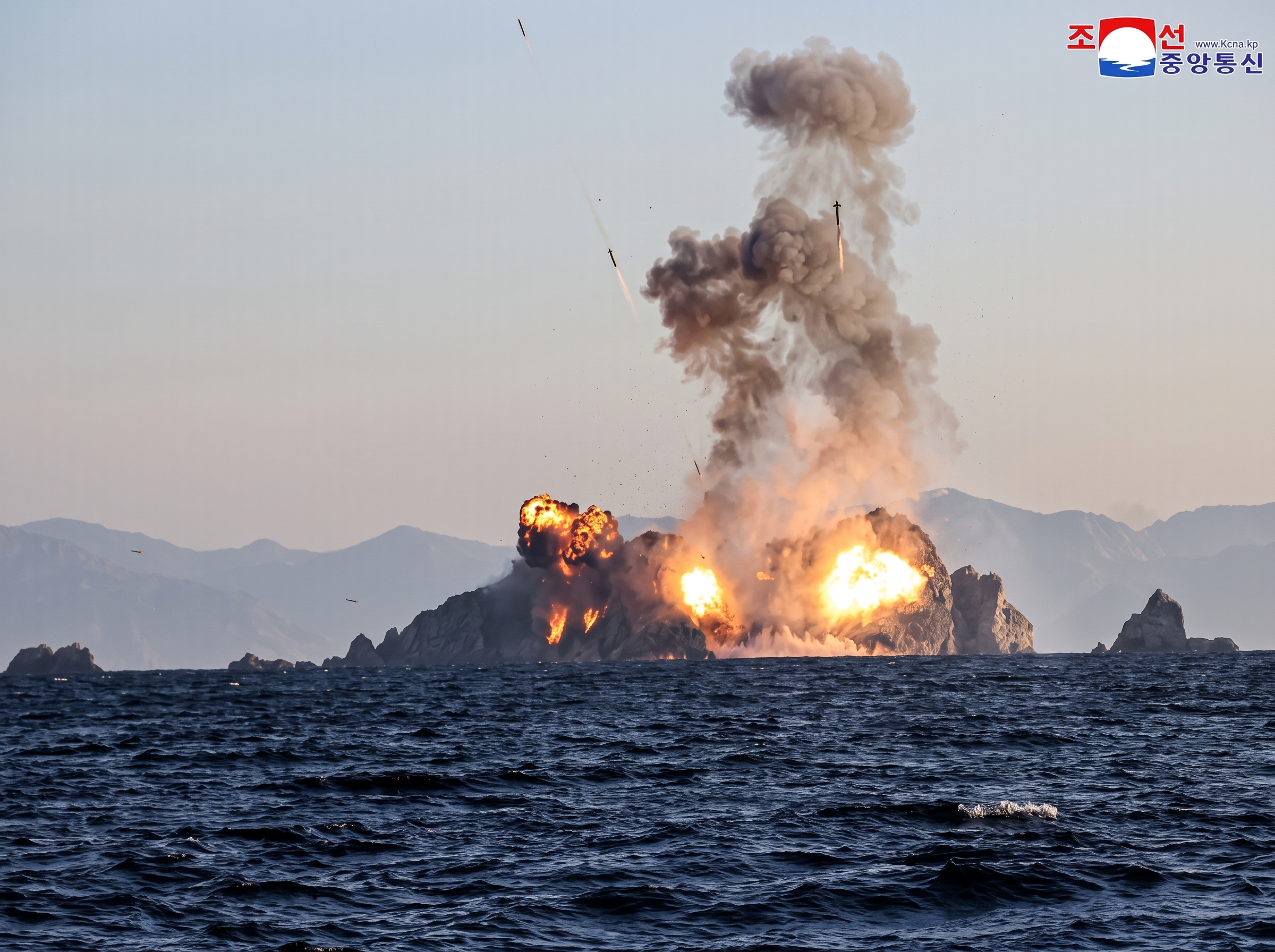
Military Sentinel, Seoul – North Korea executed a complex, multi-domain live-fire strike drill against an island target in the Sea of Japan, launching short-range ballistic missiles, cruise missiles, and one-way attack drones in a direct response to recent trilateral allied maneuvers.
According to statements released by the state-run Korean Central News Agency (KCNA), the coordinated drill involved five joint artillery and missile formations. The exercise was directed by Marshal Pak Jong-chon, vice chairman of the Workers’ Party Central Military Commission, alongside Major General Yu Chang-son.
South Korea’s Joint Chiefs of Staff (JCS) reported detecting multiple launches originating from the Wonsan coastal region. The detected ballistic projectiles flew roughly 250 kilometers (155 miles) before impacting designated target areas in the maritime exclusion zone.
State media photographs and statements identified several integrated strike assets participating in the simultaneous salvo:
Tactical Ballistic Missiles: Short-range solid-fuel ballistic missiles launched from mobile transporter-erector-launchers (TELs), evaluated by regional observers as part of the KN-23 or KN-24 family.
Tactical Cruise Missiles: Low-altitude strike platforms designed to bypass radar detection profiles.
One-Way Attack Drones: At least two distinct loitering munition designs tested against island target installations.
Heavy Rocket Artillery: Large-caliber multiple launch rocket systems (MLRS) equipped with thermobaric warheads.
Pyongyang claimed the drill served as an operational verification test for its updated Integrated Fire Command System. The stated objective was streamlining automated fire control to orchestrate concentrated, synchronized multi-axis strikes against coastal and rear-echelon targets.
The live-fire drill followed immediately after the conclusion of Freedom Edge, a five-day trilateral military exercise conducted by the United States, South Korea, and Japan. That allied drill incorporated integrated naval, air, ballistic missile defense, and defensive cyber capabilities in international waters off the Korean Peninsula.
South Korea’s JCS condemned the launches as provocative acts violating United Nations Security Council resolutions and reaffirmed allied readiness: “Under a firm combined defense posture between the Republic of Korea and the U.S., our Armed Forces are closely monitoring various North Korean movements and maintaining the capability and readiness to respond overwhelmingly to any provocation.”
U.S. Indo-Pacific Command (USINDOPACOM) acknowledged the launches, stating after initial technical assessments that the event did not pose an immediate threat to U.S. personnel, territory, or regional allies, though close consultation with Tokyo and Seoul continues.
Pyongyang’s convergence of ballistic trajectories, sea-skimming cruise vectors, and low-observable loitering drones illustrates an evolving doctrine aimed at saturating regional Integrated Air and Missile Defense (IAMD) architectures. Rather than showcasing strategic, intercontinental deterrence, this exercise highlighted operational-level tactical strike synchronization intended to challenge combined U.S.–ROK intercept networks and command centers during the opening phases of a potential theater conflict.

James Whitfield is a defense news writer at Military Sentinel, covering military technology, naval operations, military aviation, international security, and global defense developments. His work focuses on providing informative reporting, relevant context, and accessible explanations of modern military affairs and emerging defense technologies.
Contact: [email protected]