Physical Address
304 North Cardinal St.
Dorchester Center, MA 02124
Physical Address
304 North Cardinal St.
Dorchester Center, MA 02124

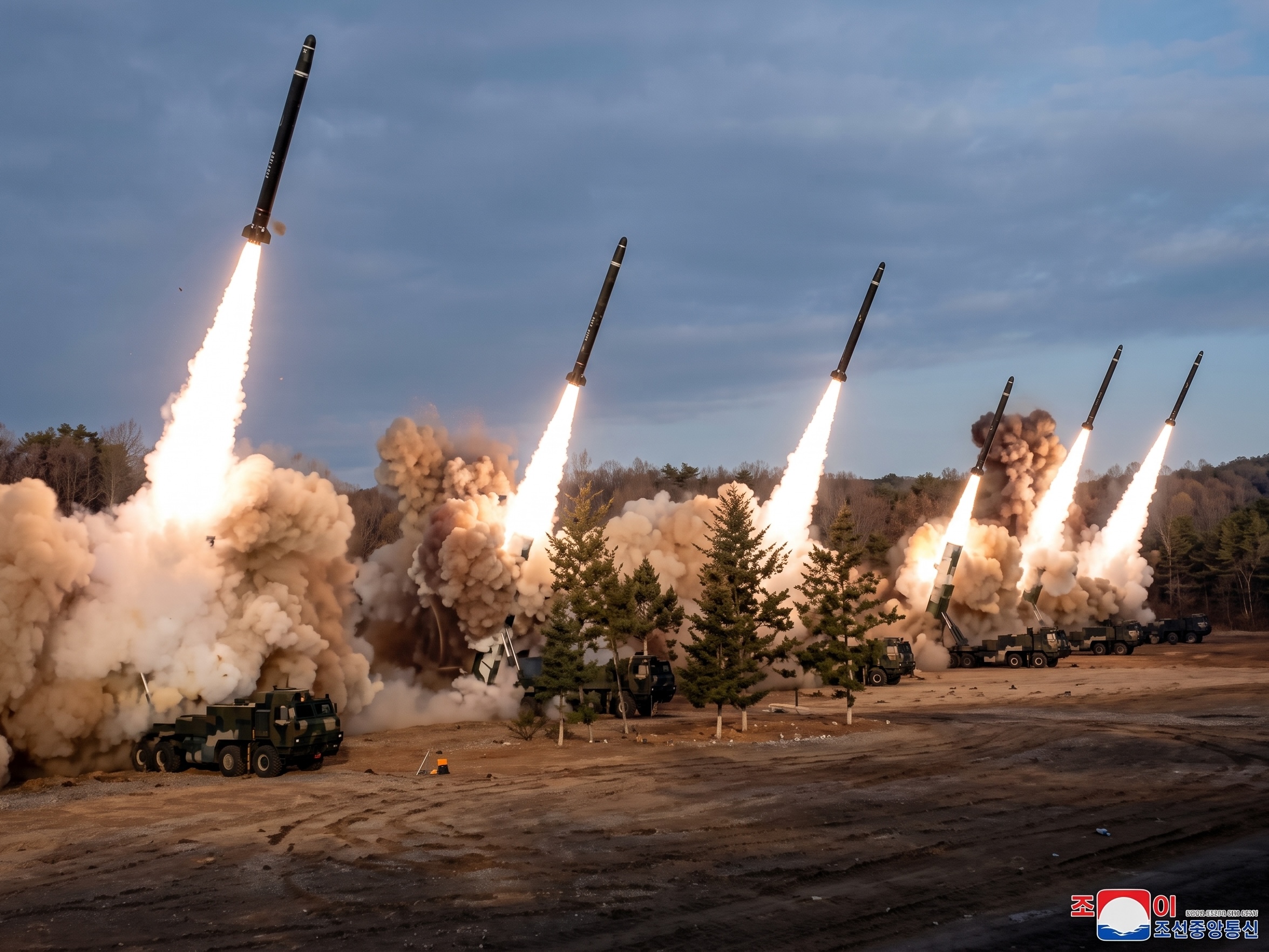
Military Sentinel, Seoul – North Korea launched a salvo of short-range ballistic missiles from its eastern territory before dawn on September 12, 2026, in a test South Korean officials say may have combined Hwasong-11-family missiles with 600mm guided multiple rocket launcher rounds, extending a pattern of tactical missile fire that puts U.S. and allied bases, airfields and command hubs in Northeast Asia within short-warning range.
South Korea’s Joint Chiefs of Staff (JCS) detected the launches at approximately 05:20 local time and stated that South Korean and U.S. intelligence authorities tracked North Korean activity from an early stage, with data subsequently shared with Japan. The weapons flew roughly 250 kilometers toward waters east of the peninsula. The JCS has not officially confirmed which specific systems fired, and South Korean reporting describing a mixed Hwasong-11/600mm salvo remains provisional.
U.S. Indo-Pacific Command said it was aware of the launches and was consulting with allies, assessing no immediate threat to U.S. personnel, territory or regional partners while reaffirming its defense commitments to Seoul and Tokyo.
The launches came one day after the United States, South Korea and Japan concluded Freedom Edge 26, a five-day trilateral exercise that included missile-defense coordination and real-time information-sharing drills, according to the U.S. Navy. That trilateral data-sharing arrangement traces back to a mechanism established in December 2023 following the Camp David summit, intended to let the three militaries jointly detect, characterize and track North Korean launches faster than through separate national networks.
Whether Pyongyang timed the test as a response to Freedom Edge 26 is not established. North Korea has previously condemned allied exercises, but the launch could equally reflect a pre-scheduled weapons-development or readiness activity a distinction that would only be clarified by an official North Korean statement, which has not yet been issued.
The Hwasong-11 family uses solid propellant, which shortens launch preparation and improves the survivability of mobile launchers against pre-emptive strikes. North Korea’s 600mm system is officially termed an MRL but carries guided munitions with range and flight characteristics that blur into short-range ballistic missile territory a distinction that matters because a mixed salvo of both weapon types forces allied radar and command networks to classify multiple trajectories simultaneously.
Analysts and allied planners have flagged this class of threat less for any single missile’s lethality than for its saturation potential: a sufficiently dense, mixed-type salvo could force U.S., South Korean and Japanese batteries to expend interceptors rapidly on early waves, leaving thinner coverage for follow-on launches. Airfields, ports, fuel depots and command nodes infrastructure the U.S. would rely on to reinforce the peninsula in a crisis are the primary targets such a threat set is designed against, since disabling runways or logistics chains can degrade operations without destroying every asset outright.
North Korea has also described some short-range systems as nuclear-capable, meaning warning networks must weigh conventional and nuclear-mission possibilities simultaneously under compressed decision timelines.
No North Korean state statement identifying the systems used or the test’s objective had been released as of publication. Confirmation of the exact missile mix and any independent verification of impact points or apogee — would sharpen the assessment.