Physical Address
304 North Cardinal St.
Dorchester Center, MA 02124
Physical Address
304 North Cardinal St.
Dorchester Center, MA 02124

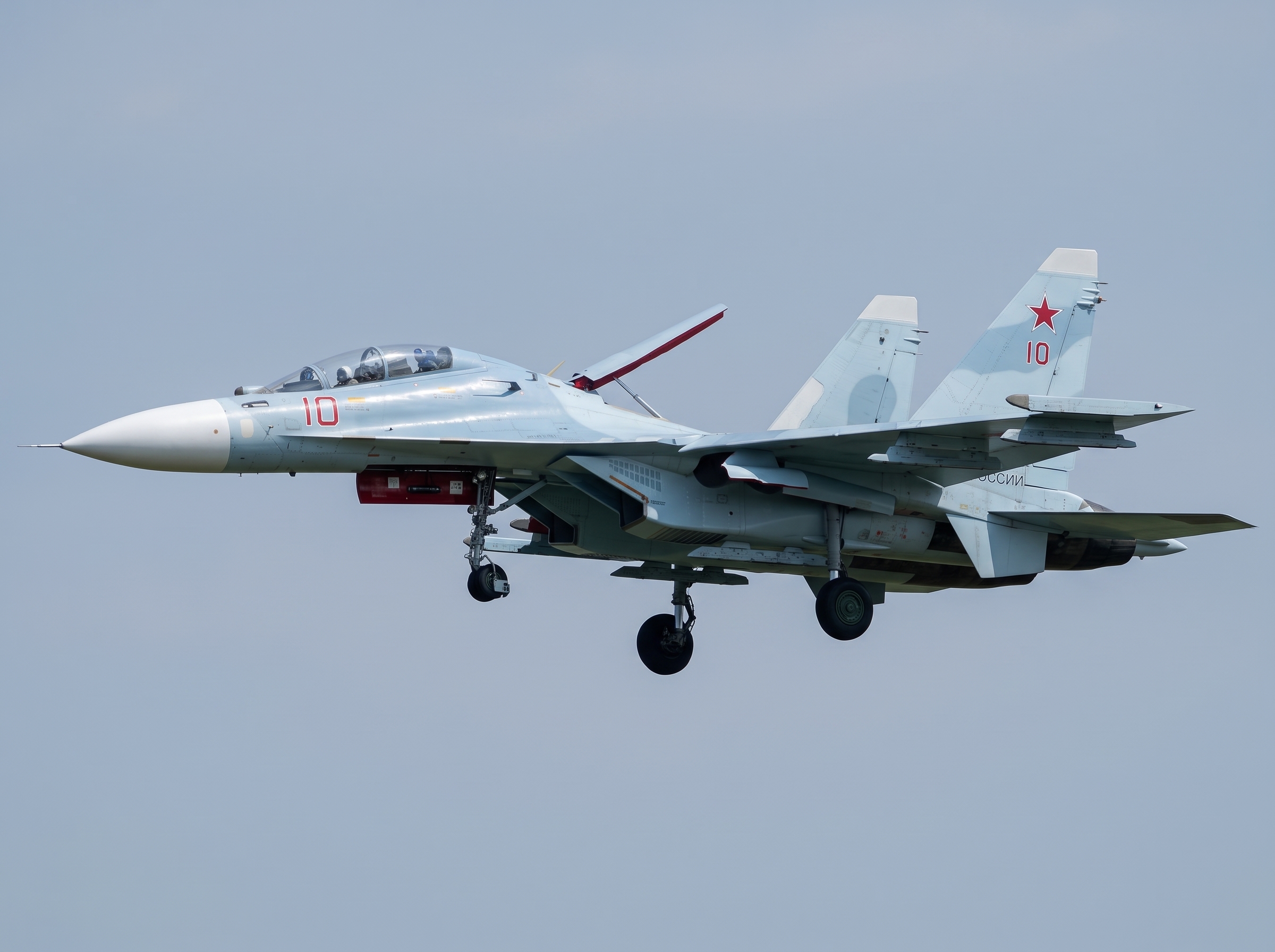
Military Sentinel, KYIV – A coordinated Ukrainian drone strike destroyed a Russian combat aircraft and a Mil Mi-8 multirole helicopter at an airfield installation near Anapa on September 9, delivering another blow to Moscow’s frontline aviation and air defense networks along the Black Sea coast.
The nighttime operation, conducted by Ukraine’s Unmanned Systems Forces (USF), caught Russian aircraft on open aprons at the V. K. Kokkinaki Anapa International Airport complex in Krasnodar Krai. Subsequent commercial and open-source satellite imagery confirmed severe damage to the targeted apron, showing scorched wreckage and heavy equipment clearing the remnants of the destroyed airframe.
Ukrainian military officials, led by USF Commander Robert “Madyar” Brovdi, announced the destruction of the aircraft following the multi-axis drone assault. While initial open-source reporting alternately identified the fixed-wing airframe as an operational Su-30SM multirole fighter or a navalized Su-33 Flanker-D, both platforms represent high-value aviation assets whose replacement remains constrained by industrial bottlenecks.
The strike package eliminated or damaged multiple frontline systems:
Fixed-Wing Combat Jet: One Sukhoi Flanker-series fighter (Su-30/Su-33) destroyed directly in its parking bay, leaving only wing fragments intact.
Rotary-Wing Aircraft: One Mil Mi-8 Hip transport and utility helicopter destroyed on the apron.
Radar and Air Defense Nodes: Near Gelendzhik, accompanying strikes damaged a Kasta-2E2 low-altitude surveillance radar and a 92N6 “Grave Stone” fire-control radar associated with the S-400 Triumf surface-to-air missile battery.
Russian defense sources and military bloggers acknowledged localized impacts during the overnight raid, criticizing the continuous practice of parking critical frontline aircraft in the open without hardened aircraft shelters (HAS) within range of one-way attack unmanned aerial vehicles (UAVs).
The Anapa strike was not an isolated sortie; it formed the aviation-focused wing of a broader synchronized strike package launched across Russia’s Black Sea littoral. During the same operational window, Ukrainian strike drones and uncrewed surface platforms targeted maritime assets and logistics infrastructure at the Novorossiysk naval base.
Kyiv has increasingly leveraged long-range indigenous strike drones such as the Fire Point FP-1 and UJ-26 Beaver to penetrate Russian layered air defense bubbles. By flying low radar cross-section flight profiles and exploiting gaps between early warning radars, Ukrainian operators have steadily attrited Russian tactical aviation on the ground rather than contesting airspace directly.
The loss of combat aircraft in Krasnodar Krai demonstrates that the safe operational radius for Russian Aerospace Forces (VKS) and Naval Aviation continues to shrink. Airbases previously treated as rear-echelon staging nodes now face daily standoff threats.
If Russia cannot deploy rapidly erectable dispersal hangars or enhance short-range point defense systems (SHORAD) around coastal facilities, the VKS will be forced to base tactical squadrons even farther east. Such a redeployment would reduce loiter time over the southern frontline, extend response timelines for maritime interdiction sorties, and accelerate the airframe wear rate across Russia’s operational fighter fleet.