Physical Address
304 North Cardinal St.
Dorchester Center, MA 02124
Physical Address
304 North Cardinal St.
Dorchester Center, MA 02124

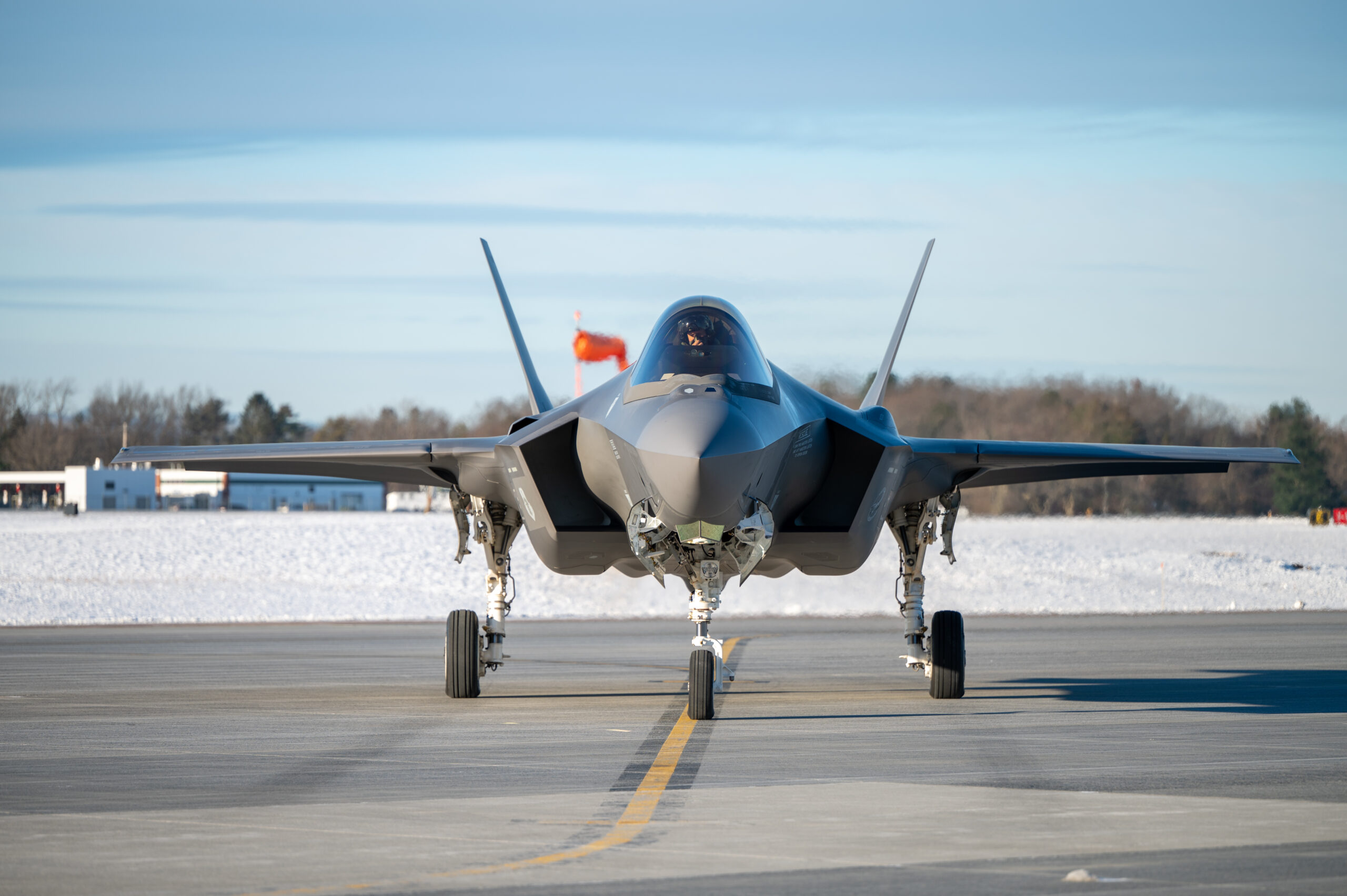
Military Sentinel, Washington, D.C. – The U.S. Department of War is developing a modification that would let the F-35 Lightning II carry six missiles internally instead of four, under an effort called “Six in the Bay” (SITB), with development targeted for completion by September 2030, according to a Selected Acquisition Report reviewed by Army Recognition.
The capability is listed in the FY2027 F-35 Modernized Selected Acquisition Report (MSAR), effective April 21, 2026, as part of the F-35 Aircraft Subprogram. I have not independently viewed the MSAR itself; this account relies on Army Recognition’s reporting of that document, and the underlying filing needs independent verification before publication.
Per that reporting, the SAR entry confirms only that SITB would raise internal missile carriage from four to six — a 50 percent increase in magazine depth without moving weapons to external stations, which would preserve the aircraft’s low-observable (stealth) configuration. The document reportedly does not:
This needs verification: no manufacturer (Lockheed Martin) or F-35 Joint Program Office statement confirming SITB’s scope, cost, or technical approach was cited in the source material, and none has been independently located as of this writing.
A separate program — a two-way datalink upgrade for the AIM-120D AMRAAM, intended to support in-flight retargeting via GPS and inertial navigation — is reportedly listed against the same September 2030 timeframe. On any direct technical link between the two efforts: the reporting explicitly cautions that the SAR does not establish that the six internally carried missiles will be AIM-120Ds, so the two should be treated as parallel modernization lines rather than a confirmed single configuration until an official source says otherwise.
SITB is described as one piece of the broader Block 4 modernization package, which the Pentagon has framed around a set of roughly 55 priority capabilities spanning kill-chain improvements, air superiority, and suppression of enemy air defenses. Technology Refresh 3 (TR-3) — the F-35’s hardware/software backbone upgrade — is cited as the computing foundation Block 4 features depend on. Other Block 4-adjacent items reportedly on a similar timeline include a move of the Multifunction Advanced Data Link to a dynamic mesh topology, Link 16 interoperability upgrades, and a Multi-Ship Infrared Search and Track capability for shared passive tracking between aircraft.
On program-level framing: TR-3’s rocky development history and past Block 4 schedule slips are well documented publicly, so continued schedule risk on SITB through 2030 is a reasonable inference — but no specific delay or cost figure for SITB itself has been confirmed here.
Internal missile capacity is a hard constraint on stealth aircraft: going external for more weapons compromises the radar cross-section advantage that defines the platform. If delivered as described, two additional internally carried missiles would give F-35 pilots more engagement opportunities per sortie in contested airspace before needing to disengage, go external, or return to rearm — without sacrificing low-observability. That is a meaningful capability if it holds up, but as of now it rests on a single acquisition-report line item, not a program office announcement, contractor statement, or flight-test milestone.

James Whitfield is a defense news writer at Military Sentinel, covering military technology, naval operations, military aviation, international security, and global defense developments. His work focuses on providing informative reporting, relevant context, and accessible explanations of modern military affairs and emerging defense technologies.
Contact: [email protected]